New Arrivals — Browse our catalog for the latest authentic Japanese sword arrivals. Browse →
Eiroku 8–9 (1565–1566)
Toda, Nogi-gun, Izumo Province (present-day Hirose-chō, Yasugi City, Shimane Prefecture)
Forces
Mōri Forces
Amago Forces (defenders)
About 11 min read
From the 8th year of Eiroku (1565) to the 9th year of Eiroku (1566), Mōri Motonari besieged Gassan-Toda Castle, the stronghold of the Amago clan, the powerhouse of Izumo Province (present-day Shimane Prefecture), and starved its defenders until he forced Amago Yoshihisa to surrender. Through the victory in this "Battle of Gassan-Toda Castle (second)," Mōri Motonari brought most of the Chūgoku region under his control and established his position as the largest Sengoku daimyo in western Japan.
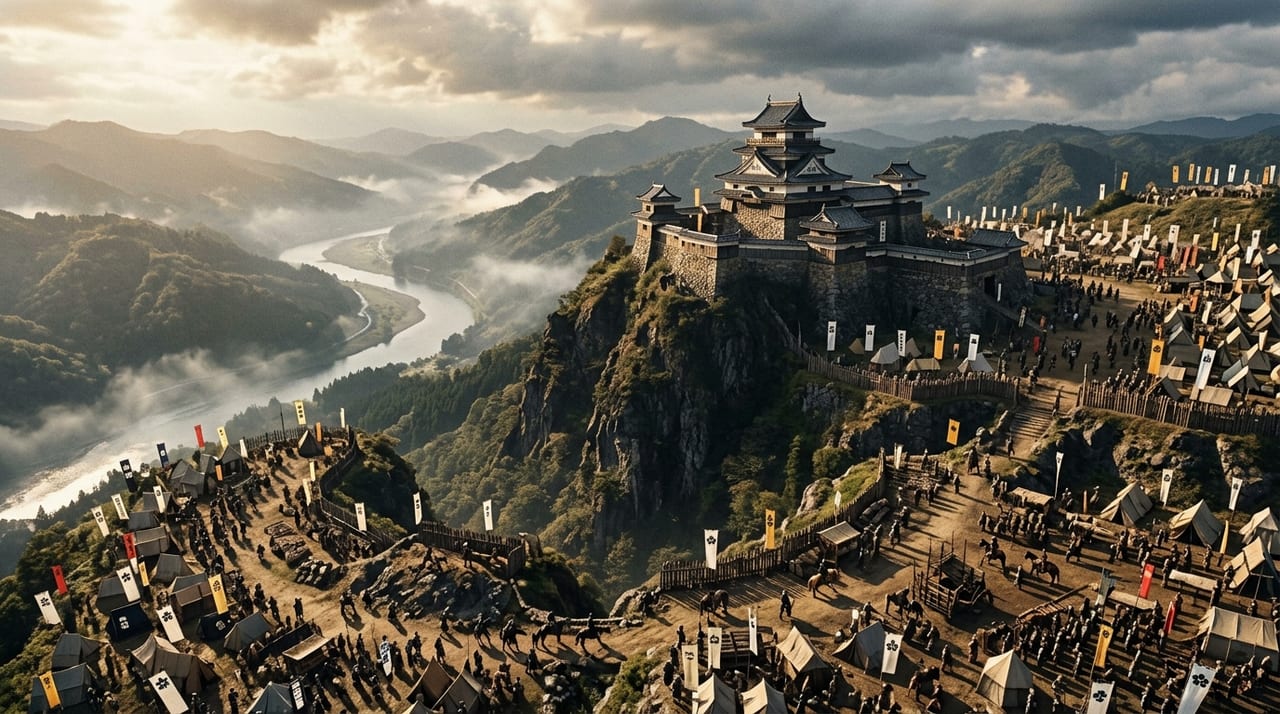
Gassan-Toda Castle was a mountain castle built on Mount Gassan (elevation about 184 m) in Izumo. It was protected on three sides, excluding the southeast, by steep slopes, and the Iinashi River flowed along its west side, making it a natural stronghold. The Amago clan was a powerful Sengoku daimyo that ruled the provinces of San'in, including Izumo, Iwami, and Oki, from the late Muromachi period through the Sengoku period. At its peak, it controlled about eight provinces of the Chūgoku region. As the clan's main castle, Gassan-Toda was known as a famed castle considered impregnable.
Mōri Motonari (1497–1571) was a minor local lord from Aki Province (present-day Hiroshima Prefecture), yet he was a strategist of rare talent who rose to become master of the Chūgoku region by skillfully combining intrigue, diplomacy, and military force. He had three sons: the eldest, Takamoto; the second son, Kikkawa Motoharu (adopted into the Kikkawa family); and the third son, Kobayakawa Takakage (adopted into the Kobayakawa family). The anecdote in which he is said to have urged unity on them through "the Lesson of the Three Arrows" is one of the most famous paternal admonitions in Japanese history.
Motonari defeated Sue Harukata, who held real power in the Ōuchi clan, through a daring stratagem at the Battle of Itsukushima (the 24th year of Tenbun, 1555). He then went on to destroy the Ōuchi clan and gain Suō and Nagato. His next target was the Amago clan of Izumo.
In fact, Mōri Motonari took part in two sieges of Gassan-Toda Castle. The first (the 11th to 12th years of Tenbun, 1542–1543) was an expedition to Izumo led by Ōuchi Yoshitaka, which Motonari joined, and it ended in failure. The second (the 8th to 9th years of Eiroku, 1565–1566) was a siege that Motonari personally led as the final stage of his unification of the Chūgoku region.
In the second campaign, Motonari avoided direct assault and made a prolonged siege by starvation his main strategy. Because of the nature of a mountain castle, the terrain was disadvantageous to the attackers, and a frontal assault could have caused heavy losses. Motonari seized the key points around the castle and cut off its supply lines, choosing a strategy to starve out the Amago forces within.
Kikkawa Motoharu (the second son, who succeeded to the Kikkawa family) and Kobayakawa Takakage (the third son, who succeeded to the Kobayakawa family) each took charge of the siege as the attacking forces at the Shiodani and Sugatani entrances. The encirclement carried out by the "three arrows" of Mōri, Kikkawa, and Kobayakawa continued to function for a year and a half. Finally, in the 11th month of the 9th year of Eiroku (1566), when the food supplies inside the castle ran out, Amago Yoshihisa opened the castle gates and surrendered.
As daimyo who ruled Izumo and Iwami, the Amago clan had protected and fostered local swordsmiths. Izumo Province has long been known as a source of high-quality iron sand, the raw material of tamahagane, and tatara iron smelting flourished in the mountainous areas near the border between Shimane and Tottori Prefectures. The tamahagane produced by this tatara smelting was of the highest quality as a material for Japanese swords, and swordsmiths of Izumo and Iwami had made famous blades by making use of this excellent material.
With the fall of the Amago clan and the transfer of Gassan-Toda Castle into Mōri hands, the patrons of Izumo's swordsmiths also changed. The Mōri clan brought the iron sand-producing areas of Izumo and Iwami into its domain.
Mōri Motonari gained fame not as a swordsman in his own right, but as a commander of strategic talent, skilled in intrigue, diplomacy, and intelligence gathering.
The philosophy expressed in the "Lesson of the Three Arrows," that "a single arrow breaks, but three together do not," embodies precisely the reality of the Mōri, Kikkawa, and Kobayakawa uniting to take Gassan-Toda Castle.
The historical significance of the Battle of Gassan-Toda Castle lies in the completion of the Mōri clan's unification of the Chūgoku region. Through this victory, Mōri Motonari grew from a minor lord of Aki into the largest Sengoku daimyo in western Japan, ruling eight to ten provinces of the Chūgoku region.
Furthermore, by bringing the rich tatara iron-smelting regions of Izumo and Iwami under its control, the Mōri clan gained command of a vital source of tamahagane, the raw material of Japanese swords. This resource advantage was one of the factors that supported the Mōri clan's military base in western Japan when it later confronted Oda Nobunaga and Toyotomi Hideyoshi (in the Siege of Bitchū Takamatsu Castle and others).
The fall of the Amago clan and the establishment of Mōri rule over Izumo directly changed the activities of swordsmiths in Izumo and Iwami. The regional sword production that had developed under the earlier protection of the Amago clan was incorporated into the Mōri clan's wide-area system of control and became part of a larger network. The traditions of tatara iron smelting and sword-making in Izumo and Iwami continued throughout the Edo period and have been passed down to present-day Japanese swordsmiths.
Mōri Motonari
Led the siege that completed his conquest of the Chūgoku region
Kikkawa Motoharu
Motonari's adopted son commanding the eastern encirclement of the castle
Kobayakawa Takakage
Motonari's adopted son commanding western approaches and naval forces
Mōri Terumoto
Motonari's grandson who inherited the Mōri clan after the fall of Gassan-Toda