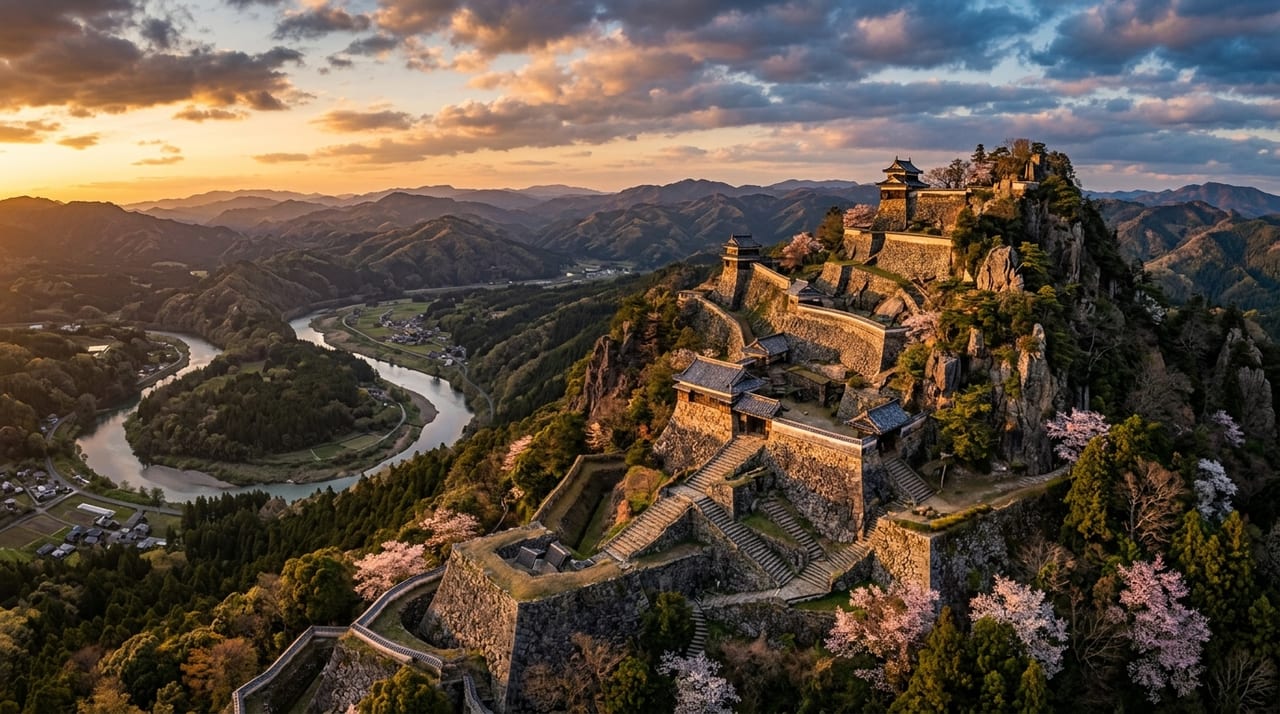
 * Image is for illustrative purposes only.
Gassan Toda Castle
月山富田城
Gassan Toda Castle is a historic castle in the Chūgoku region (Year of construction unknown (a residence of the Izumo deputy constable in the 14th century)). Its lord was Amago Tsunehisa / Amago Haruhisa.
Overview
About the Castle
Gassan Toda Castle is a mountain castle in Yasugi City, Shimane Prefecture. It is one of the greatest masterpieces of medieval mountain castles, a fortress built across the entire steep Mount Gassan (183 m) in the Chūgoku Mountains. Protected by steep slopes on three sides, excluding the southeast, its layout of countless enclosures, dry moats and stone walls made it the strongest stronghold in the Chūgoku region during the Sengoku period, and it vexed the daimyo who tried to take it. As the seat of the Amago, overlords of San'in, it reigned as the political and military center of San'in.
Rise and Fall of the Amago Clan
The ones who turned Gassan Toda Castle into the strongest castle in San'in were Amago Tsunehisa and his grandson Amago Haruhisa. Tsunehisa was a forerunner of the Sengoku daimyo who rose from deputy constable, drove out the constable by force, and became master of San'in. He was a strategist known by the epithet 'the Schemer'. In Haruhisa's time the Amago reached their greatest power. As a great daimyo appointed constable of eight provinces across San'in and San'yō, he competed fiercely for supremacy with Mōri Motonari. In Eiroku 9 (1566), after a three-year siege by Mōri Motonari, Gassan Toda Castle finally surrendered and the Amago were destroyed. The castle's reputation as impregnable could not withstand the classic strategy of a starvation siege.
Yamanaka Shikanosuke and the Amago Restoration Movement
After the Amago fell, Yamanaka Yukimori (Yamanaka Shikanosuke), considered foremost among the Ten Braves of the Amago (Amago Jū-yūshi), launched a movement to restore the Amago. Together with a prayer to the crescent moon, 'Grant me seven hardships and eight sufferings', he waged persistent guerrilla warfare against the Mōri clan. At one point he invaded Izumo and closed in on Gassan Toda Castle. Later, with support from Hashiba Hideyoshi, he held Kōzuki Castle in Harima. But in Tenshō 6 (1578) he was captured by Mōri forces and met an untimely death. Shikanosuke's loyalty and tragedy have been told as a tale of the Sengoku period for later generations, and they still move people today as a symbol of faithful retainers. A statue of Shikanosuke stands at the castle site and draws the admiration of visitors.
Layout and Highlights of the Castle
The layout of Gassan Toda Castle is a multi-enclosure mountain castle. Its enclosures are arranged vertically, running from the Honmaru on the summit through the Ni-no-maru, San-no-maru and Hananodan on the mountainside, down to the palace site at the foot of the mountain. Hiking trails are now well maintained, and the climb from the foot to the summit Honmaru takes about 40 minutes. The steep slope known as the Nanamagari path on the mountainside conveys well how difficult the castle was to attack. From the Honmaru site at the top, you can look out over the town of Yasugi and Nakaumi. The Yasugi City Historical Museum at the foot of the mountain displays materials on the Amago and Gassan Toda Castle in detail. Studying the appeal of the mountain castle there before climbing is the best plan.
The Mōri Clan and Gassan Toda Castle
After Mōri Motonari's conquest, Gassan Toda Castle became a base for Mōri rule over Izumo. After the Battle of Sekigahara, the Horio clan became lords of the castle in Keichō 5 (1600). However, when Horio Tadaharu moved to Matsue Castle in Keichō 16 (1611), the castle was abandoned, and Gassan Toda Castle quietly exited the stage of history. It is now protected as a national Historic Site. As remains showing the highest standard of Sengoku-period mountain castle architecture, it is a must-visit site for castle researchers and history enthusiasts.
Connection to Swords
The connection between Gassan Toda Castle and swords can be told through Izumo's rich supply of iron (iron sand) and through the stories of the Amago and Yamanaka Shikanosuke. Izumo and Iwami have long been known as the 'land of iron sand', and tatara iron smelting, which uses the abundant iron sand of the Chūgoku Mountains as its raw material, flourished there. From the medieval to the early modern period, iron produced in Izumo and Hōki (traditional Japanese iron, the raw material for tamahagane) was supplied to swordsmiths throughout Japan, and the region functioned as a center of the raw-material industry for Japanese swords. By controlling Izumo's iron sand and iron industry, the Amago secured their financial foundation and maintained their strong military power with the proceeds. The name of the castle mountain, Gassan, is the same as that of the famous swordsmith school, the Gassan school. However, the home of the Gassan school is Mount Gassan, the sacred peak in Dewa Province (present-day Yamagata Prefecture), so it has no direct genealogical link to Gassan Toda Castle in Izumo. The match is only in the name. The Gassan school is a group of swordsmiths in Dewa Province said to have continued since the Kamakura period. It is characterized by a distinctive beautiful surface pattern in the steel called ayasugi-hada. Ayasugi-hada is a unique beauty in which flowing ripples resembling cedar grain appear across the entire steel, and it is the greatest artistic feature of the Gassan school. In modern times, Gassan Sadakazu II was certified as a holder of an Important Intangible Cultural Property (Living National Treasure). Together with his child Gassan Sadatoshi (mukansa; holder of a Nara Prefecture-designated Intangible Cultural Property), he carried on ayasugi forging as the Osaka Gassan family. In modern times Yasugi City is known as the production site of Yasuki Steel (Yasugi hagane), and the specialty steel made by Hitachi Metals (now Proterial) is used in kitchen knives and blades worldwide. The 'iron culture' of Izumo, on which the history of Gassan Toda Castle is rooted, has been handed down continuously to today's Yasuki Steel. It can be understood as a single iron culture running from Japanese swords to modern blades.
Highlights
- Impregnable mountain-castle layout — the steep Nanamagari path and a complex group of enclosures. Superb views of Yasugi and Nakaumi from the summit Honmaru
- Yamanaka Shikanosuke statue — a bronze statue of the loyal warrior who prayed to the crescent moon, 'Grant me seven hardships and eight sufferings'
- Yasugi City Historical Museum — detailed exhibits on the history of the Amago, the layout maps and excavated artifacts of Gassan Toda Castle
- Hananodan enclosure — an enclosure on the site of the samurai-dokoro, partially restored and maintained. Gassan Toda Castle is a constituent heritage asset of the Japan Heritage 'Izumo-no-kuni Tatara Fudoki'
- dojō-sukui dance — a folk performing art representative of Yasugi City
* Opening hours and admission fees are subject to change. Please check the official website before visiting.