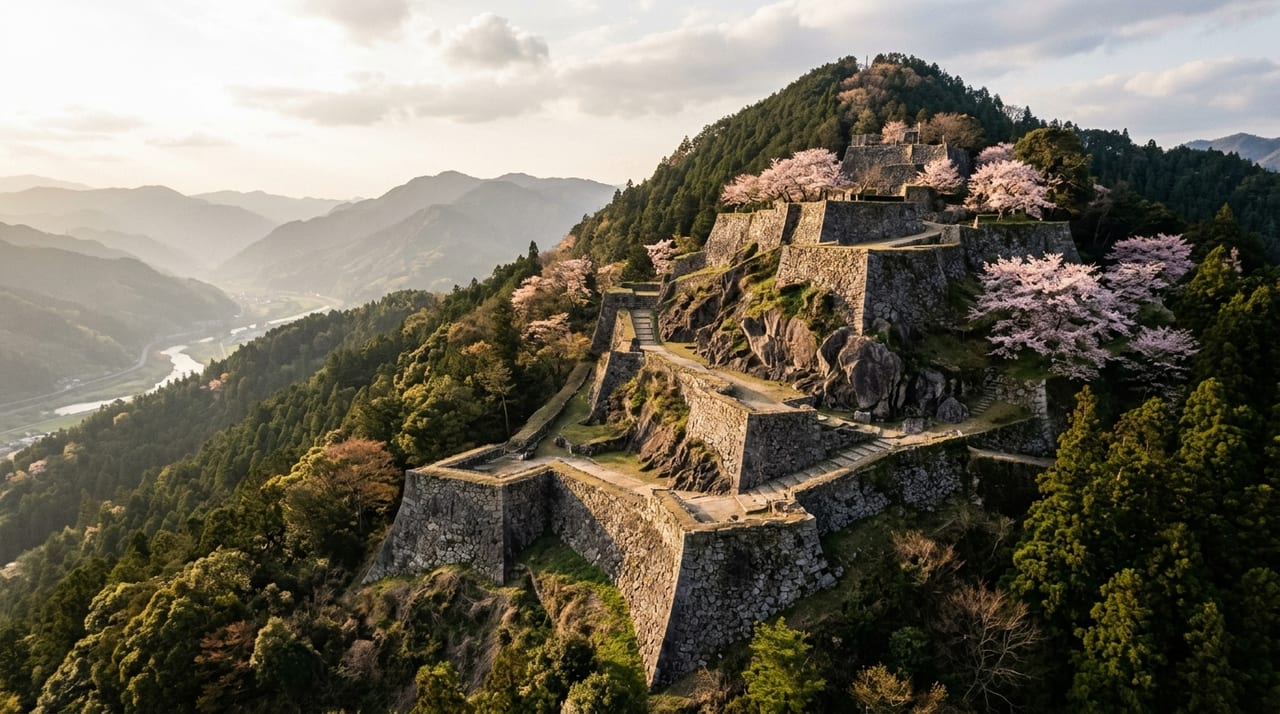
 * Image is for illustrative purposes only.
Tsuwano Castle
津和野城
Tsuwano Castle is a historic castle in the Chūgoku region (Built in Einin 3 (1295); early modern renovation from Genna 3 (1617) onwards). Its lord was Yoshimi Yoriyuki / Sakazaki Naomori / Kamei clan.
Overview
About the Castle
Tsuwano Castle is a mountain castle built on Mount Reiki (Reikizan), at an elevation of 367 meters, overlooking the Tsuwano basin nestled deep in the Chūgoku Mountain Range in western Shimane Prefecture. The castle is said to have been begun by Yoshimi Yoriyuki in Einin 3 (1295). Over the more than 300 years that followed, it underwent repeated renovation and expansion, and it was after Sekigahara, in the era of Sakazaki Naomori and the Kamei family, that it was completed as an early-modern castle. Located at a key point in western Iwami Province, Tsuwano Castle, because of its strategic importance in controlling the transport routes linking the Seto Inland Sea and the Sea of Japan, remained a constant object of contention from the medieval to the early-modern period.
The Tragedy of Sakazaki Naomori
Sakazaki Naomori, who was enfeoffed after the Battle of Sekigahara, is also said to have distinguished himself in the rescue of Princess Sen (Senhime), daughter of Tokugawa Hidetada, at the fall of Osaka Castle, and to have been promised marriage to her as his reward. However, when Princess Sen arranged her wedding to Honda Tadatoki, Naomori flew into a rage, and he was driven to forfeit his domain and take his own life on the charge of attempting to seize the wedding procession. This "Princess Sen Incident" is widely known as one of the greatest scandals of the early Edo period, and it inscribed a turbulent page in the history of Tsuwano Castle. After Naomori, Kamei Masanori was enfeoffed at Tsuwano, and from then on the Kamei family governed the Tsuwano Domain for generations until the Meiji Restoration.
The Kamei Clan and Tsuwano Culture
The Kamei family was a line of warriors that also took part in Toyotomi Hideyoshi's invasion of Korea (the Bunroku Campaign), and throughout the Edo period that followed, it contributed greatly to the cultural development of the Tsuwano Domain. In particular, the eighth domain lord, Kamei Norikata, founded the domain school Yōrōkan in Tenmei 6 (1786), laying the foundation for Tsuwano as a place of learning where, later, Nishi Amane and others studied. The thinker Nishi Amane and the man of letters Mori Ōgai, both active from the late Edo period into the Meiji era, were natives of Tsuwano, and Tsuwano is known as the birthplace of these two intellectuals, who made great contributions to Japan's modernization. Mori Ōgai was active as a military physician and a man of letters, and his delicate literary world is deeply rooted in the nature and history of Tsuwano.
The "Little Kyoto of San'in"
Tsuwano is a castle town of beautiful scenery, known nationwide as the "Little Kyoto of San'in." In the moats along Tonomachi Street swim koi carp, and the scene of samurai residences, merchant houses, and churches lining the white-walled, stone-paved streets forms a rare historical landscape that evokes the layering of eras. The mountains and castle ruins seen from Tsuwano Bridge, the spring fields where canola flowers bloom, and the autumn foliage and misty mountain castle are famous views of each season, deeply engraved in the hearts of many travelers.
The Tenshu and Ruins of Mount Reiki
At present, only stone walls and stone steps remain at the site of Tsuwano Castle's main citadel. However, the magnificent nozura-zumi (rough-stone masonry) walls piled up on the steep mountainside are ruins that reached the artistic heights of castle stone walls, and they never cease to captivate castle enthusiasts. The summit can be reached by sightseeing chairlift, and the view of the Tsuwano basin from the mountaintop gives deep emotion to those who visit. Strolling through the Tsuwano castle town spreading at the foot of Castle Mountain is an experience that condenses the essence of Japan's castle-town culture, offering a rich journey in which sword culture, the samurai spirit, and Edo culture come together as one.
Connection to Swords
The connection between Tsuwano Castle and sword culture is tied in many layers through the complex history of this castle. As the castle lords changed from the Yoshimi family to the Sakazaki and then the Kamei families, the sword cultures that each warrior brought overlap in the history of this mountain castle. Sakazaki Naomori was a fierce warrior born into the Ukita family line. Originally, under Hideyoshi's rule of the realm, he served Ukita Hideie, but at the Battle of Sekigahara he broke with his lord Hideie (Western Army), fought on the side of the Eastern Army (Tokugawa side), and was granted Tsuwano for his military merit. The Kamei family governed Tsuwano for a long time, and successive domain lords encouraged learning and culture. San'in swordsmiths were active mainly in Izumo and Iwami, and made swords against the backdrop of this region's high-quality iron sand. Mori Ōgai contributed to Meiji modernization as a military physician, while in historical novels such as "The Abe Clan" he depicted the way of life of the samurai. The fusion of martial spirit and literary intellect nurtured by the land of Tsuwano most purely embodies the dual nature of the sword in Japanese culture: its practical utility as a weapon and its beauty as art. Standing at the ruins of Tsuwano Castle and gazing at the stone walls emerging from the mist of the steep mountain, sensing the warriors who lived in this castle and their feelings toward their swords is an experience that deepens one's understanding of the world of Japanese swords at its root.
Highlights
- Stone walls on steep mountainside (exceptional dry-stone masonry)
- Panoramic view of Tsuwano basin from the honmaru (accessible by chairlift)
- Castle town stone-paved streets with koi-filled waterways
- Mori Ōgai Memorial Museum (famous writer and bushidō advocate from Tsuwano)
- Otome-tōge Maria Cathedral (memorial to Christian martyrs of the early Meiji era)
- Spring cherry blossoms and SL Yamaguchi steam locomotive
* Opening hours and admission fees are subject to change. Please check the official website before visiting.