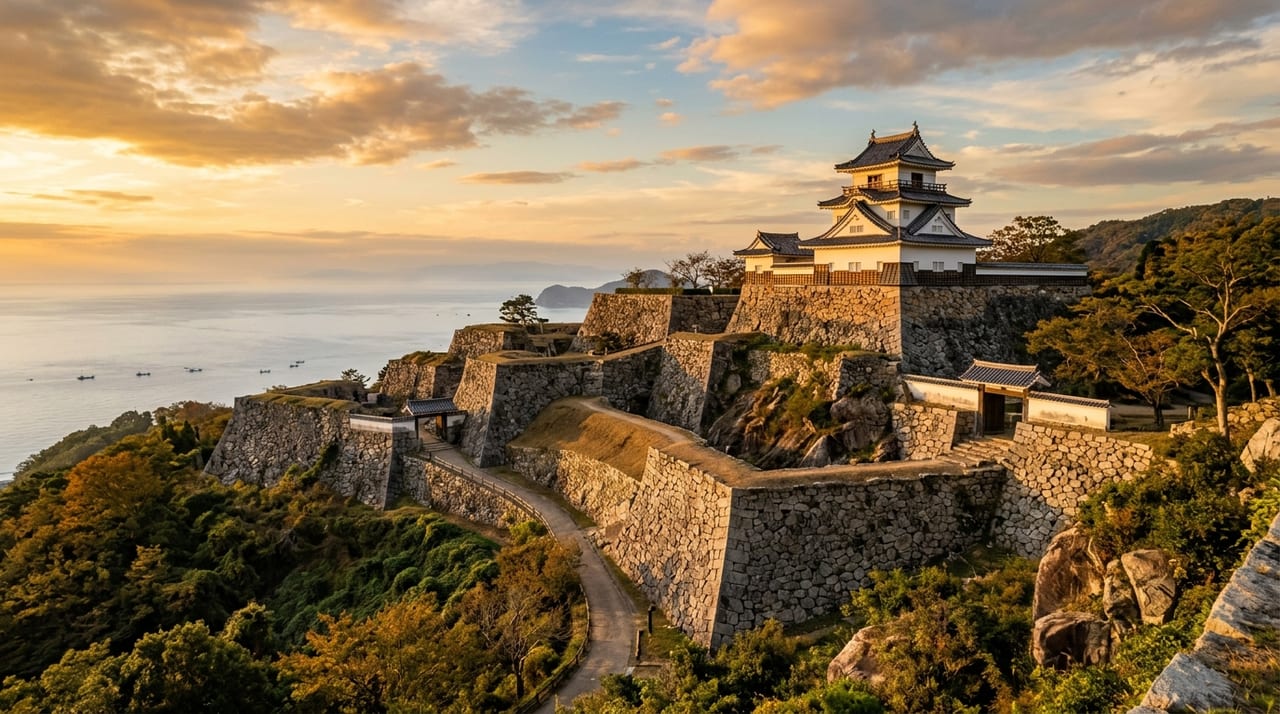
 * Image is for illustrative purposes only.
Hamada Castle
浜田城
Hamada Castle is a historic castle in the Chūgoku region (Construction begun in Genna 6 (1620) under Furuta Shigeharu; completed in Genna 9 (1623)). Its lord was Furuta Shigeharu → Matsui Matsudaira family (Hamada Matsudaira) → Matsudaira (Ochi) family.
Overview
Hamada Castle is a hirayama-jō (hill-and-plain castle) located in Hamada City, Shimane Prefecture, an early modern castle built on the hills of Hamada, the central city of the San'in region. Furuta Shigeharu, who sided with the Eastern Army (Tokugawa side) at the Battle of Sekigahara in Keichō 5 (1600), entered the domain in Genna 5 (1619); construction began in Genna 6 (1620) and was completed in Genna 9 (1623).
The castle makes use of Mount Kame, an independent hill about 68 meters above sea level, and has a ladder-type (teikaku-shiki) layout linking the Sannomaru, Ninomaru and Honmaru toward the summit. From the tenshu, which took advantage of its site close to the sea, the Sea of Japan could be seen in full, and the structure completely controlled the strategic ground linking San'in and Yamaguchi as 'Hamada of Iwami'.
After the Furuta family was stripped of its domain (kaieki) in Keian 1 (1648), daimyō of the fudai and shinpan houses, including the Matsui Matsudaira family, the Honda family and the Ochi Matsudaira family, took turns governing, and the Hamada Domain was positioned as the San'in-side check against the Chōshū Domain. In Bunkyū 3 (1863) and Genji 1 (1864), relations with the Chōshū Domain (the Mōri clan) grew tense. During the Second Chōshū Expedition (Battle of Sekishū-guchi) in Keiō 2 (1866), the domain lord Matsudaira Takeakira withdrew from the castle, and the Hamada Domain itself set fire to the castle (jishō taijō, withdrawal by self-burning). Because of this dramatic self-burning, the main buildings of Hamada Castle did not survive; today stone walls and earthen ramparts remain, and the site is designated a Shimane Prefecture Historic Site.
Connection to Swords
The connection between Hamada Castle and Japanese swords can be understood from two angles: the regional character of Iwami (western Shimane Prefecture) and the samurai culture of the castle town.
In the Second Chōshū Expedition of Keiō 2 (1866), the Hamada Domain set fire to the castle and withdrew (withdrawal by self-burning) in the face of the advancing Chōshū forces.
Highlights
- Honmaru stone walls — stone walls that survived the self-burning of Keiō 2 (1866), designated a Shimane Prefecture Historic Site
- Shiroyama Park — a castle-ruins park where the layouts of the Sannomaru, Ninomaru and Honmaru can be toured on walking paths
- Views of the Sea of Japan — a magnificent panorama of the Iwami coast and the Sea of Japan from the Honmaru site
- Memorial of the Hamada Domain — an inscription by Shiba Ryōtarō at the castle entrance that conveys the history of the withdrawal by self-burning
- Relocated gate — a gate of the former samurai residence of the Tsuwano Domain, moved to the castle entrance (main gate of the Hamada Prefectural Office)
* Opening hours and admission fees are subject to change. Please check the official website before visiting.