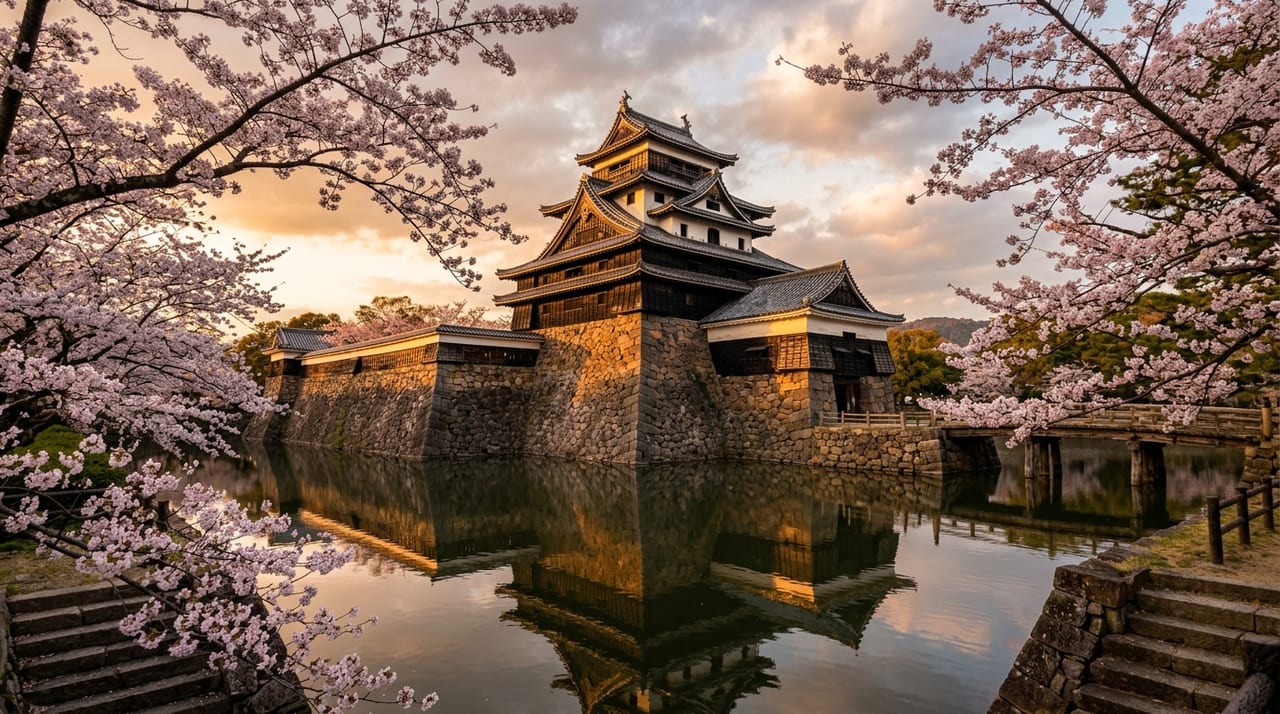
 * Image is for illustrative purposes only.
Matsue Castle
松江城
Matsue Castle is a historic castle in the Chūgoku region (Built in 1611 (Keichō 16)). Its lord was Horio Yoshiharu / Matsudaira clan.
Overview
About the Castle
Matsue Castle is a celebrated National Treasure castle standing on the shore of Lake Shinji. As the only surviving original keep in the San'in region, it has a presence that is truly distinctive. Horio Yoshiharu, father of Horio Tadauji, who received 240,000 koku of Izumo and Oki Provinces in recognition of military merit at Sekigahara, began construction in Keichō 12 (1607), and the castle was completed by the first month of Keichō 16 (1611). The keep has four tiers, five stories and one basement level. It is a masterpiece of the watchtower-style (rōrō-gata) keep, and its sturdy design, shaped by a strong awareness of actual warfare, shows defensive features throughout, such as yosegi (built-up) pillars and plank walls. The keep interior is equipped with a well, reflecting a practical design prepared for siege defense.
Architecture and Structure
The name 'Chidori Castle' is said to derive from the shape of its gables, which resemble plovers with wings spread. From the top floor of the keep, a sweeping view of Lake Shinji opens out, and at dusk one can enjoy a mystical scene in which the lake surface glows vermilion. After the Horio line ended, the domain passed to Kyōgoku Tadataka. In Kan'ei 15 (1638), Matsudaira Naomasa entered the domain, and the Matsudaira family governed the castle until the Meiji Restoration. Matsudaira Naomasa was a grandson of Tokugawa Ieyasu and a warrior who made his first campaign at the age of 14 in the Winter Siege of Ōsaka. This castle was designated a National Treasure in Heisei 27 (2015).
History of Construction
A prayer tablet (kitō-fuda) on the keep was confirmed to bear the era name 'Keichō 16,' which clarified the year of construction. This discovery was the deciding factor in the National Treasure designation and drew great attention as a 'great discovery of the Heisei era.' The castle town retains the samurai residences of Shiomi Nawate. It is also known as the place Koizumi Yakumo (Lafcadio Hearn) loved, where he wrote 'Glimpses of Unfamiliar Japan.' Matsue is also close to Izumo Taisha and Tamatsukuri Onsen, making it a base where one can experience the history and culture of Izumo, the land of myth. A sightseeing boat tour along the castle moat on the Horikawa is a pleasure unique to Matsue. Gazing up at the keep from the water while listening to the boatman's tales of the castle is especially memorable.
Sightseeing and Experiences
The Izumo region has been sung of since ancient times as 'Yakumo tatsu Izumo,' a mysterious land whose layered myths and history deepen the appeal of Matsue Castle even further. Matsue is also called the 'City of Water,' and the view of the castle town from a Horikawa sightseeing boat is an experience unique to Matsue. Izumo's myths, tatara iron-making and Matsue Castle: a journey connecting these three is a one-of-a-kind journey that touches the very origins of the Japanese sword. The Horikawa encircles the castle for about 3.7 km, and a moat cruise by sightseeing boat is a quiet journey of about 50 minutes.
Connection to Swords
Izumo Province has been connected to swords since the age of mythology. The Kojiki recounts how Susanoo slew the eight-headed serpent Yamata no Orochi and obtained the Kusanagi no Tsurugi (Ama-no-Murakumo no Tsurugi), making Izumo a mythological origin point for Japanese swords. The Izumo region has practiced tatara iron smelting since ancient times, supplying tamahagane (jewel steel) as the raw material for Japanese swords. The Wa-Kō Museum in Yasugi, Shimane showcases the history of tatara smelting. Swordsmiths were active in the Matsue domain, and Izumo's sword culture encompasses the complete tradition from smelting to forging. When visiting Matsue Castle, we recommend also exploring the tatara sites in Oku-Izumo.
Highlights
- National Treasure tower (only surviving tower in San'in)
- Sunset over Lake Shinji
- Samurai residences along Shiomi Nawate
- Lafcadio Hearn Memorial Museum & former residence
- Wa-Kō Museum (Yasugi, tatara iron smelting)
- Okuizumo tatara iron-smelting sites
* Opening hours and admission fees are subject to change. Please check the official website before visiting.