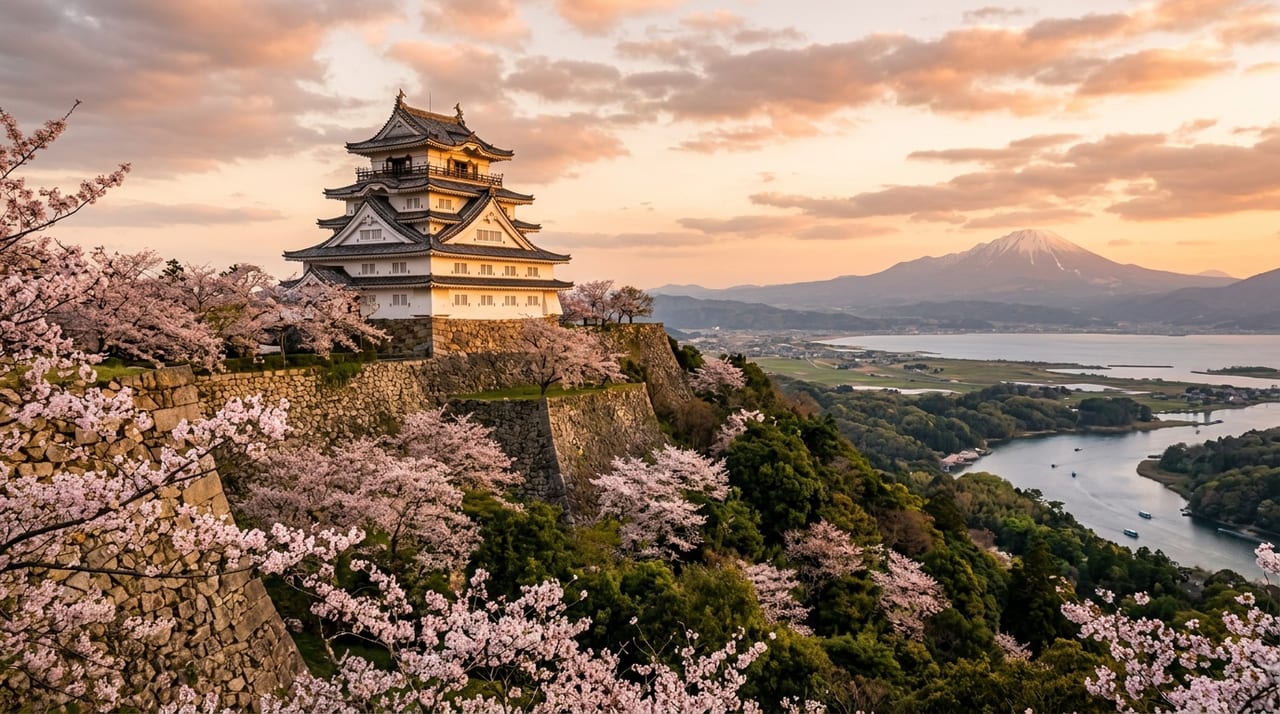
 * Image is for illustrative purposes only.
Yonago Castle
米子城
Yonago Castle is a historic castle in the Chūgoku region (Completed around Keichō 7 (1602)). Its lord was Kikkawa Hiroie / Nakamura Kazutada.
Overview
About the Castle
Yonago Castle was the central castle of Hōki Province (present-day western Tottori Prefecture), an early modern castle completed around Keichō 7 (1602) by Nakamura Kazutada. The castle's origins lie in the Bunmei era (late 15th century), when a fort was built at Yonago. Full-scale development as a castle, however, took place from the late Tenshō period through the Keichō period. In Tenshō 19 (1591), Kikkawa Hiroie began construction at Minatoyama, but after the Battle of Sekigahara Hiroie moved to Iwakuni. Nakamura Kazutada, who then entered the castle, completed it as a large-scale castle with a four-story keep. The height of the keep is thought to have been about 21 m, a scale that surpassed the keep of Tottori Castle, which would later become the main castle.
Architecture and Structure
The castle has its Honmaru on the summit of Minatoyama (90 m above sea level), with the Ni-no-maru and Obi-guruwa extending in three directions from it, forming an irregular layout. The site, which overlooks the Yonago Plain, Nakaumi and the Yumigahama Peninsula, shows that it was a traffic hub of great military and economic importance. Nakamura Kazutada succeeded to the family headship at a young age upon the death of his father, Kazuuji. After the Battle of Sekigahara he was granted all of Hōki Province. In Keichō 8 (1603), however, he caused a domestic disturbance in which he put the chief councilor Yokota Muraaki to death, and he died in Keichō 14 (1609) at the young age of 20. The Nakamura family, which died out without an heir, was succeeded at the castle by Katō Sadayasu. From Genna 3 (1617) onward, the castle became a branch castle of the Ikeda clan of the Tottori domain. From Kan'ei 9 (1632), the Arao family, senior retainers of the Ikeda clan, held the castle as castellans until the Meiji Restoration.
Castle Town and Economy
The castle town of Yonago developed as a commercial town and laid the foundation for present-day Yonago, known as 'Shōto Yonago' (the commercial capital). Yonago, with its harbor on Nakaumi, prospered through water transport and became a distribution hub where goods from Izumo, Iwami and Hōki gathered and were dispatched. In particular, the distribution of iron produced in the Chūgoku Mountains supported the economy of Yonago.
Scenery and Nature
From the castle ruins, the superb views of Mount Daisen (Hōki Fuji) and Nakaumi spread out, and on clear days one can see as far as the Oki Islands. In cherry blossom season, Minatoyama turns pale pink, and it is loved as a hanami spot by local residents. The stone walls of the castle ruins park are stacked in several tiers from the Honmaru through the Ni-no-maru and San-no-maru, and as remains that let one sense the scale of the castle in its heyday, they have high value. Excavation surveys have continued, and the foundation stones of the keep and the remains of various other buildings are gradually being revealed.
Sightseeing and Experiences
Yonago City is developing as a tourist destination together with the neighboring city of Sakaiminato, known as the hometown of manga artist Mizuki Shigeru. Together with historical and cultural facilities such as the Yonago Castle Ruins Park and the Yonago City San'in History Museum, they form a unique tourist area where the world of Kitarō coexists. Climbing Mount Daisen and sightseeing combined with a stay at Kaike Onsen are also very popular.
Connection to Swords
Any discussion of the relationship between Yonago Castle and swords must begin with the abundant iron sand resources of the Izumo, Iwami and Hōki regions. This area was so richly endowed with high-quality iron sand that it was called the 'Land of Iron.' Tatara ironmaking, the traditional method of smelting iron by reducing iron sand with charcoal, flourished here, producing high-quality tamahagane. The tamahagane made through tatara ironmaking in this region played an important role as the material for Japanese swords. In particular, Izumo's 'Yasuki steel (Yasuki hagane)' is known even today as a special steel of the highest world standard, and it demonstrates Izumo's traditional superiority as a source of steel for Japanese swords. Hōki Yasutsuna was a renowned smith of Hōki Province in the Heian period, and he is the maker of the 'Dōjigiri Yasutsuna,' which is said to have been used by Minamoto no Yorimitsu to slay Shuten-dōji. The Dōjigiri Yasutsuna is counted as one of the Tenka Goken (Five Swords of the Realm), a supreme famous sword, and it is currently held at the Tokyo National Museum as a National Treasure. Sword researchers regard the works of Hōki Yasutsuna, with their imposing taihai and mysterious hataraki, as the pinnacle of old swords, placing them among the most important of all old swords. The San'in History Museum in Yonago City preserves the shachi (roof ornament) of the four-tiered turret (Shijū-yagura) of Yonago Castle.
Highlights
- Honmaru stone walls — massive stone-wall remains stacked in multiple tiers, giving a sense of the scale of one of the largest castles in San'in
- Views of Mount Daisen (Hōki Fuji) and Nakaumi from the keep platform — superb scenery where mountains and sea spread out, the finest view in San'in
- Yonago City San'in History Museum — preserves the shachi of Yonago Castle's four-tiered turret and more
- Sakaiminato Mizuki Shigeru Road — walk through the world of Kitarō (about 15 minutes by car)
- Kaike Onsen — a famous hot spring in San'in overlooking the Sea of Japan, about 10 minutes from the castle ruins
- Climbing Mount Daisen — the highest peak in the Chūgoku region, a sacred mountain where mountain faith and samurai culture converge (about 30 minutes by car)
* Opening hours and admission fees are subject to change. Please check the official website before visiting.