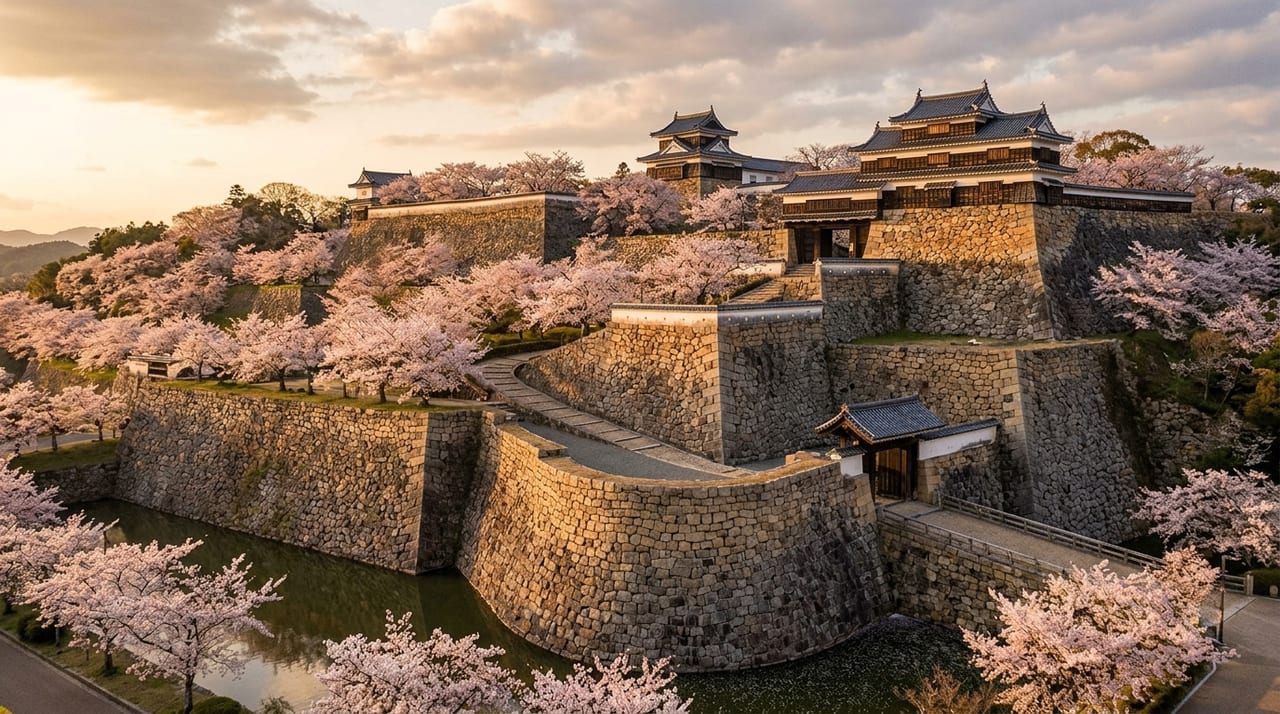
 * Image is for illustrative purposes only.
Tsuyama Castle (Kakuzan Castle)
津山城(鶴山城)
Tsuyama Castle (Kakuzan Castle) is a historic castle in the Chūgoku region (Construction begun 1603 (Keichō 8), completed 1616 (Genna 2)). Its lord was Mori Tadamasa.
Overview
Mimasaka's Famous Castle: The Founding of Tsuyama Castle and the Mori Family
Tsuyama Castle (also known as Kakuzan Castle) is a masterpiece of early modern castle architecture that Mori Tadamasa built in Mimasaka Province (present-day Tsuyama, Okayama Prefecture) over more than a decade, from its start in Keichō 8 (1603) to Genna 2 (1616). The Mori family were daimyō from the Chūbu region, and Tadamasa's elder brother, Ranmaru (Mori Nariyoshi), is renowned as a page of Oda Nobunaga who died together with his lord in the Honnō-ji Incident. After Nobunaga's death, Tadamasa came under the command of Tokugawa Ieyasu, and for his military merit at the Battle of Sekigahara he was granted 186,500 koku in Mimasaka and built Tsuyama Castle.
The layout of Tsuyama Castle is a teikaku-shiki (ladder-type) design centered on the summit of Kakuzan on the north bank of the Yoshii River, with the Honmaru, Ninomaru, and Sannomaru arranged in terraces. When completed, it had a magnificent main keep of five stories and five levels with one basement level, and it was proud of its majestic presence as one of the great castles of the Chūgoku region. However, after the Abolition of Castles Edict (1873), the buildings were dismantled, and today only the stone walls of each enclosure remain.
Castle of Stone Walls: One of Japan's Three Great Hirayama-jō
The greatest highlight of Tsuyama Castle is its magnificent group of stone walls. The stone walls supporting the complex layout on the mountaintop make use of a variety of techniques, including tall stone walls, nozura-zumi (rough-faced stacking), and sangi-zumi (interlocking corner stacking), and they display the pinnacle of the beauty of early modern castle stone walls. Known as a 'castle of stone walls,' it is, together with Kōraku-en in Okayama and the Bikan district in Kurashiki, one of the representative tourist destinations of Okayama Prefecture.
During the spring cherry blossom season (early April), approximately 1,000 Someiyoshino cherry trees within the castle grounds come into full bloom, and the spectacle of the stone walls and cherry blossoms is known nationwide as one of the finest hanami spots in Japan. It has also been selected as one of Japan's 100 Best Cherry Blossom Sites, and many tourists visit during this season. Sightseeing combined with the Tsuyama Manabi Railway Museum (near the castle site) is also popular.
From the Mori Family to the Matsudaira Family: The History of the Tsuyama Domain
In Genroku 10 (1697), the Mori family was dismantled (kaieki) because Mori Atsutoshi, who was to succeed after the death of the fourth domain lord, Mori Naganari, went mad. The following year, Matsudaira Nobutomi of the Echizen Matsudaira family was enfeoffed as lord of the Tsuyama Domain with 100,000 koku. From then until the end of the Edo period, the Matsudaira family governed the Tsuyama Domain and maintained close ties with the shogunal house as a shinpan daimyō.
The Tsuyama Domain during the period of Matsudaira rule (18th to 19th centuries) is known as a cultural domain where both Confucian studies and Rangaku (Dutch studies) flourished. In particular, Udagawa Genzui (1756–1798), a Rangaku scholar from the Tsuyama Domain, is known as a pioneer who introduced Dutch medicine to Japan, and his successors formed the 'Tsuyama Rangaku.'
Mimasaka, Adjacent to Bizen
The most important point of contact between Tsuyama Castle and the culture of swords lies in the geographical position of Mimasaka Province. Mimasaka lay north of Bizen Province (present-day southern Okayama Prefecture), and it had an extremely close relationship with Bizen, which was home to Osafune, a major production center of Bizen blades. Osafune is located in Osafune-chō, Setouchi, along the JR Akō Line, and from the Kamakura to the Sengoku periods it was the place where Japan's largest concentration of swordsmiths gathered.
Present-Day Tsuyama Castle: A Sacred Site of Stone Walls and Cherry Blossoms
The present-day Tsuyama Castle ruins (Kakuzan Park) are famous nationwide as a sightseeing destination for stone walls and cherry blossoms. It is counted as one of Japan's three great hirayama-jō, and the beauty of its magnificent stone walls continues to captivate castle enthusiasts.
The Bitchū-yagura (reconstructed), developed within the castle grounds, is a building reconstructed in 2005, and it serves as an exhibition facility that conveys the internal structure of the castle and the lifestyle of the period. Within Tsuyama city there is also the Tsuyama Local History Museum, which displays reconstruction models of Tsuyama Castle produced on the basis of documents and old photographs.
A journey combining railways and sword sightseeing in Tsuyama, namely Tsuyama Castle (stone walls and cherry blossoms), the Tsuyama Manabi Railway Museum, and the Bizen Osafune Sword Museum (about one hour by car), is a rich route through which one can enjoy the martial culture and the iron culture of the Chūgoku region all at once.
Connection to Swords
The connection between Tsuyama Castle and swords can be understood through its geographical proximity to Bizen Province.
Osafune is located about one hour by car from Tsuyama, and it is the birthplace of renowned smiths of the Osafune school, including Mitsutada, Nagamitsu, Kagemitsu, Kanemitsu, Motoshige, and Sukesada.
Ranmaru (Mori Nariyoshi), the elder brother of Tadamasa, the first lord of the Mori domain, was a page who enjoyed the favor of Oda Nobunaga.
Currently, the Bizen Osafune Sword Museum (Setouchi, Okayama Prefecture) is conveniently accessible from Tsuyama and exhibits swords of the Bizen Osafune school. A trip that combines a visit to Tsuyama Castle with a visit to the Bizen Osafune Sword Museum is a route that allows one to understand the sword culture of the Chūgoku region most deeply, and I would strongly recommend it to sword enthusiasts.
TOUKENZA's base, Sendai (Tōhoku), and Tsuyama (Chūgoku) are geographically far apart, but they are connected by the keyword of Bizen blades. Shokudaikiri Mitsutada (made by Osafune Mitsutada) is a masterpiece of the Bizen Osafune school, and the Date family, who ruled the Tōhoku region, also prized the Bizen blades of the Chūgoku region. The fact that daimyō across the whole country sought Bizen blades speaks to the universal appeal and high technical level of Bizen blades.
Highlights
- Stone walls group (National Historic Site) — the magnificent early modern stone walls of a castle counted among Japan's three great hirayama-jō, the beauty of its tall stone walls and sangi-zumi
- Bitchū-yagura (reconstructed) — the castle's only reconstructed building, exhibiting the castle's internal structure, samurai culture, and lifestyle
- Japan's 100 Best Cherry Blossom Sites — approximately 1,000 cherry trees and stone walls in a spectacular display, with peak viewing in early April
- Tsuyama Local History Museum — exhibits reconstruction models of Tsuyama Castle and other items
- Bizen Osafune Sword Museum (about one hour by car) — a sword museum exhibiting swords of the Osafune school
- Tsuyama Manabi Railway Museum — an exhibition facility utilizing the former Tsuyama locomotive depot, displaying SL steam locomotives and diesel railcars
* Opening hours and admission fees are subject to change. Please check the official website before visiting.