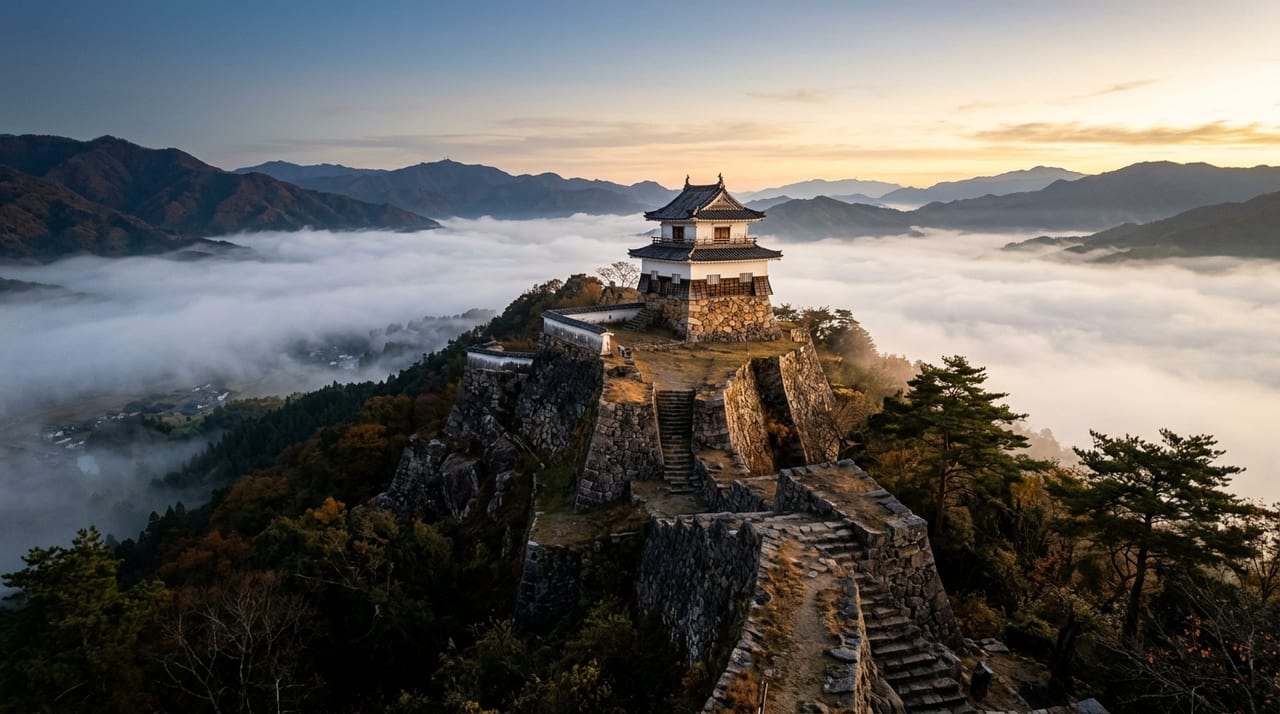
 * Image is for illustrative purposes only.
Bitchū Matsuyama Castle
備中松山城
Bitchū Matsuyama Castle is a historic castle in the Chūgoku region (Built in 1240 (Ninji 1)). Its lord was Akiba Shigenobu / Itakura clan.
Overview
About the Castle
Bitchū Matsuyama Castle was built on the summit of Mount Gagyū at an elevation of 430 m. It is a castle with an extant keep located at the highest elevation of any mountain castle in Japan. On early mornings from autumn into winter, when clouds form at the foot of the mountain and the keep appears to float above them, the “Castle in the Sky” scene has, along with Takeda Castle, become enormously popular in recent years as one of the most fantastical sights among Japan's castle landscapes. Its history began when Akiba Shigenobu built the castle in the 1st year of Ninji (1240), giving it a history of some 780 years. During the Sengoku period, a fierce struggle for control of Bitchū took place between the Mimura clan and the Mōri clan.
Architecture and Structure
In the Bitchū War of Tenshō 3 (1575), Mimura Motochika was attacked by Mōri forces and took his own life, and Bitchū Matsuyama Castle fell into the hands of the Mōri clan. In the Edo period, Kobori Enshū repaired the castle. Later, Mizunoya Katsumune, son of Mizunoya Katsutaka, who was enfeoffed here in Kan'ei 19 (1642), carried out a major renovation over three years beginning in Tenna 1 (1681) and completed the present keep. The two-tiered, two-story keep belongs to the smallest category among extant keeps, but standing on the summit at 430 m, its appearance radiates a lofty, solitary presence that is small yet full of dignity. Inside the keep extends a plain space without ornamentation, in which the rugged character and practicality of a mountain castle can be felt directly.
History of Construction
The high stone walls directly beneath the keep were built on natural bedrock, and this imposing structure overwhelms anyone who looks up at it from the approach path. The cat “Sanjūrō,” who settled in the castle, became popular nationwide as the “Cat Lord” of Bitchū Matsuyama Castle and has many fans through social media. The stone walls used in the opening sequence of the taiga drama “Sanadamaru” also greatly raised the castle's profile. Among extant keeps, Bitchū Matsuyama Castle has the strongest sense of a “hidden place,” and the sight of the stone walls and keep that appear at the end of a mountain path is full of the joy of “discovery.”
Development of the Castle Town
The experience that can be savored only by those who have climbed with effort is the greatest appeal of a mountain castle. The castle town of Takahashi lies in the mountainous region of Okayama Prefecture and retains a strong castle-town atmosphere, including the samurai residences of Ishibiya-chō and the dry landscape garden of Raikyū-ji. The Bitchū Matsuyama Domain produced the eminent retainer Yamada Hōkoku in the late Edo period, known for a reform that dramatically restored the domain's finances. Hōkoku taught at the domain school Yūshūkan and urged the domain's retainers to embrace the spirit of excelling in both letters and martial arts.
Sightseeing and Experiences
The garden of Raikyū-ji is a famous scenic site said to be the work of Kobori Enshū, and a stroll through Takahashi, touring the castle, the samurai residences and the gardens, further enriches a journey to a mountain castle. The former domain of the Aoe school lies in present-day Kurashiki, and the route from Bitchū Matsuyama Castle through Kurashiki to Osafune in Bizen is the finest journey through the sword history of the Chūgoku region. Bitchū Matsuyama Castle is also counted among Japan's Three Great Mountain Castles and, together with Takatori Castle (Nara Prefecture) and Iwamura Castle (Gifu Prefecture), forms the pinnacle of mountain castles.
Connection to Swords
Bitchū Province, where Bitchū Matsuyama Castle stands, was an important center of Japanese swordmaking alongside neighboring Bizen Province, and its history goes back to the koto period. The most famous smith school of Bitchū is the Aoe school. Aoe was located in present-day Kurashiki City, and from Ko-Aoe at the end of the Heian period, through Chū-Aoe in the Kamakura period, to Sue-Aoe in the Nanboku-chō period, it produced many master smiths over roughly 300 years. Ko-Aoe is represented by Moritsugu and Tsunetsugu, and its highlight is the hada, or grain of the steel, known as “sumihada”, a distinctive feature of its style. Sumihada is a steel in which dark patches called jifu appear within a clear, blue-tinged steel, a beauty distinct from the steel of Bizen blades. Aoe blades are highly prized among enthusiasts for their beautiful steel and quiet dignity, and many masterpieces of Ko-Aoe have been designated as National Treasures and Important Cultural Properties. Bitchū Province was also home to several other smith groups besides the Aoe school, such as the Katayama Ichimonji school, and the Kibi region, encompassing both Bizen and Bitchū, formed a major sword culture of Japan as a whole. Although the Bitchū Matsuyama Domain was a small domain of 50,000 koku, it valued the martial arts, and it is also known for domain reforms that produced eminent retainers such as Yamada Hōkoku. A journey from Bitchū Matsuyama Castle to the Bizen Osafune Sword Museum is a route that sword enthusiasts covet, touring the two great sword-producing regions of Aoe in Bitchū and Osafune in Bizen.
Highlights
- Surviving tower (highest mountain castle in Japan)
- Castle in the sky above clouds (autumn-winter early morning)
- Towering stone walls
- Castle cat 'Sanjūrō'
- Bitchū Matsuyama Castle observation deck (cloud sea viewpoint)
- Bizen Osafune Sword Museum (about 1 hour by car)
* Opening hours and admission fees are subject to change. Please check the official website before visiting.