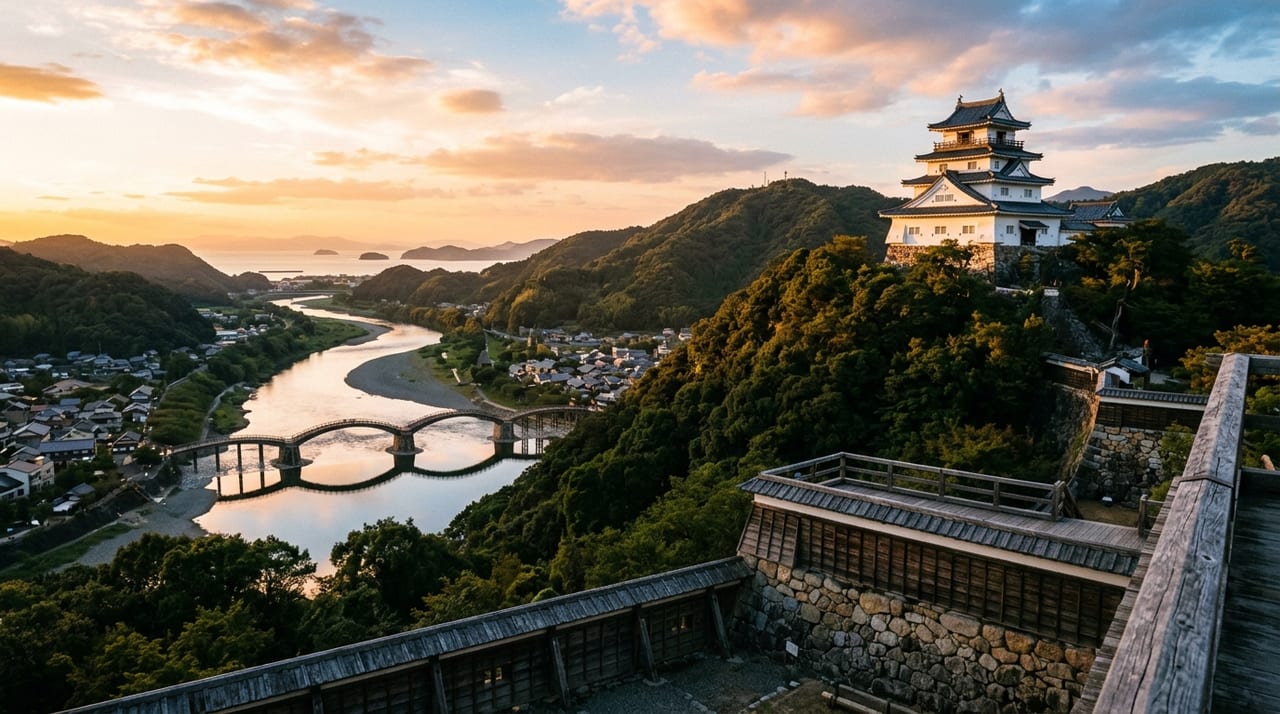
 * Image is for illustrative purposes only.
Iwakuni Castle
岩国城
Iwakuni Castle is a historic castle in the Chūgoku region (Castle construction in Keichō 6 (1601), completed in Keichō 13 (1608), keep dismantled under the One Castle per Province edict in Genna 1 (1615), reconstructed (fukkō) keep built in 1962). Its lord was Kikkawa Hiroie.
Overview
The Kikkawa Clan's Castle Overlooking the Nishiki River
Iwakuni Castle is a mountain castle whose construction began in Keichō 6 (1601) under Kikkawa Hiroie, who had been assigned to western Japan after the Battle of Sekigahara (1600). Its bold layout is a distinctive feature. It uses the Nishiki River, which flows through the center of Iwakuni, as a natural moat, and places the keep on the summit of Mt. Yokoyama at an elevation of about 200 meters. Making the most of Iwakuni's terrain, the castle's design was a symbol of the military acumen and authority of the Kikkawa clan.
However, only seven years after its completion, in Genna 1 (1615), Iwakuni Castle fell under the Tokugawa shogunate's One Castle per Province edict, and the keep had to be dismantled. Kikkawa Hiroie maintained his rule as lord, yet the castle itself was lost, an ironic outcome. Afterward, samurai residences and merchant districts were developed in the castle town. Together with the Kintai Bridge spanning the Nishiki River (first built in 1673), Iwakuni grew as a key strategic point linking the Chūgoku and western Japan region.
The current keep is a reconstructed (fukkō) keep of reinforced concrete, built in 1962 about 30 m south of the original keep platform. The white keep standing atop the summit commands a majestic view over the clear waters of the Nishiki River and the Kintai Bridge. Visitors can reach the summit by ropeway, and from the top floor of the keep one can take in a panoramic view of Iwakuni's castle town and the islands of the Seto Inland Sea.
The Kikkawa Clan and Swords: The Martial Culture of the Chūgoku Region
The Kikkawa clan was a prestigious member of the Mōri family, as Kikkawa Motoharu, the second son of Mōri Motonari, took over the family headship as an adopted heir. The clan played a part in the Mōri house, which held hegemony over the Chūgoku region. As a warrior house, the Kikkawa had a deep appreciation for swords, and generation after generation of household heads carefully passed down famous blades as heirlooms. When Kikkawa Hiroie was transferred to Iwakuni after Sekigahara, swords handed down in the Kikkawa family were brought with him, and these became the foundation of the samurai culture of the Iwakuni domain.
In the Chōshū region (Yamaguchi Prefecture), which includes Iwakuni, sword culture has been nurtured since ancient times through exchange with Bizen and Bitchū. In the Chūgoku region, the influence of the Bizen tradition centered on Bizen Osafune spread strongly, and smiths who were active in the Kamakura and Muromachi periods are also recorded in the Iwakuni area. In Iwakuni, which became the castle town of the Kikkawa clan, swordsmiths who met the demand of samurai worked at their craft, and it is said that blades were forged using local iron (iron sand).
Kintai Bridge and the Castle Town: Iwakuni's Cultural Heritage Linking Swords and Bridges
Inseparable from Iwakuni Castle is the Kintai Bridge, a world-famous wooden arch bridge. Built in 1673 (Enpō 1) by Kikkawa Hiroyoshi, the Kintai Bridge is known for its five-arch span reflected in the Nishiki River, and it is counted as one of Japan's Three Famous Bridges. The landscape in which castle and bridge form one whole has remained a symbol of Iwakuni since the Edo period.
In the past, samurai residences lined the areas at each end of the Kintai Bridge, and warriors came and went with swords at their waists. In the castle town of Iwakuni, the care, buying, and selling of swords were part of daily life, and the relationship between swordsmiths and samurai supported the economy and culture of the castle town. Even today, the Kikkawa Historical Museum in Iwakuni City holds artworks and arms connected to the Kikkawa family, where visitors can see a valuable collection of swords and armor.
Every year, the “Kintaikyō Festival” and the “Iwakuni Festival” are also held around the Kintai Bridge, in which warrior processions and armored warriors recreate the castle town of the past. For sword enthusiasts, this is an excellent opportunity to experience the samurai culture in which armor and swords come together.
Highlights and Visitor Guide to Iwakuni Castle
The usual route to Iwakuni Castle is to cross the Nishiki River from the Kintai Bridge and take the ropeway toward the summit of Mt. Yokoyama. On the walking path leading to the keep, you can experience the layout of a mountain castle. The view from the top floor of the keep is spectacular: below lie the Kintai Bridge and the Nishiki River, and in the distance spread the islands of the Seto Inland Sea.
A tourist area centered on Iwakuni Castle has been developed in the castle town. The trio of the Kintai Bridge, Iwakuni Castle, and the white snake viewing facility (the Iwakuni white snakes are a National Natural Monument) forms the classic sightseeing route in Iwakuni. At the Kikkawa Historical Museum, swords, armor and helmets, letters, and other items handed down in the Kikkawa family are on display, so sword enthusiasts can enjoy a particularly rich visit.
Connection to Swords
The Kikkawa clan, as a martial branch of the Mouri family, preserved swords as treasured heirlooms, passing down renowned blades of the Bizen and Soshu traditions through generations. The Iwakuni vicinity maintains a tradition of forging using iron sand, and the Kikkawa Museum still houses collections of swords and armor connected to the clan's lords.
Highlights
- Views from the tenshu's upper floors—a spectacular vista commanding the Nishiki River, Kintai Bridge, and islands of the Seto Inland Sea
- Kintai Bridge—a renowned five-arch wooden structure, counted among Japan's Three Most Famous Bridges (first constructed 1673)
- Kikkawa Museum—preserving primary materials including the Kikkawa family's hereditary swords, armor, and documents
- Ropeway ascent—experiencing the mountain castle via summit access and woodland paths
- Iwakuni Castle town—historic streetscape preserving remnants of samurai residences and merchant districts
- White snakes of Iwakuni—a species endemic to Iwakuni and designated a national natural monument
* Opening hours and admission fees are subject to change. Please check the official website before visiting.