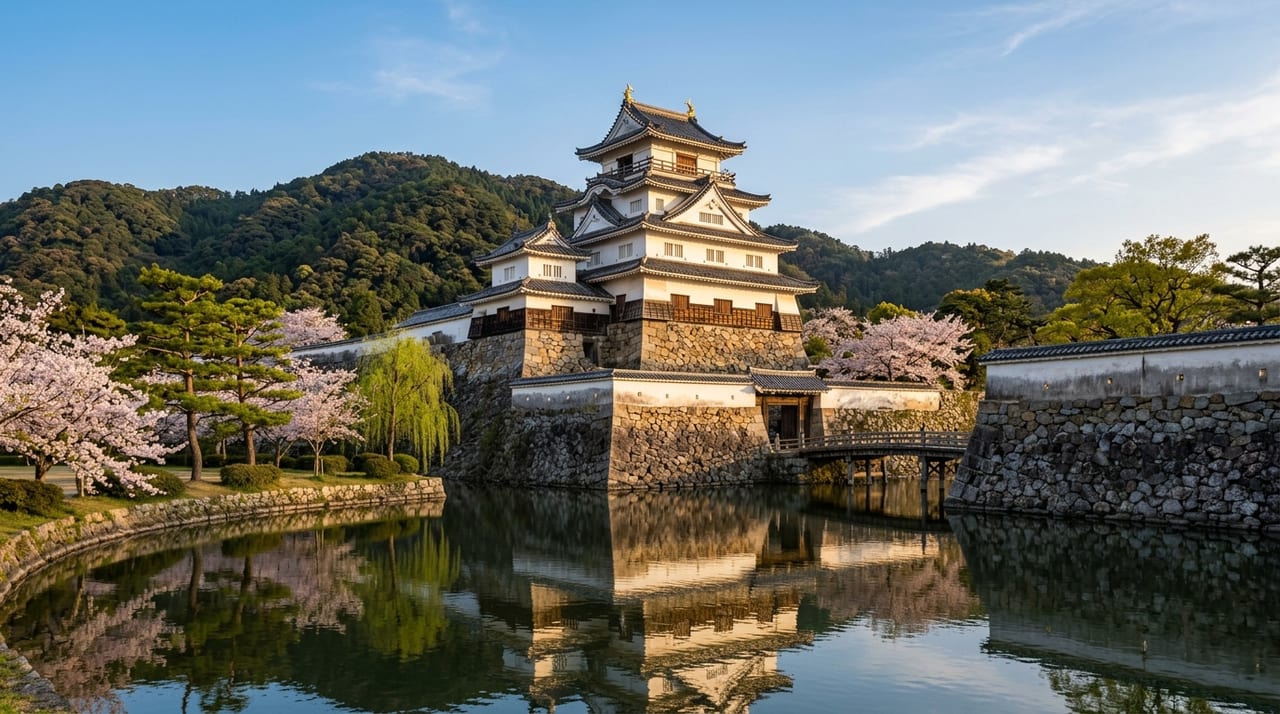
 * Image is for illustrative purposes only.
Hagi Castle (Shizuki Castle)
萩城(指月城)
Hagi Castle (Shizuki Castle) is a historic castle in the Chūgoku region (Founded in 1604 (Keichō 9)). Its lord was Mōri Terumoto.
Overview
Mōri Family's Castle Town
Hagi Castle (Shizuki Castle) was built by Mōri Terumoto, who had served as supreme commander of the Western Army at the Battle of Sekigahara, after he was ordered to relocate from Hiroshima in Aki Province to Suō and Nagato in Keichō 9 (1604). It is also called Shizuki Castle because it sits at the foot of Mount Shizuki. The Mōri family was a prestigious daimyo house that competed fiercely with Oda Nobunaga and Toyotomi Hideyoshi as the dominant power of the Chūgoku region. Although its koku assessment was drastically reduced after Sekigahara, it survived as the Chōshū Domain based in Hagi until the end of the Bakumatsu period and became a driving force of the Meiji Restoration.
Mōri Family's Martial Prowess and Swords
The Mōri family was a martial house that, generation after generation, placed great importance on the sword and on military strategy, and its sword culture is deeply tied to the lineage of Chōshū swordsmiths. From the time of Mōri Motonari onward, the family treasured famous blades from Bizen and Sagami while also actively nurturing local swordsmiths of Nagato and Suō. Even after the family was relocated to Chōshū following Sekigahara, the Mōri continued to patronize swordsmiths, and the activity of Chōshū swordsmiths centered on Hagi flourished.
Chōshū and Swords in the Bakumatsu Period
Hagi became the protagonist of history in the Bakumatsu period. From the Shōka Sonjuku, led by Yoshida Shōin, came Takasugi Shinsaku, Itō Hirobumi, Yamagata Aritomo, and other architects of the Meiji Restoration. The Chōshū Domain, together with the Satsuma Domain, became the center of the movement to overthrow the shogunate. In this era, the swords carried by Chōshū samurai were not merely symbols of social status but spiritual pillars embodying their resolve to topple the shogunate. The Kiheitai, organized by Takasugi Shinsaku, was a revolutionary military force in which samurai and farmers fought side by side regardless of social standing, and the swords wielded by its members carved out the history of the Meiji Restoration.
The Lineage of Chōshū Swordsmiths
Chōshū (Yamaguchi Prefecture) swordsmiths have long boasted a high standard. Particularly in the Bakumatsu period, under the domain's patronage, they produced many outstanding works. Hagi, known for its Hagi ware kilns, was a cultural land where swordsmiths were active as well as potters. It had a distinctive cultural soil where the tea ceremony and swords intersected. The Mōri family's tea culture and sword collecting were passed down as two sides of the same cultural endeavor.
The Legacy of Hagi's Castle Town
Even after the castle was abandoned in the early Meiji period, Hagi is known as a miraculous castle town whose town layout has been preserved almost exactly as it was in the Edo period. The defensive, bent lanes called kagi-magari (hooked lanes), the earthen walls of samurai residences, and the yellow fruit of natsumikan form a landscape that is a living museum, conveying the samurai society of the Edo period just as it was. The Shōka Sonjuku, the former residence of Itō Hirobumi, and the residence of Kido Takayoshi have been preserved. Hagi as a whole has become a historic space that conveys the atmosphere on the eve of the Meiji Restoration. The Hagi Castle ruins and castle town are also counted among the constituent assets of the World Heritage site "Sites of Japan's Meiji Industrial Revolution," and they attract international attention.
Connection to Swords
The sword culture of the Chōshū Domain and the Mōri family, which made Hagi Castle its base, is deeply tied to the special era of the Bakumatsu period. Even before Sekigahara, the Mōri family had collected famous blades from Bizen and Sagami, and it also put great effort into training swordsmiths within the domain. The swordsmiths retained by the Chōshū Domain produced swords that were both practical and dignified. In the Bakumatsu period, when the Chōshū Domain became the center of the movement to overthrow the shogunate, domain samurai's demand for swords surged. Kido Takayoshi (Katsura Kogorō) was also an excellent swordsman who served as the senior student (jukutō) of the Renpeikan. Moreover, many Chōshū samurai studied Shintō Munen-ryū under Saitō Yakurō at the Renpeikan in Edo. Katsura Kogorō (Kido Takayoshi), Takasugi Shinsaku, Itō Hirobumi, and others belonged to this lineage, so the sword-arts level of Chōshū samurai was high even by national standards. The Hagi Museum holds many historical materials of the Hagi Domain (Chōshū Domain), and the treasures handed down in the Mōri family are held by the Mōri Museum in Hōfu. Even after the Restoration, the lineage of Chōshū (Yamaguchi Prefecture) swordsmiths continued, and it has produced excellent swordsmiths even today. The sword culture of Hagi is special, in that the tradition of martial arts and the spirit of the Restoration are unified. As swords of the land that gave birth to modern Japanese history, they carry unparalleled historical weight.
Highlights
- Hagi Castle Ruins (Shizuki Park) — Stone walls and moats convey the castle's appearance in its heyday. Also renowned as a cherry blossom spot
- Shōka Sonjuku — Historic building where Yoshida Shōin trained his disciples (World Heritage)
- Hagi Museum — Core facility of the "Hagi Machijū Hakubutsukan" (Hagi city-wide museum) initiative, displaying historical materials of the Hagi Domain (Chōshū Domain)
- Samurai Residence District of Hagi's Castle Town — A miraculous castle town where the Edo-period town layout remains
- Former Residences of Kido Takayoshi and Itō Hirobumi — Commemorate the birthplaces and daily lives of the Restoration's heroes
* Opening hours and admission fees are subject to change. Please check the official website before visiting.