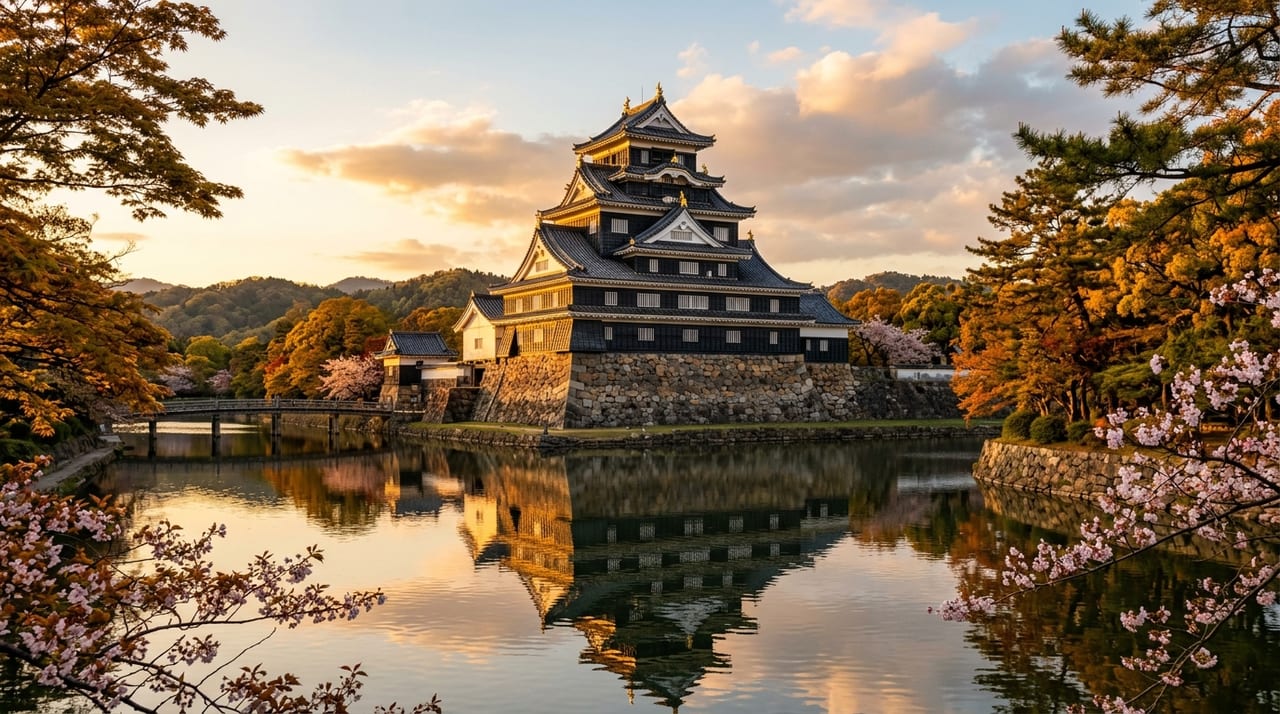
 * Image is for illustrative purposes only.
Okayama Castle
岡山城
Okayama Castle is a historic castle in the Chūgoku region (Built in 1597 (Keichō 2)). Its lord was Ukita Hideie / Ikeda clan.
Overview
About the Castle
Okayama Castle is a renowned castle known as "Ujō" (Crow Castle) for its jet-black exterior, covered in black-lacquered vertical boards. It is a magnificent castle complex with a moat fed by the abundant waters of the Asahi River, and it houses Kōraku-en, one of the Three Great Gardens of Japan. In the 1st year of Tenshō (1573), Ukita Naoie entered the Okayama area, and in the 2nd year of Keichō (1597), his son Hideie carried out a large-scale construction of the castle as an early modern fortress. Ukita Hideie was a handsome warrior who was cherished as a yūshi (nominal adopted son) of Toyotomi Hideyoshi, and he was counted among the Five Elders. However, he fought on the Western Army side at the Battle of Sekigahara, was defeated, and was exiled to Hachijō-jima.
Lords and Governance
Hideie's turbulent life is told as a story that symbolizes the glory and downfall of a daimyo. After Sekigahara, Kobayakawa Hideaki was briefly installed as lord. After Hideaki died young, the Ikeda clan was installed, and from then until the Meiji Restoration, the Ikeda clan governed Okayama Domain. The Ikeda clan was a distinguished house descended from Ikeda Terumasa, the lord of Himeji Castle. As Okayama Domain (315,000 koku), a major domain, it held a commanding presence among the leading domains of the Chūgoku region. In Reiwa 4 (2022), the main tower was completely renovated and reborn as an exhibition facility using the latest digital technology.
Connection to Swords
The greatest feature of Okayama Castle is its location very close to Bizen Osafune, the largest production center of Japanese swords (now Osafune-chō in Setouchi City). The Bizen tradition is the greatest school of Japanese swords, producing the most master smiths among the Gokaden, and Okayama Castle can truly be said to be located at the center of Bizen sword culture. Kōraku-en is a daimyo garden built in the Genroku era by Ikeda Tsunamasa, the second lord of Okayama Domain. The vast lawns, ponds, and the main tower of Okayama Castle, used as shakkei (borrowed scenery), together form a landscape that is a treasure of Japanese gardens. The view of the main tower from Kōraku-en across the Asahi River is famous as one of Okayama's finest vistas.
Culture and Crafts
Okayama Castle is the gateway to the holy land of Bizen swords. For those who love Japanese swords, visiting this castle means standing at the prologue of the grand story of Bizen sword culture. The jet-black Ujō and the swords of Bizen Osafune are bound together by an aesthetic of black and steel. Okayama is blessed with a warm climate known as the "Land of Sunny Skies" and is also known as a famous producer of fruit. Okayama, where the history of a castle town and modern urban culture coexist, is an ideal base for a pilgrimage to the holy sites of Bizen swords. On the lower tier (Shimo-no-dan) of Okayama Castle's Honmaru, there is also a Bizen ware experience workshop, where you can experience the common traits of Japanese traditional culture through "fire" in pottery and swords.
Development of the Castle Town
In Bizen, both swords and pottery are arts of "earth and fire." The Okayama tram "MOMO" is a modern vehicle that runs through the castle town, and traveling to the castle itself becomes an enjoyable experience.
Connection to Swords
Speaking of the relationship between Okayama Castle and Japanese swords is, in other words, speaking of the grand history of Bizen swords. Bizen Osafune (Osafune-chō, Setouchi City), located about 30 minutes by car from Okayama Castle, is the largest and most important sword production center in the history of Japanese swords. The Bizen tradition is said to be the foremost of the Gokaden, and from the late Heian period through the Muromachi period, it continued without interruption to produce master smiths. Beginning with Ko-Bizen Tomonari, and passing through the Fukuoka Ichimonji school's Norimune, Yoshifusa, and Sukezane, the Osafune school's Mitsutada, Nagamitsu, Kagemitsu, Kanemitsu, and Chōgi, down to the Sue-Bizen's Sukesada and Katsumitsu, its lineage is the history of Japanese swords itself. Mitsutada is known for his gorgeous chōji-midare temper line. Nagamitsu inherited his father's style while further refining his technique. Kagemitsu originated a unique hamon called kataochi-gunome. Kanemitsu, influenced by the Sōshū-den, became a master representative of the Nanboku-chō period with a bold and majestic style. The Bizen Osafune Sword Museum was built as the first public museum in Japan to hold permanent sword exhibitions, and it offers monthly demonstrations of forging by active sword smiths, including koshiki tanren (traditional forging demonstration). Watching steel taken from the blazing furnace being forged while sparks fly is an overwhelming experience in which you witness the moment the soul of Japanese swords takes shape. The Hayashibara Museum of Art (in Okayama City) holds swords collected by businessman Hayashibara Ichirō, together with heirlooms of the Ikeda clan, lords of Okayama Domain, and the swords include National Treasures and Important Cultural Properties. Starting from Okayama Castle and visiting Bizen Osafune is truly a pilgrimage to the holy land for Japanese sword enthusiasts, and it is the sword journey that TOUKENZA most strongly recommends. When you gaze at the fire in the forge at Bizen Osafune, you will feel that the souls of swordsmiths who worked over 800 years still live on in this land. Okayama is also known as the birthplace of the Momotarō legend, and it is a land where myth and martial tradition intertwine, from the corridors of Kibitsu Shrine to Kinojō.
Highlights
- Main Tower (renovated in Reiwa 4 (2022)) — The history of Ujō brought back to life with the latest digital exhibits
- Kōraku-en (one of the Three Great Gardens of Japan) — Genroku-era daimyo garden with Okayama Castle's main tower as borrowed scenery, beautiful in every season
- Bizen Osafune Sword Museum (about 30 minutes by car) — Sword museum with a collection centered on Bizen swords, with monthly koshiki tanren (traditional forging demonstration) open to the public
- Hayashibara Museum of Art — Sword collection including National Treasures and Important Cultural Properties, and heirlooms of the Ikeda clan, lords of Okayama Domain
- Views of the Asahi River and Ujō — Okayama's finest vista, where the jet-black main tower and clear waters create a scene together
* Opening hours and admission fees are subject to change. Please check the official website before visiting.