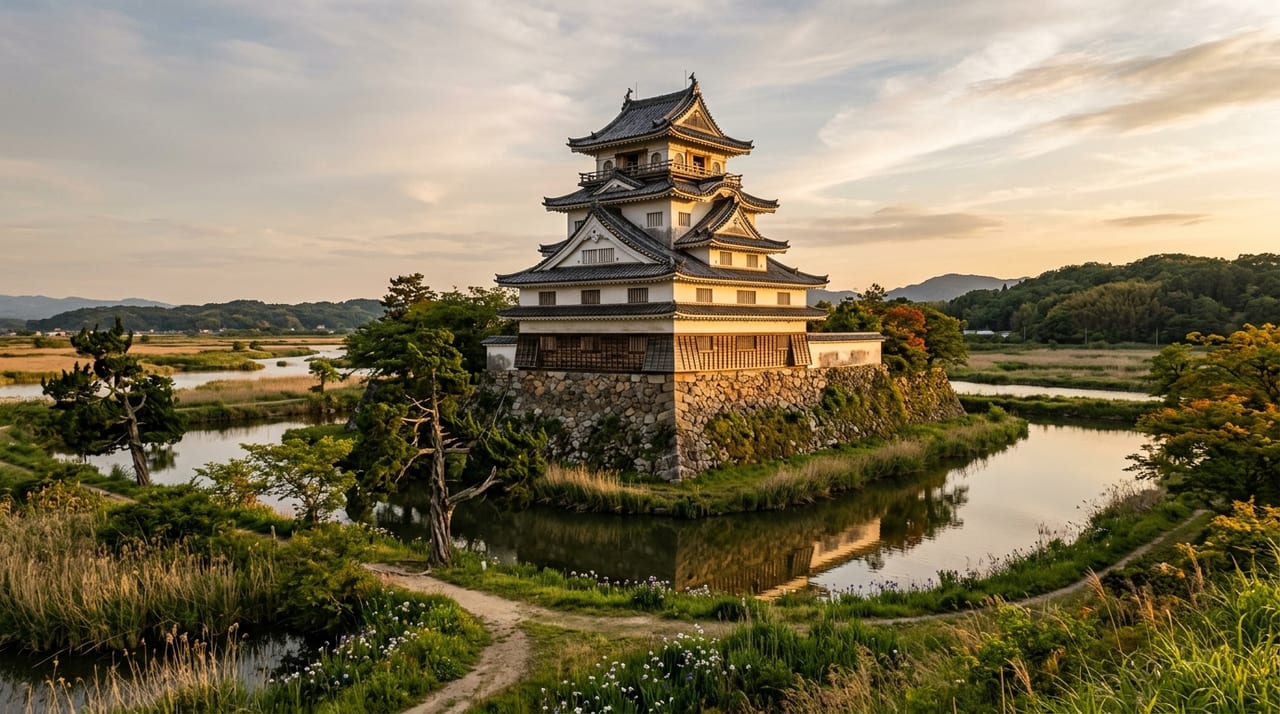
 * Image is for illustrative purposes only.
Bitchū-Takamatsu Castle
備中高松城
Bitchū-Takamatsu Castle is a historic castle in the Chūgoku region (Year of construction unknown (built by the Ishikawa clan during the Sengoku period)). Its lord was Shimizu Muneharu.
Overview
About the Castle
Bitchū-Takamatsu Castle is a flatland castle located in Kita Ward, Okayama City, Okayama Prefecture. In Tenshō 10 (1582), it earned a permanent place in history through the 'water siege' carried out by Hashiba Hideyoshi (later Toyotomi Hideyoshi). The castle made skillful use of its terrain, surrounded by the low-lying marshland of the Ashimori River, and the natural defensive strength of the wetlands made a conventional siege difficult. In Tenshō 10 (1582), Shimizu Muneharu, who had come under the Mōri clan's allegiance, served as castle lord. Acting on the orders of Oda Nobunaga, Hashiba Hideyoshi (later Toyotomi Hideyoshi) moved to take the castle as part of the campaign against the Chūgoku region.
The Water-Flooding Ploy
Hideyoshi avoided a frontal assault. In just 12 days, he built an embankment about 3 km long around the castle, the Kaeru-ga-hana embankment, to flood it. Taking advantage of heavy rains in the rainy season and the swelling of the Ashimori River, he completed the embankment, and at the same time the whole area around the castle was submerged, turning Bitchū-Takamatsu Castle into an isolated 'castle on the water.' The garrison was cut off without help, but castle lord Shimizu Muneharu refused to surrender and continued to hold the castle. While advancing peace negotiations with the Mōri side, Hideyoshi set a condition: the castle lord's seppuku (ritual suicide) would be the price for sparing the lives of the garrison.
Shimizu Muneharu's Heroic Death
On the 3rd day of the 6th month of Tenshō 10 (1582), news of the Honnō-ji Incident reached Hideyoshi. Oda Nobunaga had been killed by Akechi Mitsuhide, an event that shook the realm. Hideyoshi did not disclose this information to the Mōri side, and he quickly concluded a peace with the Mōri family. On the 4th day of the 6th month of Tenshō 10 (1582), Shimizu Muneharu, to save the lives of the garrison as castle lord, floated a boat on the water in full view of Hideyoshi's army, composed a death poem, and calmly performed seppuku. The poem reads: 'Ukiyo o ba / ima koso watare / mononofu no / na o Takamatsu no / koke ni nokoshite.' It has been passed down as embodying the ideal of the warrior's way in later times. After witnessing Muneharu's self-sacrifice, Hideyoshi immediately withdrew his army, defeated Mitsuhide at the Battle of Yamazaki, and began his path to becoming ruler of the realm.
Historical Significance
The water siege of Bitchū-Takamatsu Castle and Shimizu Muneharu's heroic death have been handed down as one of the most dramatic siege battles in Japanese history. The loyalty Muneharu showed to his lord and the mercy he showed to the garrison were long praised as ideals of the warrior's way. Today the castle ruins area is designated as a national historic site, and remnants of the Kaeru-ga-hana embankment and Shimizu Muneharu's head mound remain. From the castle ruins, the low-lying marshland of the Ashimori River spreads out, and one can imagine the scene of the castle becoming an isolated island during the water siege.
The Castle Ruins Today
On the first Sunday of June each year, the local Takamatsu-jōshi Hōkōkai holds a memorial service for Shimizu Muneharu. The present castle ruins, developed as Takamatsu Castle Ruins Park, contain Muneharu's head mound and a museum, and are cherished by local residents. Although the castle's main tower has been lost, in its historical drama and the spiritual character of its warrior it is one of the most moving historic sites among Japan's castles. This place, where Hideyoshi took the first step toward becoming ruler of the realm, is one of Japan's foremost stages where Sengoku-period ingenuity and the warrior's pride intersect.
Connection to Swords
The story of Bitchū-Takamatsu Castle and Shimizu Muneharu is one of the historical events that most purely embodies the spiritual relationship between Japanese swords and the way of the warrior. For a warrior, the short blade used for seppuku was the final tool for achieving an honorable death. It was not merely a weapon but a spiritual symbol. The death poem Muneharu composed, 'Ukiyo o ba / ima koso watare / mononofu no / na o Takamatsu no / koke ni nokoshite,' is known as a poem expressing the state of mind of a warrior facing death. Bitchū (western Okayama Prefecture) is also an important region in sword history, bordering Bizen Province (eastern Okayama Prefecture), which produced the masterpieces of the Bizen-den tradition. Bizen Osafune was home to Japan's largest group of swordsmiths, and its sword production continued over several centuries. It ranged from the Kamakura-period masters Mitsutada, Nagamitsu, and Kagemitsu, to the Nanboku-chō-period masters Kanemitsu and Moromitsu, and on to Kiyomitsu and Sukesada of the Muromachi and Sengoku periods. The greatest feature of Bizen blades is their high toughness (resilience). They have long been highly valued as battle-ready swords that resist breaking and chipping even in fierce combat. The Bizen Osafune Sword Museum, about an hour by car from the Bitchū-Takamatsu Castle ruins, is one of the most important facilities for deepening a comprehensive understanding of Japanese swords. Visiting it together with the sites connected to Muneharu lets you deeply feel the spiritual bond between the sword and the way of the warrior.
Highlights
- Takamatsu Castle Ruins Park — historic park where Shimizu Muneharu's head mound and death poem monument remain; stroll while imagining the stage of the water siege
- Kaeru-ga-hana embankment remains — remnants of the embankment Hideyoshi built in 12 days for the water siege
- Shimizu Muneharu's head mound — a memorial monument that conveys the lord's loyalty and resolve to the present day
- Muneharu memorial service (every June) — held by the local Takamatsu-jōshi Hōkōkai on his death anniversary
- Bizen Osafune Sword Museum (about 1 hour by car) — comprehensive Japanese sword museum housing many famous Bizen blades
* Opening hours and admission fees are subject to change. Please check the official website before visiting.