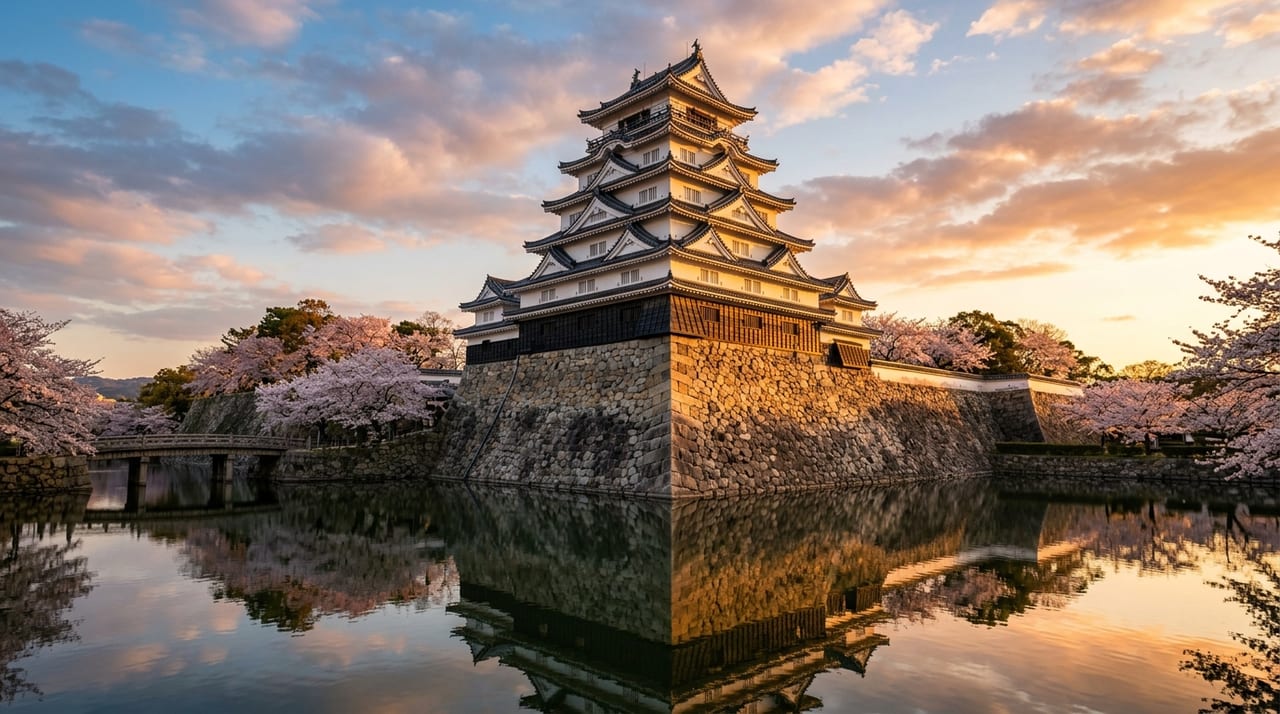
 * Image is for illustrative purposes only.
Fukuyama Castle
福山城
Fukuyama Castle is a historic castle in the Chūgoku region (Built in 1622 (Genna 8)). Its lord was Mizuno Katsunari / Abe clan.
Overview
About the Castle
Fukuyama Castle is an early-modern castle built in Genna 8 (1622) by Mizuno Katsunari, a cousin of Tokugawa Ieyasu. It is known nationwide as the castle closest to the platform of the Shinkansen station. Behind its construction was the shogunate's strategic aim of guarding against the tozama daimyō of western Japan, especially the Mōri family, and it was built with the shogunate's full financial and technical support. As a result, the castle was among the largest in western Japan, an imposing fortress with a five-story tenshu and numerous yagura and gomon. Mizuno Katsunari wandered various regions from a young age. He was a veteran fierce warrior who took part in many major battles, including the Battle of Nagakute, the Battle of Sekigahara, and the Siege of Osaka, and he earned the nickname "Oni-Hyūga."
History of Construction
The contrast between Katsunari's turbulent early life and his later years, when he governed the Fukuyama domain with good government, symbolizes an era moving from the Sengoku period to peace. In Reiwa 4 (2022), the castle marked the 400th anniversary of its construction, and its tenshu was fully renewed. The iron-plate cladding on the north side is a defensive structure that is rare even nationwide. It is said to have strengthened the north side, where mountain ranges pressed close and which had been a weak point in defense. The restored north face, clad in jet-black iron plates, vividly revives the appearance of the past and has become a topic of conversation. Fushimi Yagura and Sujigane Gomon are valuable surviving structures (Important Cultural Properties) said to have been relocated from Fushimi Castle. They are important nationwide as remains of the Fushimi Castle rebuilt by Tokugawa Ieyasu.
Connection to Swords
Fukuyama Castle stands in Bingo Province, and to the east lie Bizen Osafune and Bitchū Aoe, sword-producing regions. This location makes it a key point on the journey of sword culture. The convenience of being able to see the tenshu from the Shinkansen window makes it an ideal castle to stop at during a trip, and it is an unmatched base for touring the swords of Bizen, Bitchū, and Bingo. The castle ruins are also known as a famous cherry blossom spot. Fukuyama is also a city that includes Tomonoura, a historic port town ranked among the finest on the Seto Inland Sea. The view from this scenic harbor, looking out over the islands of the Seto Inland Sea, which was even sung about in the Man'yōshū, has captured the hearts of travelers since ancient times.
Sightseeing and Experiences
By visiting Tomonoura, also known as the stage of Sakamoto Ryōma's Iroha-maru Incident, you can appreciate the history of Bingo even more deeply. With the Reiwa renovation, Fukuyama Castle has also advanced barrier-free access, creating an environment where everyone can easily engage with history. The convenience of being able to climb the castle right after getting off the Shinkansen is a major attraction that makes it easy to stop by even during a busy itinerary.
Connection to Swords
Bingo Province, where Fukuyama Castle is located, was a region where sword production had flourished since the Kamakura period as a base of the Mihara smiths. The Mihara smiths traced their origin to Masaie, and many swordsmiths were active throughout the Muromachi period. The characteristics of Mihara blades are a style based on sugu-ha (straight temper) influenced by the Yamato-den tradition, and a sturdy construction that prioritizes practicality above all. In contrast to the flashy Bizen blades, Mihara blades possess a subdued and powerful beauty, and they earned the trust of samurai who went into battle. In Bingo Province, besides the Mihara smiths, there were also swordsmiths in places such as Onomichi, and swords circulated to various regions through maritime trade on the Seto Inland Sea. Mizuno Katsunari, lord of Fukuyama Castle, was a fierce warrior with the nickname "Oni-Hyūga," and in his youth he ran away from home and then fought in various regions as a wandering general. From Nagakute, Sekigahara, and the Siege of Osaka to the Shimabara Rebellion in his later years, Katsunari took part in nearly all the major battles from the late Sengoku period to the early Edo period, and he handled countless swords in actual combat. The Abe family, who later governed the Fukuyama domain, were a prestigious fudai daimyō house that produced rōjū such as Abe Masahiro. The Fukuyama Museum of Art holds swords from the Komatsu Yasuhiro Collection, including seven National Treasure swords. A route starting from Fukuyama Castle to visit the Bizen Osafune region is a sword journey that lets you experience the sword cultures of Bingo and Bizen all at once. The understated, practical beauty of Bingo blades reflects the essential aesthetic sense of samurai who did not seek flashiness, and the contrast with the splendor of Bizen blades is fascinating. The fact that Mizuno Katsunari governed Fukuyama with good government in his later years and was loved by its people is a rare example of a fierce warrior of the battlefield transforming into a benevolent ruler.
Highlights
- Renewed Tenshu — fully renovated in Reiwa 4, bringing the history of the Fukuyama domain to life with the latest exhibits
- Restored Iron-Plate North Face — a defense rare even nationwide, the jet-black majesty is breathtaking
- Fushimi Yagura and Sujigane Gomon (Important Cultural Properties) — valuable surviving structures said to have been relocated from Fushimi Castle
- Fukuyama Museum of Art — holds swords from the Komatsu Yasuhiro Collection, including seven National Treasure swords
- Right on foot from the Shinkansen station — exit the north exit of Fukuyama Station and the castle is right in front of you, Japan's most accessible castle
- Tomonoura (about 30 minutes by car) — a port town that has prospered since the Man'yō era, enjoy the historic scenery of the Seto Inland Sea
* Opening hours and admission fees are subject to change. Please check the official website before visiting.