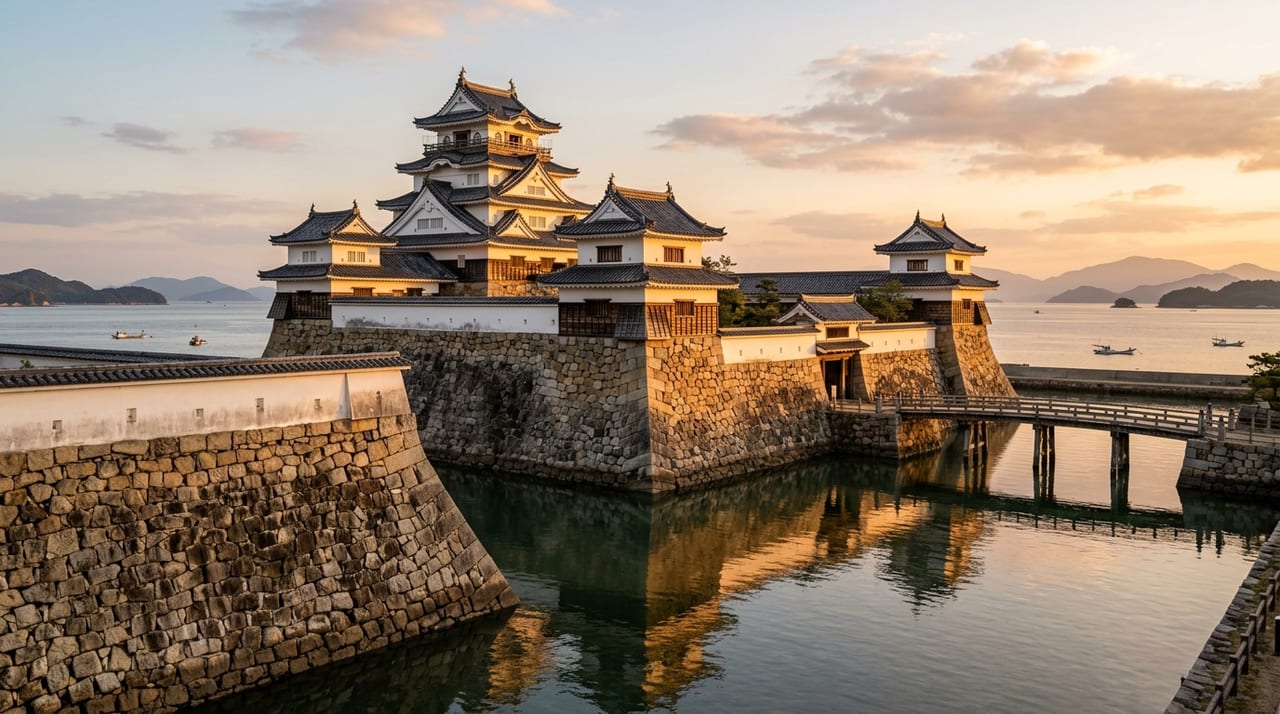
 * Image is for illustrative purposes only.
Mihara Castle
三原城
Mihara Castle is a historic castle in the Chūgoku region (Built in 1567 (Eiroku 10)). Its lord was Kobayakawa Takakage.
Overview
Ukishiro, the "Floating Castle" on the Seto Inland Sea
Mihara Castle is an early-modern water castle located in Mihara City, Hiroshima Prefecture, built along the Seto Inland Sea coast by Kobayakawa Takakage in Eiroku 10 (1567). The castle was built spanning between the mainland and an island, and because it appeared to float on the sea at high tide, it was called Ukishiro (Floating Castle). Its stone walls meet the sea directly, and its function as a "sea castle," where boats were used to enter the castle, has made Mihara Castle renowned as the foremost water castle in the Seto Inland Sea. Today, remains of the stone walls and the tenshudai (keep foundation) survive, and it is designated as a national historic site.
Kobayakawa Takakage, the Man
Kobayakawa Takakage (1533–1597) was born as the third son of Mōri Motonari, was adopted into the Kobayakawa family, and was a distinguished general who led the naval forces of the Seto Inland Sea. As one of the Mōri Ryōsen (the "two rivers" of the Mōri), he supported his father Mōri Motonari together with his elder brother Kikkawa Motoharu and contributed to the establishment of hegemony in western Japan. Takakage was known as a general combining wisdom and courage, and was one of the "Five Elders" who were also trusted in Toyotomi Hideyoshi's unification of the realm. Mihara Castle was built by Takakage as a base for the Mōri family, and it combined the function of a waterborne fortress for controlling the Seto Inland Sea's naval forces with the development of its castle town.
The Historical Significance of Mihara and Mihara Castle
Behind the construction of Mihara Castle lay the strategic aim of the Mōri family to secure control of the seas of the Seto Inland Sea. Mihara lay at a relay point of the Seto Inland Sea connecting Honshu with Shikoku and Kyushu, an ideal location as a launch base for naval forces and a collection point for supplies. Takakage directed military operations to Shikoku and Kyushu from Mihara Castle as his base, and during Toyotomi Hideyoshi's invasion of Korea (Bunroku War), as lord of Najima in Chikuzen he crossed the sea himself and drove back Ming forces at the Battle of Byeokjegwan. Blacksmiths, carpenters, and merchants gathered in the castle town of Mihara Castle, and industries supporting the maintenance and supply of the naval forces developed.
The Castle Ruins and Mihara Today
Today, the Mihara Castle ruins retain the tenshudai and stone walls, and a rare sight can be seen where the stone walls loom right beside the platform of Mihara Station on the JR Sanyo Main Line. It is known as a "castle ruin visible from the Shinkansen," and when the Sanyo Shinkansen stops at Mihara Station, the stone walls can be seen from the train window. The site has been developed as Mihara Castle Ruins Park, and from the tenshudai one can take in a panoramic view of the city and the Seto Inland Sea.
Connection to Swords
Kobayakawa Takakage and the Aesthetics of the Sword
Kobayakawa Takakage was a general excelling in military strategy, and also a man of deep accomplishment in the tea ceremony and cultural arts.
Mihara's Background as a Sword-Producing Region
Bingo Province (Hiroshima), where Mihara is located, was a region where swords of Bizen Osafune were abundantly circulated via the Seto Inland Sea. In Mihara, smiths of the Mihara school, tracing their origin to Masaie, had been active since the Kamakura period, and their works were called Mihara-mono.
Testimony of Swords from the Korean Campaigns
The Bunroku War (1592–93), in which Kobayakawa Takakage took part, also marked an important turning point for Mihara's sword culture. The army led by Takakage experienced actual combat on the Korean Peninsula, and during it many swords were used, damaged, and exchanged. After returning home, the generals refined their discernment of swords based on their battlefield experiences, and swords brought back by generals and soldiers who returned from the Korean campaigns have been passed down in various places. As a place where the memories of such historical swords are concentrated, Mihara Castle holds special meaning for sword enthusiasts.
Highlights
- The 'Floating Castle' stone walls and donjon base (National Historic Site) — once washed by tidal sea water
- Visible from the Shinkansen — stone walls rise immediately beside JR Mihara Station platforms
- Kobayakawa Takakage heritage — stronghold of one of Japan's greatest naval commanders
- Castle park hilltop views — panoramic views over Mihara city and the Seto Inland Sea
- Seto Inland Sea island excursions — ferry access to Sagi Island, Ikuchi Island, and beyond
* Opening hours and admission fees are subject to change. Please check the official website before visiting.