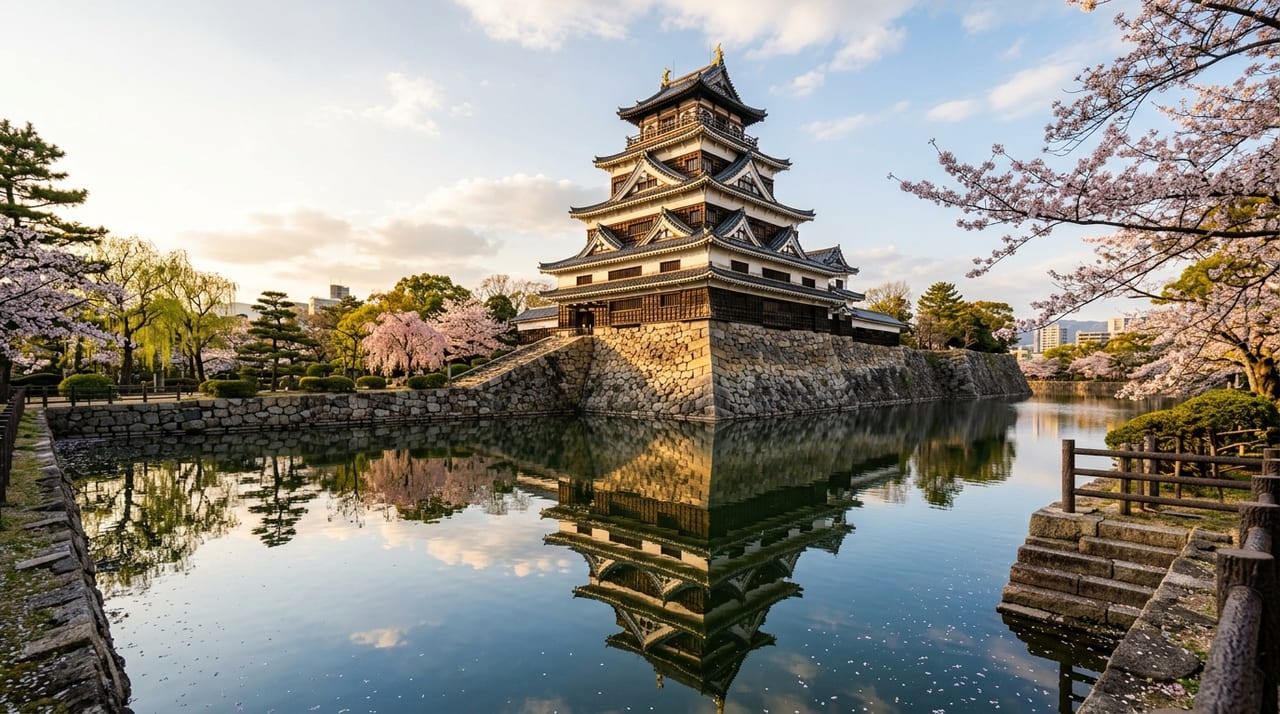
 * Image is for illustrative purposes only.
Hiroshima Castle
広島城
Hiroshima Castle is a historic castle in the Chūgoku region (Built in 1589 (Tenshō 17)). Its lord was Mōri Terumoto / Asano clan.
Overview
About the Castle
Hiroshima Castle is a large flatland castle that Mōri Terumoto, the dominant lord of the Chūgoku region, built in Tenshō 17 (1589) on the delta at the mouth of the Ōta River. It is also known by the elegant name "Rijō (Carp Castle)". Terumoto was the head of the Mōri family, the largest Sengoku-period daimyō house in the Chūgoku region. His grandfather Motonari is known for the teaching of the "Three Arrows." Terumoto was counted among the Five Elders of Toyotomi Hideyoshi. Modeling the castle on Hideyoshi's Ōsaka Castle, he built Hiroshima Castle and developed the castle town, laying the foundations for Hiroshima as a city. At the Battle of Sekigahara, Terumoto was nominally made commander of the Western Army (actual command was held by Ishida Mitsunari). After the defeat, his domains were reduced to the two provinces of Suō and Nagato.
Architecture and Structure
In his place, Fukushima Masanori was assigned to the domain. However, Masanori was dismissed from his fief after he repaired the stone walls without permission, which angered the shogunate. This incident was a symbolic event that made the strictness of the Buke Shohatto known throughout the realm. In Genna 5 (1619), Asano Nagaakira was assigned to the domain, and from then on the Asano clan governed the Hiroshima domain of 426,000 koku until the end of the Bakumatsu period. On August 6, Shōwa 20 (1945), the atomic bomb was dropped, and the main keep and all other structures collapsed in an instant. Located about 1 km from the hypocenter, Hiroshima Castle is the castle that received the catastrophe of the bombing most directly.
Present State
In Shōwa 33 (1958), the main keep was rebuilt, and its interior was transformed into a museum introducing warrior culture and the history of Hiroshima. Due to aging, however, it closed in March 2026, and now only the exterior can be viewed. Hiroshima Castle is a unique castle with a history of reconstruction after the bombing, and it conveys to future generations both the memory of war and the cultural heritage of the warrior class. The Omote-mon gate, Hiradeyagura, Tamon-yagura, and Taiko-yagura of the Ninomaru were rebuilt in wood in Heisei 6 (1994), conveying the appearance of the castle in its heyday. Its location adjoining Peace Memorial Park makes it the only place where one can experience the past and present of Hiroshima at the same time.
Battles and Warfare
The fact that Hiroshima Castle was rebuilt after the bombing reflects Hiroshima's spirit of recovery from destruction in the history of the warrior class as well. The wooden reconstructions of the Ninomaru buildings are faithfully recreated, and visitors can walk through the space of warrior culture and experience it firsthand. Hiroshima is also the gateway to Miyajima (Itsukushima Shrine). By visiting both the old battlefield where Mōri Motonari defeated Sue Harukata at the Battle of Itsukushima and the World Heritage shrine buildings, one can understand more deeply the history of martial and aesthetic traditions in the Chūgoku region. Hiroshima is also nationally known for its food culture, including okonomiyaki and oysters, and a food trip combined with a castle visit can be enjoyed as well.
The Spirit of the Warrior Way
Mōri Motonari's spirit of "Hyakuman Isshin" overlaps with the civic strength that supported Hiroshima's recovery, making it a city where the spirit of the warrior lives on in the present day. Hiroshima Castle is an indispensable base for understanding the history of the Chūgoku region. In one place, one can experience the grand story of the Mōri family, from their unification of the Chūgoku region through the bombing and reconstruction.
Connection to Swords
Mōri Terumoto, who built Hiroshima Castle, was the grandson of Mōri Motonari, the dominant lord of the Chūgoku region, and the Mōri family had handed down many famous swords accumulated from Motonari's era onward. Motonari is known as a wise strategist for the teaching of the "Three Arrows," but he was also a warlord rich in combat experience, having defeated Sue Harukata at the Battle of Itsukushima (1555), and he acquired many swords through battle. The Mōri family passed down a household tradition that valued martial arts across generations and was also enthusiastic about collecting swords. Sword smiths had been active in Aki Province (western Hiroshima Prefecture) since long ago, and Aki swords were known for their sincere, straightforward style. Bingo Province (eastern Hiroshima Prefecture) was an even more important sword-producing region and was the base of a group of smiths known as the Mihara smiths. The Mihara smiths traced their origins to Masaie in the Kamakura period and produced large quantities of practical swords throughout the Muromachi period. The characteristic of Mihara swords lies not in splendor but in a solid style that pursues reliability in actual combat, and their quality was widely trusted by warriors of the Chūgoku region. The Asano clan, which governed the Hiroshima domain, was also a distinguished tozama daimyō house, and it maintained a high-quality sword collection that included works transmitted from the Kishū Asano family. Hiroshima Castle's main keep closed in March 2026, and the swords and armor displayed inside the keep will be moved to the Hiroshima Castle Sannomaru History Museum, scheduled to open in June 2027. The Fukuyama Museum of Art (Fukuyama City) exhibits works by Bingo and Mihara smiths, and visiting it together with Hiroshima Castle allows a comprehensive understanding of the sword culture of Aki and Bingo. Hiroshima is a rare city with two distinct historical layers, the history of the bombing and the cultural heritage of the warrior class, and the meaning of visiting Peace Memorial Park and Hiroshima Castle on the same day is profound. War and peace, destruction and reconstruction, the history of martial arts and the prayer for peace: Hiroshima Castle condenses these contrasting themes into one place.
Highlights
- Restored main keep — a unique castle rebuilt after the bombing. Closed in March 2026; only the exterior can currently be viewed
- Ninomaru restored structures — Omote-mon gate, Hiradeyagura, Tamon-yagura, and Taiko-yagura rebuilt in wood
- Moats and stone walls — vast moats fed by water from the Ōta River, evoking the scale of the castle in the Mōri era
- Hiroshima Gokoku Shrine — a famous shrine for New Year's visits enshrined within the castle grounds, a guardian of martial fortune
- Peace Memorial Park (adjacent) — Atomic Bomb Dome and Peace Memorial Museum, experience Hiroshima's past and future
- Fukuyama Museum of Art (Fukuyama City) — displays swords by Bingo and Mihara smiths, a sword journey from Aki to Bingo
* Opening hours and admission fees are subject to change. Please check the official website before visiting.