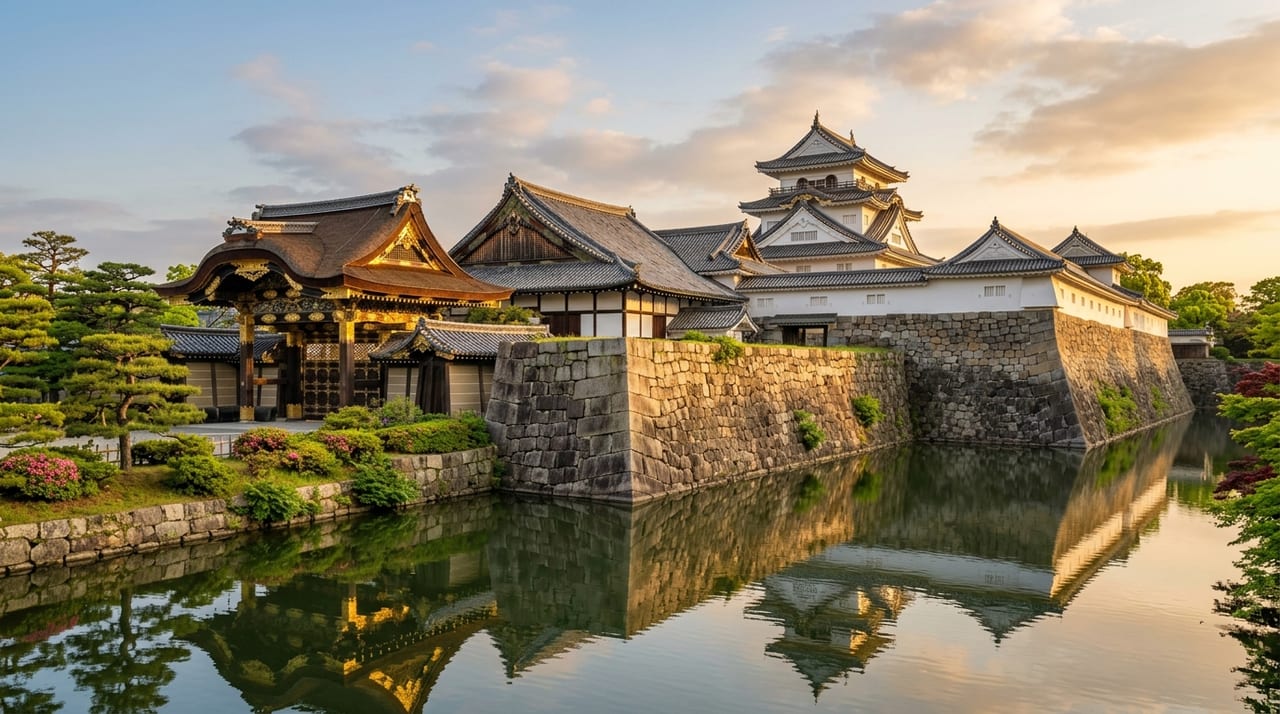
 * Image is for illustrative purposes only.
Niitakayama Castle
新高山城
Niitakayama Castle is a historic castle in the Chūgoku region (Said to have been founded in the Kamakura period as a subsidiary castle of Takayama Castle; after 1552 (Tenbun 21), expanded and developed by Kobayakawa Takakage; abandoned in 1596 (Keichō 1)). Its lord was Kobayakawa clan (notably Kobayakawa Takakage).
Overview
Overview
Niitakayama Castle was a medieval mountain castle in Hongō, Mihara City, Hiroshima Prefecture. Built on Mount Niitakayama (elevation 197.6 m) on the west bank of the Numata River, it was a stronghold forming a pair with Takayama Castle on the opposite bank. It is said to have begun in the Kamakura period, when Kobayakawa Masahira, the fifth generation of the Kobayakawa clan, built it as a subsidiary castle to the main castle, Takayama Castle. From 1552 (Tenbun 21) onward, Kobayakawa Takakage, the third son of Mōri Motonari who succeeded to the Kobayakawa household, thoroughly developed and expanded this castle, and for the following 45 years it served as the main castle of the Kobayakawa clan.
Structure
The castle was a large mountain fortress in which the entire mountain was fortified. The main enclosure (honmaru) was placed on the summit, enclosures (kuruwa) were arranged on terraced levelled ground stepping down the slope, and at the foot of the mountain the Kobayakawa clan also established a naval base. Remains of enclosures such as the Honmaru, Naka-no-maru and Tsurui-no-dan survive, and in the Honmaru, earthen rampart remains of a masugata and foundation stones of buildings can be seen.
Current Status
In 1596 (Keichō 1), when Takakage moved his main base to Mihara Castle, facing the Seto Inland Sea, Niitakayama Castle was abandoned. The Niitakayama Castle site, together with the Takayama Castle site (the former main base of the Kobayakawa clan) and the Mihara Castle site (to which Takakage newly moved), was designated a national historic site in 1957 as the “Kobayakawa Clan Castle Ruins,” and in 2017 it was selected for the Continued Top 100 Japanese Castles.
Connection to Swords
A katana known as “Namikuguri Munechika” (blade length 2 shaku 2 sun 5 bu, about 68.2 cm; signed “Munechika”) is said to have been carried by Kobayakawa Takakage, who made Niitakayama Castle his main base. It is traditionally attributed to the smith Sanjō Munechika, regarded as the founder of the Sanjō school. In the early Meiji period it was reportedly held by Katada Shōsuke, a shizoku (former samurai) temporarily residing in Yamaguchi town, but its subsequent whereabouts are unknown. As one of the “Two Rivers” of the Mōri (Kikkawa and Kobayakawa), who commanded the navy of the Seto Inland Sea and who was also ranked among the Five Elders under the Toyotomi regime, Takakage found that carrying a famous blade was an important means of displaying his authority as a warrior.
Highlights
- Honmaru site — the central enclosure of the Kobayakawa main base, built on the summit
- Masugata earthworks and foundation stones — remains preserved in the Honmaru
- Kobayakawa Clan Castle Ruins (national historic site) — designated together with the Takayama Castle site and the Mihara Castle site
- Naval base site — the base of the Kobayakawa navy established at the foot of the mountain
- Continued Top 100 Japanese Castles — selected in 2017
* Opening hours and admission fees are subject to change. Please check the official website before visiting.