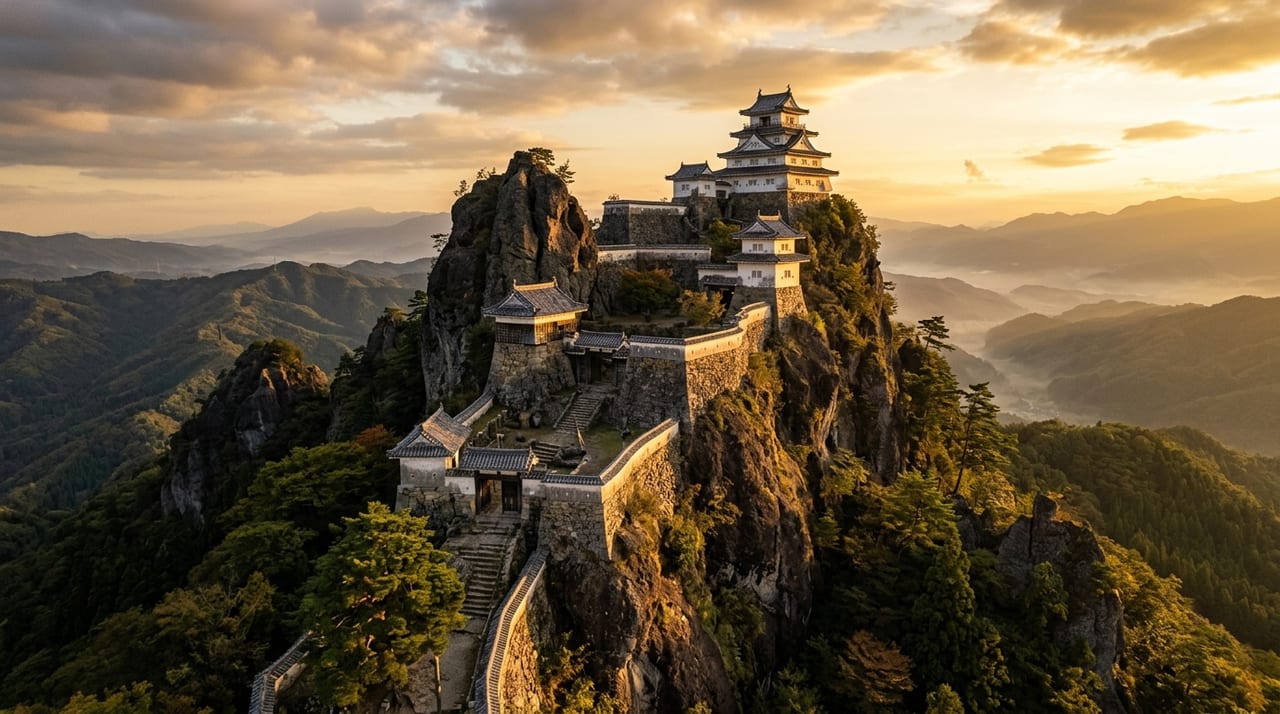
 * Image is for illustrative purposes only.
Kinojo Castle
鬼ノ城
Kinojo Castle is a historic castle in the Chūgoku region (Asuka to Nara period (late 7th to early 8th century)). Its lord was Yamato Court (constructed in the latter half of the 7th century).
Overview
Overview and Location
Kinojō is an ancient mountain fortress located in Sōja City, Okayama Prefecture. It was built on the summit of Mt. Kinojō (Kinojōzan), at an elevation of 397 meters, and is a large-scale fortress site with a wall approximately 2.8 kilometers in length encircling the area. Rammed-earth ramparts (approximately 7 meters wide and 6 to 7 meters high) make up more than 80% of the walls. Four gates, six water gates, corner towers (sumiyagura), foundation-stone building remains and other features have been confirmed. It was designated as the national historic site "Kinojōzan" in 1986, and in 2006 it was selected as No. 69 of Japan's 100 Castles.
Korean-Style Mountain Fortress of the Late 7th Century
Kinojō is one of the ancient mountain fortresses classified as a Korean-style mountain fortress (or a fortress influenced by that style). No historical records (the Nihon Shoki or the Shoku Nihongi) mention it, and there are no reliable documents on who built it or when. However, excavations (ongoing investigations by the Sōja City Board of Education and the Okayama Prefectural Board of Education) have dated remains within the castle to the period from the Asuka IV phase (the fourth quarter of the 7th century) to the early Nara period, and construction in the latter half of the 7th century is considered the most likely.
The latter half of the 7th century falls in the period immediately after the Battle of Baekgang (Hakusukinoe) (663), in which the combined forces of the Yamato court and Baekje suffered a crushing defeat at the hands of the combined Tang and Silla forces. Following this defeat, the court rapidly strengthened its defenses against invasion from the continent and built mountain fortresses one after another at key points from Tsushima and northern Kyushu to the Kinai region, such as Ōno Castle, Kii Castle and Kaneda Castle. Kinojō is considered to be one of the castles on this defensive line, and the participation of technicians from the Korean Peninsula in its construction has been suggested.
Structural Features
Kinojō's walls consist of ramparts extending about 2.8 kilometers along the summit ridgeline in a roughly symmetrical pattern, east-west and north-south. Most are rammed-earth ramparts built with the rammed-earth construction method (a method of compacting soil in layers), although sections combining stone masonry have also been confirmed. The West Gate is believed to have been the main entry route, and its roofed gate building has been reproduced through current restoration work.
Six water gates are provided, which drain water flowing down the valleys out of the castle while preventing intrusion from outside. A "first paved stone remains in Japan" has been confirmed, indicating that advanced civil engineering techniques influenced by continental technology were employed. Remains of seven foundation-stone buildings have been confirmed within the castle, and traces of a forge workshop (with 12 hearth remains), storage facilities and beacon sites (hōkadai, signal-fire platforms) have also been found inside.
Demon Legends and the Momotarō Tale
Kinojō is a castle closely tied to the legend of Ura. Ura is said to have been a descendant of a royal lineage from the Korean Peninsula (Baekje), who used Kinojō as a base to rule Kibi Province and plundered passing ships. In response, Ōkibitsuhiko-no-Mikoto, said to be a son of Emperor Kōrei, was dispatched to defeat Ura, and this battle is said to have become the origin of the founding legend of Kibitsu Shrine and the Momotarō tale.
From an academic standpoint, the Ura legend is interpreted as a tale reflecting the clash and fusion between migrants (technician groups of Baekje and Silla origin) and local power. This is consistent with the involvement of migrant civil engineering and architectural technology in the construction of Kinojō.
Forge Workshops and Ironware Production
One of Kinojō's most distinctive features is the traces of a forge workshop discovered inside the castle. Excavations have confirmed as many as 12 forge hearth (kajiro) remains, revealing that iron product manufacturing was carried out systematically within the castle. Excavated artifacts include tuyères (haguchi), iron slag, nails, yariganna (spear-shaped planes) and whetstones, suggesting that the making and maintenance of ironware played part of the castle's function.
This indicates a character not as a purely military base but as a composite mountain fortress equipped with production facilities. The discovery of a forge workshop built into a mountain fortress of the late 7th century is a significant example of the integrated operation of ironware production and military bases in ancient Japan. It is extremely noteworthy from the perspective of archaeology and sword history.
Abandonment and Later Legacy
Researchers describe Kinojō as having "fulfilled its mission in a very short period," and it is thought to have ceased its main defensive functions around the early 8th century. The main cause of its abandonment (cessation of function) is considered to be the easing of tensions between Japan and Tang and Silla, several decades after the Battle of Baekgang.
After it was abandoned, Mt. Kinojō was revered as a sacred mountain of Kibi Province. In later ages it became the background of demon legends across various regions, as "a mountain where demons live." In modern times, Sōja City has advanced development of the castle site under its "outdoor museum of history and nature" concept, and the West Gate, corner tower and rammed-earth ramparts have been restored and opened to the public.
Current State and Highlights
At the maintained castle site, visitors can view the West Gate (a restored gate building), the corner tower (a restored stone masonry structure) and the rammed-earth ramparts. From the summit of the castle mountain, the scenery of Kibiji can be seen in full, and on clear days even the distant Seto Inland Sea is visible. The Kinojōzan Visitor Center, operated by Sōja City (located alongside the parking area), explains the display of excavated artifacts and the results of the archaeological investigations. It allows a deep understanding of Kinojō from both the perspectives of ancient mountain fortresses and demon legends.
Access is about 5 kilometers (mountain road) from Hattori Station on the JR Kibi Line, but taking a taxi from Sōja Station (about 30 minutes) is recommended. Parking is available near the summit.
Connection to Swords
The 12 forge hearth remains discovered inside the castle are archaeological evidence of ironware production in a mountain fortress of the late 7th century. The excavated artifacts (tuyères, iron slag, nails, yariganna, whetstones) suggest the making of ironware within the castle. The construction of the castle by migrant technicians (of Baekje origin) and the introduction of forge technology is an important example illustrating the reception of continental technology in the history of Japanese swords.
Highlights
- National Historic Site; Japan's 100 Famous Castles (No. 69)
- Korean-style mountain castle of the late 7th century (no chronicle records; date established through excavation)
- Twelve smithing furnace pits (archaeological evidence of iron production within the castle)
- Reconstructed West Gate, corner tower, and rammed-earth ramparts (outdoor museum concept)
- Origin of the Ura legend and the Momotarō (Peach Boy) folktale
* Opening hours and admission fees are subject to change. Please check the official website before visiting.