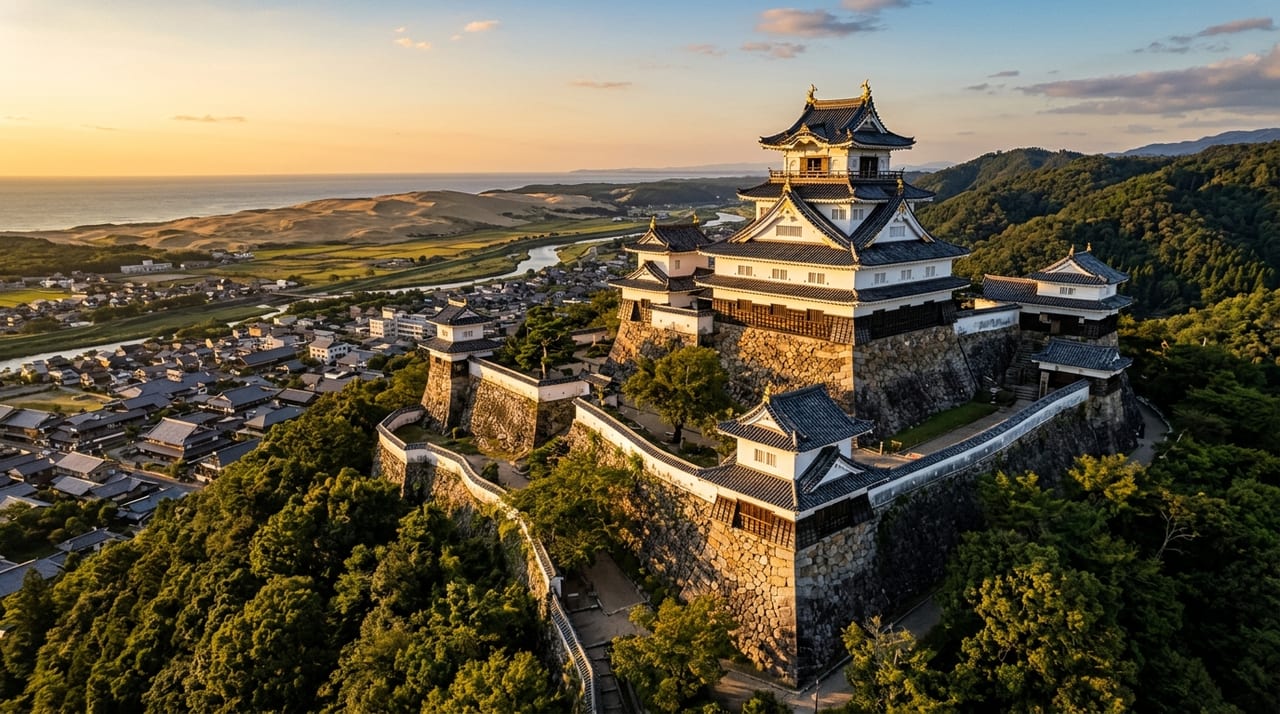
 * Image is for illustrative purposes only.
Tottori Castle
鳥取城
Tottori Castle is a historic castle in the Chūgoku region (Built around the Tenbun era (1532–1555)). Its lord was Yamana Toyokuni / Kikkawa Tsuneie / Ikeda Mitsumasa / Ikeda Mitsunaka (hereafter the Ikeda family of Tottori domain).
Overview
About the Castle
Tottori Castle is a multi-part castle complex in the central part of Inaba Province. It consists of a mountain castle built on Mount Kyūshō (Kyūshōzan, elevation 263 meters) and the second and third enclosures (ni-no-maru and san-no-maru) laid out at its foot. It is said to have been built around the Tenbun era (1532–1555) by the Inaba Yamana clan. During the Sengoku period, Takeda Takanobu, Yamana Toyokuni and others served as castellans. In Tenshō 9 (1581), Hashiba (Toyotomi) Hideyoshi carried out the "Tottori no Katsue-goroshi" (Tottori Starvation Siege), forcing the castle to surrender through a starvation siege. It is known as a grisly siege in which castle troops and domain residents died of hunger. This siege is recorded in history as the most cruel example of a starvation siege in Japanese history.
The Ikeda Family and Dune Culture
After the Battle of Sekigahara, Ikeda Nagayoshi entered Tottori Castle with 60,000 koku and remodeled it into an early modern castle. Later, in Genna 3 (1617), Ikeda Mitsumasa entered with 320,000 koku of Inaba and Hōki provinces. The castle was improved and expanded and became the center of domain government in Inaba. In particular, Ikeda Mitsumasa served as lord of Tottori domain and then became lord of Okayama domain. He is renowned as a wise lord and worked to promote scholarship and martial arts. In Kan'ei 9 (1632), he exchanged domains with Ikeda Mitsunaka of Okayama, and thereafter the line of Mitsunaka served as lords of Tottori domain until the Meiji Restoration. The Tottori Sand Dunes, spreading along the Sea of Japan coast near Tottori Castle, are among the largest sand dunes in Japan and symbolize the natural environment unique to Inaba Province.
Hashiba Hideyoshi's Starvation Siege
The siege of Tottori Castle in Tenshō 9 (1581) is a particularly famous operation among Hideyoshi's campaigns in the Chūgoku region. Hideyoshi made careful advance preparations, buying up rice around Tottori at high prices so that the castle's provisions would run out. Inside the castle, starvation deaths occurred one after another. Castellan Kikkawa Tsuneie committed suicide on condition that the castle troops be spared, and the castle surrendered. This battle has both aspects, "victory through strategy" and "a grim outcome." It is handed down as a historical event that shows the tension between Hideyoshi's cold-blooded military strategy and humanitarian issues.
Inaba Swordsmiths and Hōki Yasutsuna
Hōki Province (present-day western Tottori Prefecture), next to Inaba Province where Tottori Castle stands, is one of the sacred places of Japanese swords. Hōki Yasutsuna was a sword smith of Hōki Province in the Heian period, and is said to have forged "Dōjigiri Yasutsuna," which is considered one of the "Five Great Swords of Japan." Dōjigiri Yasutsuna is a famous legendary blade said to have been used by Minamoto no Yorimitsu to slay the oni Shuten Dōji of Ōe Mountain. It is now a National Treasure held by the Tokyo National Museum. The Tottori and Hōki region holds a unique place in the history of Japanese swords as a place that produced top-level sword smiths from the dawn of Japanese swordmaking.
Connection to Swords
Inaba Province, where Tottori Castle is located, and the neighboring Hōki Province (present-day Tottori Prefecture) are among the most important regions in the history of Japanese swords. The legendary swordsmith Hōki Yasutsuna, who was active in Hōki Province, is said to have been active in the Heian period. The sword attributed to him, "Dōjigiri Yasutsuna," is one of the "Five Great Swords" (Dōjigiri Yasutsuna, Mikazuki Munechika, Ōtenta Mitsuyo, Juzumaru Tsunetsugu and Onimaru Kunitsuna) and is positioned as a famous blade at the pinnacle of Japanese sword history. Dōjigiri Yasutsuna carries the legend that Minamoto no Yorimitsu used it when he defeated Shuten Dōji. It has been treasured as an ancient tachi of the highest standard. It is now a National Treasure held by the Tokyo National Museum. In the Edo period, when the Ikeda family governed the domain, Ikeda Mitsumasa encouraged martial arts and scholarship as a wise lord in both the Okayama and Tottori domains. The Tottori Prefectural Museum, built on the site of Tottori Castle, holds materials related to the Ikeda family, where visitors can experience the depth of the sword culture of Inaba and Hōki since the time of Hōki Yasutsuna.
Highlights
- Mountain castle ruins at the summit of Mount Kyūshō: a panoramic view of the Tottori Plain and the Sea of Japan from the 263-meter summit. Hiking trail available
- Jinpūkaku: a Meiji-era Western-style building and former guest house of the Ikeda marquis family. National Important Cultural Property
- Tottori Sand Dunes: among the largest sand dunes in Japan. About 15 minutes by car from the castle. Japan's mysterious natural landscape
- Tottori Prefectural Museum: located on the castle grounds; displays historical materials of Tottori, including materials related to the Ikeda family
- Naka-no-Gomon and Giboshi Bridge: a gate and bridge on the Ōte approach route, reconstructed in wood. The changes in stone-wall techniques, from nozura-zumi (rough-faced masonry) to kirikomi-hagi (cut-fitted masonry), can also be seen
* Opening hours and admission fees are subject to change. Please check the official website before visiting.