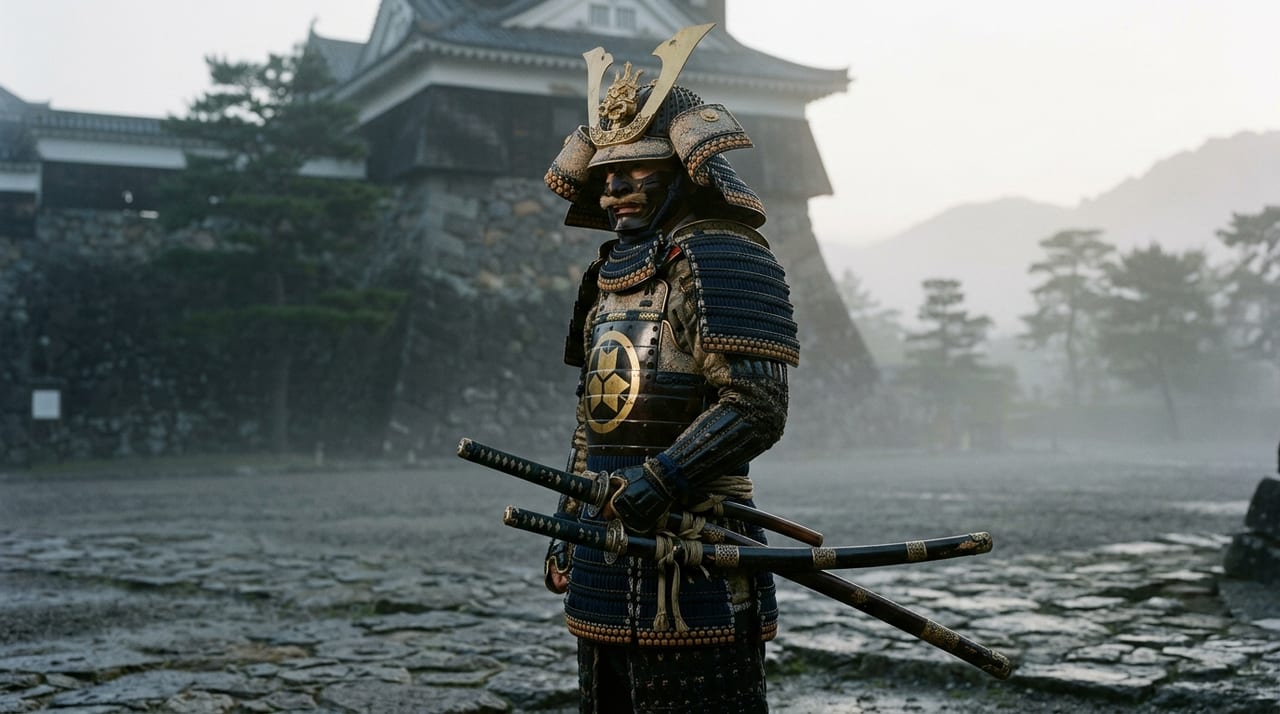
 * Image is for illustrative purposes only.
Mōri Terumoto
毛利輝元
Lord of the Chūgoku Region: The Mōri Heir Grandson Who Continued Motonari's Legacy and Faced Sekigahara as Supreme Commander of the Western Army
Description
Inheriting Motonari's Legacy
In Tenbun 22 (1553), Mōri Terumoto was born in Aki Province. He was the grandson and direct heir of the wise commander Mōri Motonari, renowned for the Lesson of the Three Arrows, and succeeded to the position of 14th head of the Mōri clan. His grandfather Motonari had asserted hegemony over ten provinces of the Chūgoku region through battle-hardened strategy, but after Motonari's death, the heavy responsibility of maintaining and developing that vast legacy fell upon Terumoto's shoulders. Terumoto did not possess his grandfather's outstanding strategic talent, but on the foundation of the Mōri Ryōsen system (a support structure formed by the Kikkawa and Kobayakawa families), which his grandfather had left behind, he achieved a certain measure of success in maintaining the power of the Mōri house.
Position under the Toyotomi Regime
In the process of Toyotomi Hideyoshi's unification of the realm, the Mōri house was compelled to submit to the Oda and Toyotomi, yet it continued to hold its position as a great daimyo of western Japan. Terumoto took part in the central council of the Toyotomi regime as one of the Council of Five Elders and also played an important role in the Korean campaigns. Deeply trusted by Hideyoshi, Terumoto was, in the period surrounding the later Battle of Sekigahara as well, a great daimyo boasting the largest koku assessment in western Japan, and his political influence was immeasurable. Within the Council of Five Elders system, Terumoto maintained connections with both the military faction and the administrative faction, and while Hideyoshi was still living, he skillfully sustained his position.
Supreme Commander of the Western Army at Sekigahara
In the Battle of Sekigahara in Keichō 5 (1600), Terumoto responded to the call of the three magistrates (Maeda Gen'i, Mashita Nagamori, and Natsuka Masaie), entered Osaka Castle, and was proposed as supreme commander of the Western Army. However, Terumoto himself did not go to the main battlefield of Sekigahara and remained at Osaka Castle. This decision (or indecisiveness) later drew great criticism. When the Western Army was defeated, Terumoto left Osaka Castle in exchange for a promise of confirmation of his territories. However, it was discovered that he had commanded the Western Army as its supreme commander, and the promise was nullified. Although he escaped forfeiture thanks to the efforts of Kikkawa Hiroie and others, his territories were greatly reduced (from approximately 1.12 million koku to approximately 300,000 koku in the two provinces of Suō and Nagato), and the Mōri house came to continue as the Chōshū (Hagi) Domain.
Founding of the Chōshū (Hagi) Domain and Sword Culture
The Chōshū (Hagi) Domain, which Terumoto effectively founded, functioned throughout the Edo period as a latent base opposed to the Tokugawa, and eventually came to play a central role in the anti-Tokugawa movement as the Chōshū Domain of the late Edo period. In this sense, Terumoto's political choice became a distant foreshadowing of the Meiji Restoration, the greatest transformation in Japanese history, which came 270 years later. Terumoto was also an enthusiastic sword collector, and it is said that he asked Hon'ami Kōtoku, whose family business was sword appraisal, to make a copy of the Katana Ezu (sword drawings), and had it sent to him.
Famous Swords Associated with Terumoto
Among the famous swords associated with Terumoto is the tanto 'Mōri Tōshirō' by Awataguchi Yoshimitsu. Its name derives from Terumoto's possession of it, and it is currently held by the Tokyo National Museum. Many points about the process by which it was transmitted within the Mōri house remain unclear, but it has also been suggested that it may have been a treasured heirloom passed down through generations of the Mōri house. Additionally, Itsukushima Shrine preserves a long and splendid lacquer-painted daishō mounting (jintō, campaign sword) that is said to have been dedicated by Terumoto.
Later Years and Legacy
After Sekigahara, Terumoto shaved his head and nominally handed the headship of the house to his eldest son, Hidenari. He nonetheless continued to conduct domain administration as the de facto head, and formally handed over the headship in Genna 9 (1623). In Kan'ei 2 (1625), Terumoto died at the age of 73. His reputation has been subject to both praise and criticism, and he tends to be overshadowed by the great achievements of his grandfather Motonari. Yet his realistic judgment in surviving the harsh Sengoku period and keeping the Mōri house alive should be valued as a kind of political talent. The fact that the Mōri house continued until the end of the Edo period and ultimately became the driving force behind the Meiji Restoration is a result that might not have been realized without Terumoto's choices.
Notable Swords
- Mōri Tōshirō (a tanto by Awataguchi Yoshimitsu, named for its having been possessed by Terumoto, and currently held by the Tokyo National Museum)
- lacquer-painted daishō mounting (jintō, campaign sword) (a long and splendid campaign-sword mounting said to have been dedicated by Terumoto to Itsukushima Shrine)