New Arrivals — Browse our catalog for the latest authentic Japanese sword arrivals. Browse →
9th month of Tenbun 9 (1540) – 1st month of Tenbun 10 (1541)
Kōriyama Castle, Yoshida, Aki Province (present-day Yoshida Town, Akitakata City, Hiroshima Prefecture)
Forces
Amako Forces
Mōri Forces (Aki coalition)
About 16 min read
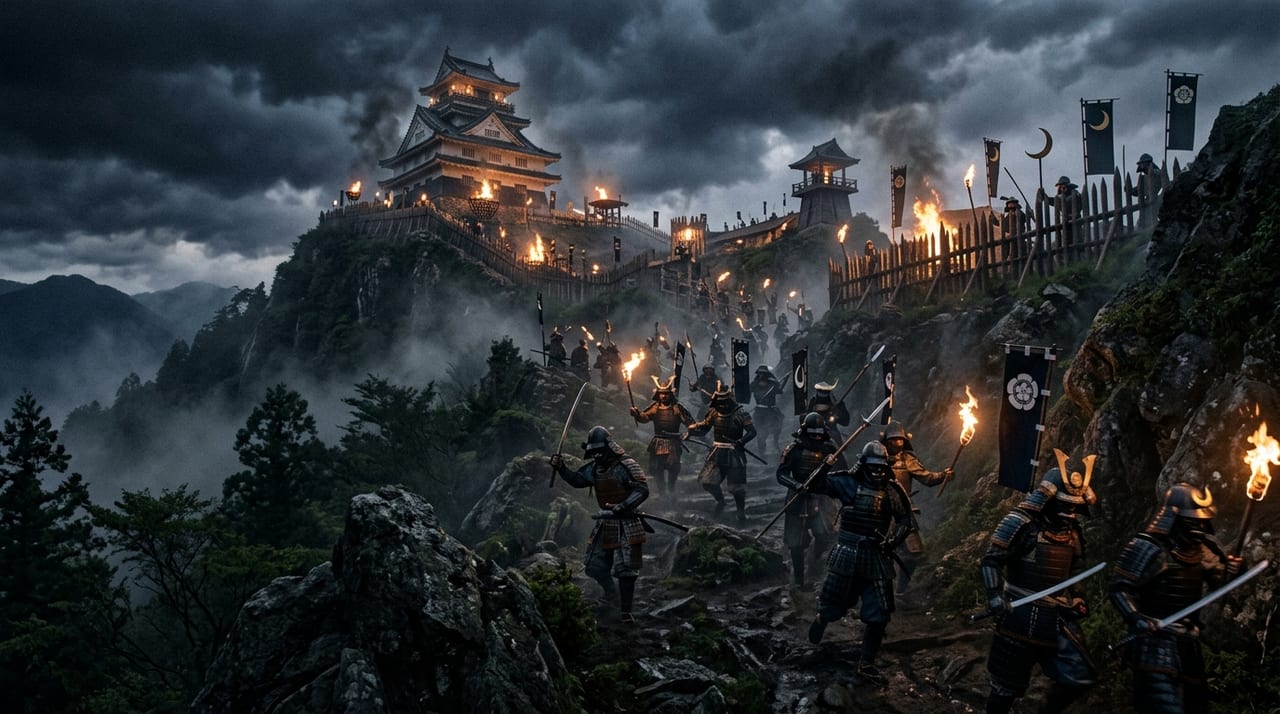
The Battle of Kōriyama in autumn of Tenbun 9 (1540), fought at Kōriyama Castle in Yoshida, Aki Province (present-day Akitakata, Hiroshima Prefecture), was the decisive battle in which Mōri Motonari emerged as a renowned commander of the Sengoku period. Facing a massive army led by Amako Akihisa (later known as Amako Haruhisa), the great warlord of Izumo, Motonari made a stand in Kōriyama Castle with merely a few thousand troops. Through skillful siege defense and aggressive sorties outside the castle and counterattacks, he repelled a formidable enemy. This victory marked a historical turning point, as the Mōri clan evolved from a local power in Aki Province into the supreme hegemon of the Chūgoku region.
Mōri Motonari was born in Meio 6 (1497) as the second son of Mōri Hiromoto, a provincial lord of Aki. Known for his intelligence from childhood, Motonari inherited the Mōri clan leadership after the successive deaths of his elder brother Okimoto and Okimoto's son Kōmatsumaru. Initially, he maneuvered skillfully for survival between two great powers—the Amako and the Ōuchi.
Motonari's nature was that of the "boushō" (master strategist)—a Sengoku daimyo who achieved victory through intrigue and cunning rather than raw military might. The tactics Motonari displayed at the Battle of Kōriyama were a consummate demonstration of his character as a true master strategist.
In Tenbun 9 (1540), Amako Akihisa determined to launch a major campaign southward into Aki Province. The Amako clan, based in Izumo Province (present-day Shimane Prefecture), was a great power of the San'in region, commanding many provincial lords and warlords of the Chūgoku region under their dominion. Amako Akihisa sought to establish hegemony over the Chūgoku region by inheriting the great legacy of his grandfather Amako Tsunehisa, and the Mōri clan of Aki stood as a barrier in his path.
The Amako army that marched toward Kōriyama Castle numbered, according to historical records, approximately 30,000 troops. The Mōri army, by contrast, consisted of merely a few thousand—a disparity that should have made victory for the smaller force impossible by simple arithmetic. Yet Motonari refused to abandon the castle and flee; instead, he chose to conduct a siege defense within Kōriyama Castle.
Kōriyama Castle was a mountain stronghold, and its rugged terrain provided the conditions for a small garrison to resist a much larger force. Motonari rallied the surrounding provincial lords, requested military reinforcements from the Ōuchi clan, and adopted a strategy of prolonged attrition warfare.
The tactical hallmark of the Battle of Kōriyama was Motonari's deployment of aggressive sorties beyond the castle walls and counterattacks even while defending the castle. Through this paradoxical tactic of "attacking while defending," he progressively wore down the enemy's morale and supply lines.
The Mōri forces repeatedly repelled the Amako army through ambushes and sorties beyond the castle, and at the Battle of Aoyama-Tsuchitoriba they even broke through the outer palisade of the Amako main camp. The arrival of reinforcements from the Ōuchi clan further made it difficult for the Amako to sustain a prolonged siege.
After several months of siege, the Amako army was forced to withdraw. For Amako Akihisa, it was an unexpected and devastating defeat, and his subsequent campaigns into Aki Province were severely constrained.
There were also sword-producing areas around the battlefield of the Battle of Kōriyama—Aki Province (present-day western Hiroshima Prefecture). Though Bizen Province (present-day eastern Okayama Prefecture), farther east, stands without question as the greatest sword-producing region, with its renowned "Bizen Osafune" tradition, the sword smiths of neighboring Bingo (present-day eastern Hiroshima Prefecture) also developed their own distinct traditions.
The sword smiths of "Mihara in Bingo Province" are known as a production center with a tradition stretching back to the Northern and Southern Courts period. The generals and warriors under Mōri Motonari in Aki and Bingo are believed to have carried fine blades forged by local smiths of these regions onto the battlefield.
Of particular note is the relationship between the Mōri and the Ōuchi clans. Ōuchi Yoshitaka, based in Suō Province (present-day Yamaguchi Prefecture), sent reinforcements to support Motonari during the Battle of Kōriyama. The Ōuchi clan, backed by substantial economic power, maintained high standards in the collection of martial equipment, including swords, and it is believed that the Ōuchi reinforcements included elite troops equipped with superior weapons.
Mōri Motonari is known as a man of intrigue, one who prioritized information warfare and strategy over direct military might through swordplay. This does not mean, however, that he scorned the sword.
As a Sengoku daimyo seeking to demonstrate his power and capability, Motonari understood both the practical utility and the symbolic significance of the sword.
The victory at the Battle of Kōriyama elevated Motonari's renown both within and beyond Aki Province, and it laid the foundation for the subsequent rise of the Mōri clan—the destruction of Sue Harukata at the Battle of Itsukushima (1555) and the conquest of Gassantoda Castle, which led to the extinction of the Amako clan. Through strategy and courage, the Mōri clan repelled their formidable enemies. The Battle of Kōriyama is remembered as the most crucial turning point of the Chūgoku region in an era when the Japanese sword held the stage of the battlefield.
Amako Akihisa, the leader of the Amako forces at the Battle of Kōriyama, was the grandson of Amako Tsunehisa, who was known as a "master strategist" and matched Motonari in cunning. Izumo Province (present-day Shimane Prefecture), the base of the Amako clan, was known as a source of iron produced through tatara smelting.
The swords carried by the soldiers and generals of the Amako army are believed to have included many blades forged by sword smiths of Izumo and Hōki. The Battle of Kōriyama thus bore the character of a confrontation between the Amako forces, backed by the sword culture of Izumo, and the Mōri army, rooted in the sword-culture sphere of Aki and Bingo.
After the Battle of Kōriyama, Mōri Motonari steadily expanded his power. In Tenbun 24 (1555), at the Battle of Itsukushima, Motonari defeated the massive army of Sue Harukata through ingenious strategy exploiting the island's terrain, establishing Mōri hegemony over the western Chūgoku region. The stratagems Motonari employed in the Battle of Itsukushima—nocturnal surprise attacks, exploitation of terrain, and taking advantage of enemy complacency—were developments of the tactics he had honed in the Battle of Kōriyama.
The Mōri clan, having subdued the Chūgoku region, amassed celebrated swords from Bizen, Bichū, and Bingo. The Mōri clan subsequently endured as a powerful daimyo under the Toyotomi regime and became the lords of Chōshū Domain (present-day Yamaguchi Prefecture) during the Edo period. During the late Edo period, Chōshū samurai carried swords while leading the movement to overthrow the shogunate—even 300 years after the Battle of Kōriyama, the sword continued to drive history in the lineage of the Mōri.
Today, the ruins of Kōriyama Castle (Mōri clan castle ruins) in Yoshida, Akitakata City, Hiroshima Prefecture are preserved and managed as a national historic site, where visitors can see the remains of Motonari's residence and the castle's main enclosure. The city also houses the Akitakata City Museum of History and Folklore, which displays materials related to the Mōri clan.
Standing at the battlefield of the Battle of Kōriyama and gazing upon the terrain of that era, one intuitively understands why Motonari chose this location for his siege defense strategy. The Yoshida basin, encircled by the harsh ridge lines of mountains, is unsuitable for deploying large armies and provides advantageous conditions for the defending side. To truly understand Sengoku-period battles, one must visit the actual locations, not merely consult historical records. The Kōriyama site is an outdoor classroom where one can learn the essence of the master strategist Mōri Motonari's strategic genius. For enthusiasts of the Japanese sword, Akitakata City is an indispensable destination in their quest to explore the wellspring of sword culture in the Chūgoku region. Reflecting upon the age of the Sengoku period, when swords shone brightest, from this ground where Motonari repelled enemies many times his number, offers the finest experience for deeply understanding the spiritual value of the Japanese sword.
Mōri Terumoto
Mōri Motonari's grandson who inherited the domain built on the Kōriyama victory
Mōri Motonari
Defender of Kōriyama Castle who repulsed the massive Amako invasion through strategic brilliance
Kikkawa Motoharu
Kikkawa Motoharu — Mōri Motonari's second son who benefited from the foundation laid at Kōriyama
Kobayakawa Takakage
Kobayakawa Takakage — Mōri Motonari's third son who inherited the Kōriyama legacy
Ōuchi Yoshitaka
Ōuchi Yoshitaka — the great Suō daimyo who sent relief forces to Mōri against the Amako at Kōriyama