 * Image is for illustrative purposes only.
Dōjigiri Yasutsuna
童子切安綱
Also known as: Dōjigiri; Onikiri no tachi
Description
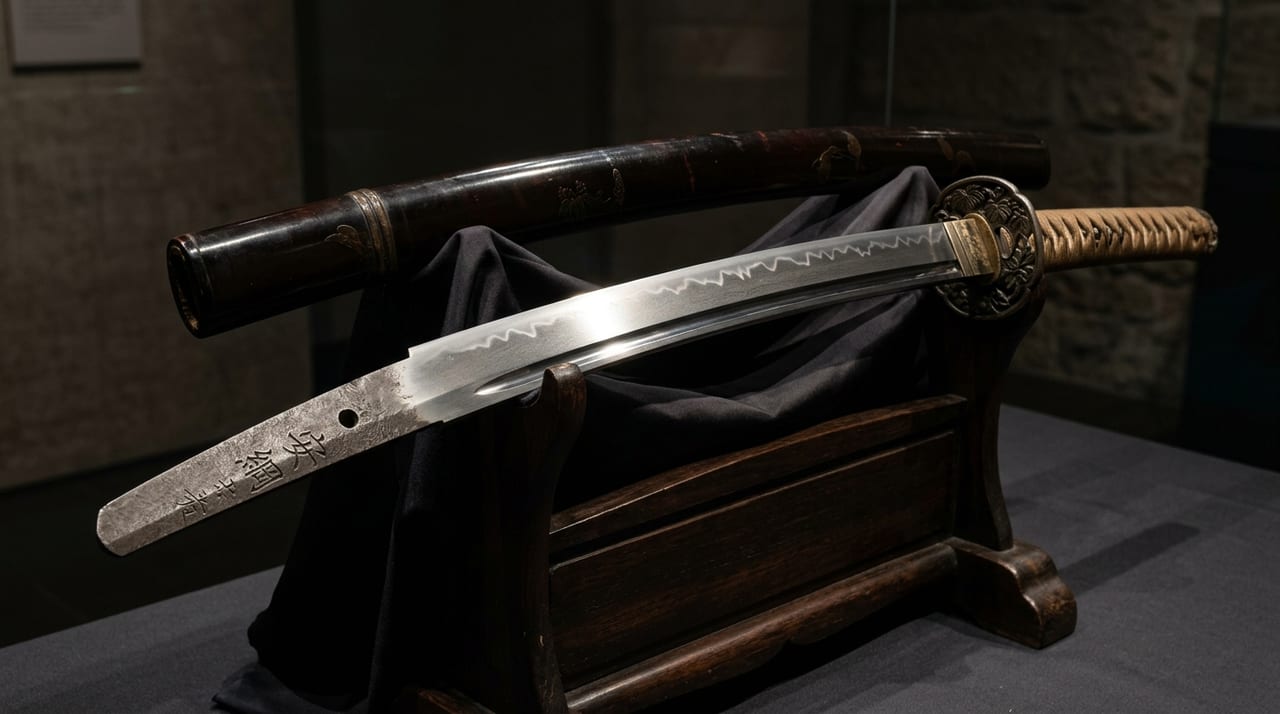
Dōjigiri Yasutsuna is a tachi forged by Hōki Yasutsuna, a master smith of the Heian period, and is a national treasure counted among the Tenka Goken (Five Swords under Heaven). The Tenka Goken are the collective name for five celebrated swords that received particularly high acclaim in the history of Japanese swords and became widely known to later generations: Dōjigiri Yasutsuna, Mikazuki Munechika, Ōdenta Mitsuyo, Juzumaru Tsunetsugu, and Onimaru Kunitsuna. Dōjigiri Yasutsuna is often positioned as the foremost of these. It is held by the Tokyo National Museum, where it is strictly preserved and managed as a national treasure and is exhibited to the public on a regular basis.
Hōki Yasutsuna was a swordsmith based in Hōki Province (present-day Tottori Prefecture). Very few of his extant works survive, and he remains a smith with many unknowns, yet through Dōjigiri Yasutsuna his name shines with an undying brilliance in the history of Japanese swords. The mid-Heian period, in which Yasutsuna is said to have been active, was the era when the curved, single-edged sword that we now recognize as the nihontō, the tachi, took shape, and Yasutsuna is evaluated as a pioneer who produced tachi of the highest standard in its dawn.
Compared with tachi from the Kamakura period onward, the blade's form retains a slightly stronger koshizori (curvature) and a small kissaki (point), embodying the classical tachi form of the late Heian to early Kamakura period. The blade length is approximately 80.0 centimeters, somewhat long, and the mihaba (width of the blade) is kept moderate. The jigane shows a dense koitame-hada (small, close-grained itame) with a finely detailed appearance, and fine, even ji-nie forms, giving it a deep luster. The hamon is primarily komidare (small irregular temper line) with ko-chōji mixed in, in an archaic style, with fine, even nie and a clear, pure hachū (interior of the blade). The sabi-ji jigane, the calm hamon, and the slender nakago all convey the features of Heian-period tachi as a precious testimony, and it is evaluated as one of the finest masterpieces among the extant Heian tachi.
Together with Ōkanehira, it is called the 'twin yokozuna of Japanese swords, east and west,' and the appearance of ji-nie and chikei on the fine koitame-hada is highly esteemed as a concentration of the essence of Heian-period swordsmithing.
Legends & Stories
The name Dōjigiri Yasutsuna originates from the legend that this sword was used by Minamoto no Yorimitsu (948–1021) when he slew the demon king Shuten-dōji of Mount Ōe. In the mid-Heian period, a series of mysterious disappearances afflicted the capital and the surrounding provinces. Ordered by the imperial court, Yorimitsu, accompanied by his Four Heavenly Kings — Watanabe no Tsuna, Sakata Kintoki, Usui Sadamitsu, and Urabe Suetake — and Fujiwara no Yasumasa, set out to destroy Shuten-dōji, the demon lord dwelling on Mount Ōe in Tanba Province (near present-day Fukuchiyama, Kyoto Prefecture). Disguised as mountain ascetics, the party was invited to Shuten-dōji's banquet, where they administered poisoned sake (shinpen-kidoku-shu) to intoxicate the demon, and when Shuten-dōji fell into sleep, Yorimitsu severed his head with this blade.
But the legend continues further. Even though his head was severed, Shuten-dōji's head flew through the air and attempted to bite Yorimitsu's helmet. From this extraordinary supernatural power, the sword came to be called "Dōjigiri" — the blade that "cut down the demon of Mount Ōe," the blade that "severs demons."
Thereafter, Dōjigiri Yasutsuna became a treasured possession of the Ashikaga shōgun, and subsequently passed through the hands of Toyotomi Hideyoshi and Tokugawa Ieyasu. It is said that Tokugawa Hidetada gave it to his third daughter, Princess Masako, upon her marriage into the Echizen Matsudaira family, and thereafter it was passed down through the Echizen Matsudaira and subsequently the Tsuyama Matsudaira of Tsuyama Domain. It is recorded in the Kanbō Meibuts-chō as a celebrated sword. In the modern era it eventually came to be housed in the Tokyo National Museum; yet the belief in its "power to sever demons" continues to live on, and it is said that with each exhibition of Dōjigiri Yasutsuna, many visitors come to pay their respects as if on a pilgrimage.