New Arrivals — Browse our catalog for the latest authentic Japanese sword arrivals. Browse →
October 13–21, 1600 (Keichō 5, 9th month, 7th–15th day)
Ōtsu Castle, Shiga District, Ōmi Province (present-day Hamaōtsu, Ōtsu City, Shiga Prefecture)
Forces
Western Army coalition
Ōtsu Castle garrison (Kyōgoku faction)
About 15 min read
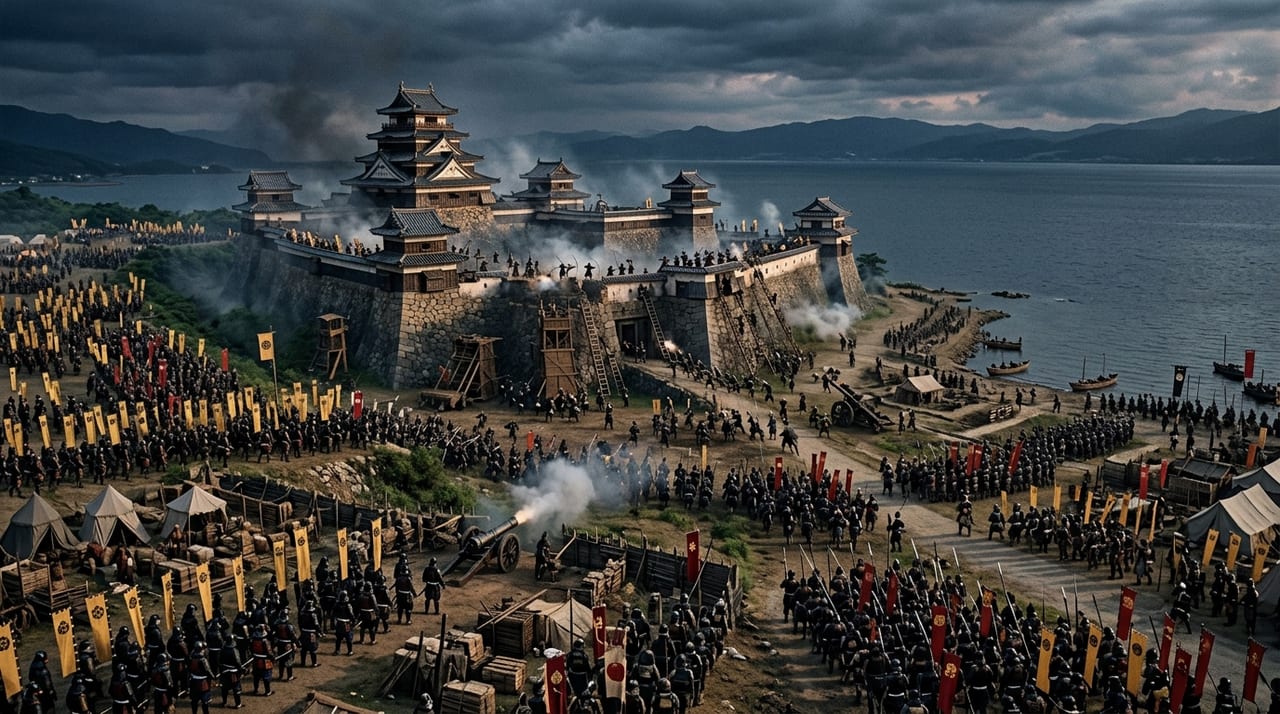
From the 7th to the 15th day of the 9th month of Keichō 5 (1600), the Battle of Ōtsu Castle was fought at Ōtsu Castle in Ōmi Province (present-day Ōtsu, Shiga Prefecture). It is known as the most dramatic siege among the preliminary engagements to the Battle of Sekigahara. Kyōgoku Takatsugu, the castle's commander, led about 3,000 troops who held out for nine days against an elite Western Army force of roughly 15,000 led by Tachibana Muneshige and others. The castle finally surrendered on the day of the main battle of Sekigahara (the 15th day of the 9th month). Later assessments hold that this small difference in timing decisively shaped the outcome of the Battle of Sekigahara.
Kyōgoku Takatsugu (Eiroku 6 to Keichō 14, 1563–1609) came from the Kyōgoku family, a prestigious house of the Ōmi Genji. Under the Toyotomi regime, he survived as a daimyō of Ōtsu in Ōmi Province.
Takatsugu's reputation was complicated both during his lifetime and after his death. His younger sister Tatsuko (Matsunomaru-dono) became a concubine of Hideyoshi, and through his wife, Jōkō-in, the younger sister of Yodo-dono, he had ties to the Toyotomi family. However, his record as a military commander was thin. Because he was seen as having risen through his sister's and wife's connections rather than his own ability, he was mocked as a "firefly daimyō" (hotaru daimyō). The implication is that, like a firefly's light, he shone through other brilliance rather than his own strength.
However, on the eve of the Battle of Sekigahara in Keichō 5 (1600), Takatsugu made a critical decision. Although he initially appeared to side with the Western Army, just before the battle he declared a switch to the Eastern Army (the Tokugawa side) and holed up in Ōtsu Castle to resist the Western Army. There are various theories about the reasons for this switch. It is said to have involved a tangle of factors, including loyalty to the Eastern Army, personal trust in Ieyasu, and dissatisfaction with the Toyotomi family in Osaka.
The last glimmer of the "firefly daimyō" took the form of a nine-day siege, and posterity has praised it as a significant strategic contribution.
On the 7th day of the 9th month of Keichō 5 (1600), Western Army commanders Tachibana Muneshige, Mōri Motoyasu, and Tsukushi Hirokado surrounded Ōtsu Castle. For the Western Army, capturing Ōtsu Castle was essential to securing their rear. Ōtsu was a key point linking Kyoto and Ōmi. If an enemy castle remained here, the Western Army's lines of communication would be threatened.
Ōtsu Castle was a water castle facing the shore of Lake Biwa, but its stone walls were low, and it was hardly a castle well suited to a siege. Moreover, the disparity in troop numbers, 3,000 against 15,000, was stark, and there were limits to how long it could hold out.
Tachibana Muneshige was a famous commander from Kyushu and one of the fiercest generals of his era, who also distinguished himself in the Korean campaigns. The fact that Muneshige struggled for so long with Ōtsu Castle shows the quality of Takatsugu's defense. It is also said that the Western Army brought cannon and bombarded the castle walls and stone walls. After a fierce nine days of fighting, Ōtsu Castle surrendered on the 15th day of the 9th month.
That the day of surrender coincided with the main battle of Sekigahara was no coincidence but a historical irony. The elite 15,000 troops of Tachibana Muneshige and the Western Army were kept pinned down at Ōtsu until the very day of the decisive battle at Sekigahara. Whether the outcome would have been different had Ōtsu Castle fallen early and Muneshige's forces reached Sekigahara in time is a "what if" that Japanese historians have continued to ask repeatedly.
Tachibana Muneshige (Eiroku 10 to Kan'ei 19, 1567–1643) was a late Sengoku general known as "Saigoku Musō" ("peerless in the west"). He took over the Tachibana family as the adopted son-in-law of Bekki Dōsetsu, a famous commander of Kyushu.
Muneshige is renowned as one of the most valiant Japanese generals fighting on the Korean Peninsula during the Bunroku-Keichō campaigns. In the Battle of Byeokjegwan (1593), he earned distinction by defeating a large Ming army. The fact that this same Muneshige struggled to take Ōtsu Castle and failed to reach Sekigahara in time confirms the high quality of Takatsugu's defense.
After Sekigahara, Muneshige, who had sided with the Western Army, lost his status as a daimyō. However, because of his renown as a warrior, the Edo shogunate later restored him, and he was ultimately able to return to his former domain, the Yanagawa Domain (present-day Yanagawa City, Fukuoka Prefecture). Muneshige's life, which holds the historical distinction of recovering a former domain after losing it, as the only tozama daimyō to do so, exemplifies the fate of warriors from the late Sengoku period into the early Edo period.
Ōmi Province (present-day Shiga Prefecture), the setting of the Battle of Ōtsu Castle, was not an important production center of Japanese swords. However, it holds special significance as a crossroads of sword culture.
Ōmi Province was a key transportation hub where the Tōkaidō, Hokurikudō, and Nakasendō routes intersected, and a relay point for logistics linking Kyoto with the provinces. Famous blades from Bizen, Mino, and Yamato circulated nationwide through Ōmi, and daimyō traveling to Kyoto from across the country passed through it. The Kyōgoku family, a prestigious house of Ōmi, is thought to have been involved in the collection and circulation of many famous blades.
The Western Army that attacked Ōtsu Castle in Keichō 5 (1600), under the command of Mōri Motoyasu, included warriors from diverse regions of Kyushu and Chūgoku, and each carried swords made by smiths from different regions. The battlefield of Ōtsu was thus also a place where the sword culture of all of Japan came together.
The swords carried by the warriors who fought under Kyōgoku Takatsugu's defense are thought to have included, alongside works by local Ōmi smiths, masterpieces of the Bizen, Mino, and Sōshū-den traditions. Over nine days of fierce fighting, the "soul blade" of each warrior shone in the land of Ōmi.
The Battle of Ōtsu Castle holds special importance in Japanese history because of its "what if" possibilities.
What if Kyōgoku Takatsugu had not holed up in Ōtsu Castle, and had instead cooperated with the Western Army? Then Tachibana Muneshige and his 15,000 elite troops might have taken part in the Battle of Sekigahara. At the main battle of Sekigahara, the Western Army was roughly equal in number to the Eastern Army, but it was driven into decisive defeat by Kobayakawa Hideaki's defection to the Eastern Army. Had Muneshige's 15,000 elite troops been added, the outcome of Sekigahara might have been different. At the very least, it might not have become a quick, overwhelming victory for the Eastern Army.
The stigma of being a "firefly daimyō" was entirely erased by the nine days of siege at Ōtsu Castle, and later historians evaluate Takatsugu as an unsung hero of Sekigahara.
Ōtsu Castle was abandoned in Keichō 6 (1601), the year after Sekigahara, and its building materials are said to have been reused for Zeze Castle and Hikone Castle. Few remains of Ōtsu Castle survive in the area around present-day Hamaōtsu in Ōtsu City. However, the Ōtsu City Museum of History exhibits materials on Kyōgoku Takatsugu and the Battle of Ōtsu Castle, explaining the castle's place as a preliminary engagement to Sekigahara.
Ōmi Province borders Gifu Prefecture, the site of the Battle of Sekigahara, and it is about an hour's drive from Ōtsu to Sekigahara. A historical trip visiting the "three-point set of the Sekigahara preliminaries" (the Ōtsu Castle site, the Sekigahara battlefield, and Gifu Castle) is one of the best routes for experiencing a late Sengoku battle.
For Japanese sword enthusiasts, too, swords associated with many of the warriors connected to Sekigahara are scattered across museums in various places. A "sword journey" through Ōtsu, Sekigahara, and Gifu is also a journey to deeply understand the warrior culture before the Edo period. Imagining the "what if" of history from Ōtsu, where Takatsugu held out for nine days before opening the castle, gives the most vivid understanding of the age in which these swords shone.
Tachibana Muneshige
Tachibana Muneshige — the renowned Kyūshū general who led the Ōtsu siege and arrived at Sekigahara too late
Ishida Mitsunari
Ishida Mitsunari — Western Army commander who ordered the Ōtsu siege, a decision that cost him Muneshige's forces at Sekigahara
Tokugawa Ieyasu
Tokugawa Ieyasu — whose Sekigahara victory was indirectly aided by Takatsugu's nine-day resistance at Ōtsu
Ii Naomasa
Ii Naomasa — Eastern Army commander whose forces at Sekigahara benefited from the Western Army's weakening at Ōtsu
Ōtani Yoshitsugu
Ōtani Yoshitsugu — Western Army strategist involved in planning the Ōtsu siege operation