New Arrivals — Browse our catalog for the latest authentic Japanese sword arrivals. Browse →
May 1592 – June 1593 (4th month, Bunroku 1 – 5th month, Bunroku 2)
Korean Peninsula (Busan to Pyongyang)
Forces
Japanese Forces (Toyotomi Army)
Korean and Ming Forces
About 11 min read
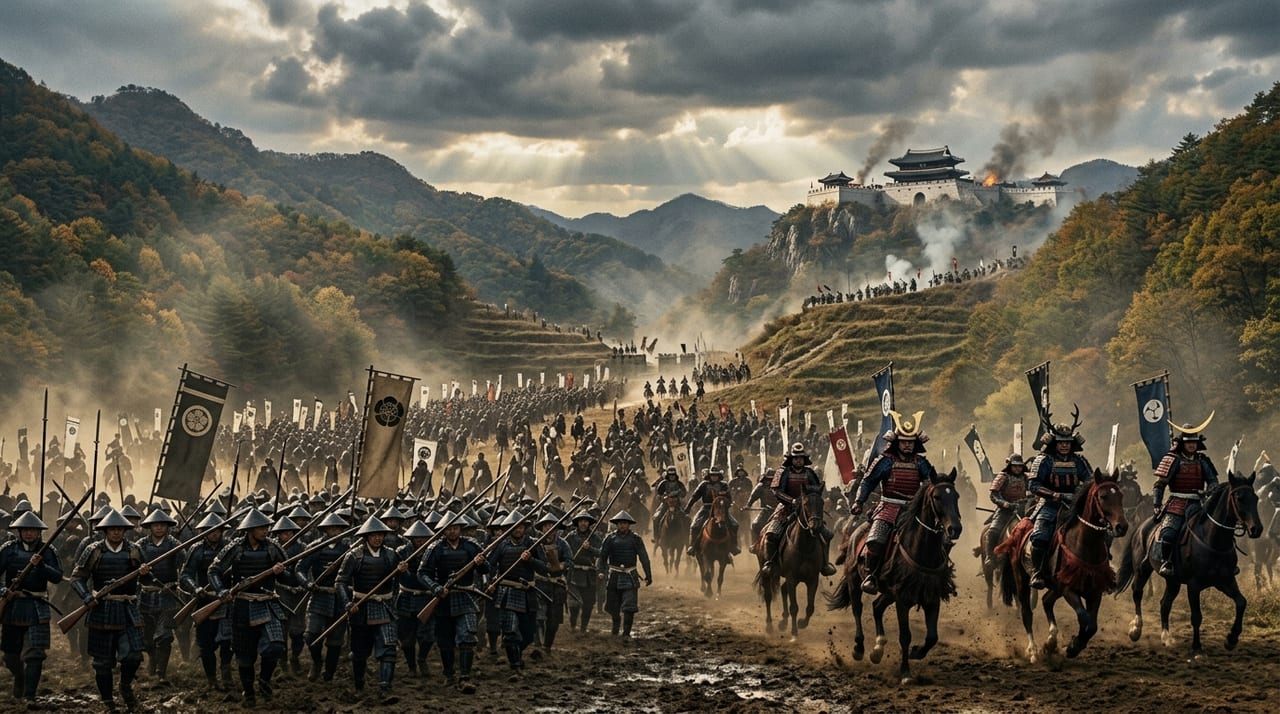
In the 4th month of Bunroku 1 (1592), after achieving domestic unification, Toyotomi Hideyoshi—seeking to fulfill his ambition of continental conquest—dispatched a massive force of approximately 158,000 men to the Korean Peninsula. The "Bunroku Campaign," the first of "the Bunroku and Keichō Campaigns" (1592–1598), was not only the largest overseas military expedition of premodern Japan, but also a war in which Japanese swords were deployed on an international stage on a large scale.
The vanguard units under Katō Kiyomasa and Konishi Yukinaga advanced with lightning speed from Busan to Seoul (Hanseong), and further to Pyongyang. However, the Korean navy under Admiral Yi Sun-sin and others, with its panokseon warships and turtle ships (geobukseon), threatened the Japanese supply lines, and a Ming relief force counterattacked to retake Pyongyang. Despite maintaining superiority on land, the Japanese forces were forced to withdraw due to supply difficulties, and the conflict shifted to ceasefire negotiations.
Historians debate Hideyoshi's motivation for the invasion of Korea on several grounds.
First, the "continental conquest ambition" theory—after unifying Japan, Hideyoshi aimed at the conquest of Ming China, positioning Korea as a pathway to that goal. This vision, called the "invasion of the Tang" (唐入り), was Hideyoshi's dream in his final years.
Second, the "problem of accommodating Sengoku warriors" theory—after unification, redirecting the military power of warriors who had lost their battlefields overseas was intended to suppress discontent and prevent rebellion within Japan.
Third, the "hegemony over East Asian trade" theory—seeking the center of the developing East Asian trade in Korea and Ming China, this view emphasizes economic motives to control those interests.
Each theory carries some persuasiveness, and scholarly debate on the full scope of Hideyoshi's motives continues to this day.
One of the most famous anecdotes of the Bunroku Campaign is the "tiger hunt" (虎狩り) by Katō Kiyomasa. According to legend, Kiyomasa advanced into Hamgyong Province and slew a Korean tiger with his spear. The spear said to have been used when Kiyomasa killed the tiger—a Japanese spear—and the tiger pelt said to have been brought back as a trophy became symbols of Kiyomasa's feats of valor.
Katō Kiyomasa was known for his tall eboshi-shaped helmet (naga-eboshi-nari kabuto) and his "serpent's eye" (蛇の目) family crest, and his imposing figure was depicted in numerous paintings and woodblock prints (ukiyo-e). Many legends surrounding Kiyomasa's swords and spears remain in Higo (present-day Kumamoto Prefecture), where Kiyomasa was lord. Kiyomasa continues to be revered as a "hero" of Higo.
The Bunroku Campaign was a war in which Japanese swords were deployed on a large-scale international battlefield. The primary weapons of the Japanese forces were the matchlock arquebuses (火縄銃), Japanese swords, and spears. In particular, the sharpness of the Japanese blade and the skill of Japanese swordsmen in close combat left a profound impression on Korean and Ming forces.
Korean records contain frequent references to the sharpness of the wodao (倭刀, "Japanese sword"), and Yu Seong-ryong's Jingbirok records that the swords of the Japanese soldiers were all three to four shaku long and unmatched in sharpness. On the other hand, the blockade of maritime supply lines by Yi Sun-sin's fleet proved to be the decisive factor that ultimately forced the militarily dominant Japanese forces to retreat.
This war affected the swordsmanship and military technology on both sides. Some research suggests that Korean swordsmanship was influenced by Japanese blade techniques following the Bunroku Campaign. Conversely, Japanese daimyo brought Korean potters back to Japan, influencing Japanese ceramic culture (the campaigns are also called the "pottery wars").
The launching point for the Japanese forces in the Bunroku Campaign was Nagoya Castle (名護屋城), constructed in Nagoya, Hizen Province (present-day Karatsu, Saga Prefecture). In the 4th month of Bunroku 1 (1592), Hideyoshi arrived at Nagoya, and daimyo from throughout the realm assembled around the massive fortress.
More than 130 daimyo residences stood in the vicinity of Nagoya Castle. The gathering of famous swords brought by each daimyo to Nagoya represented a major concentration point of Sengoku sword culture.
The Bunroku Campaign holds a special place in the history of the Japanese sword as a war in which Japanese blades made a significant presence on a truly international stage. In close combat on land, the swordsmanship of Japanese soldiers and the sharpness of Japanese swords made an overwhelming impression on Korean and Ming forces. In the wake of this war, wodao (倭刀) and other weapons modeled on the Japanese sword were also made on the Korean Peninsula.
At the same time, the Bunroku Campaign foreshadowed the "beginning of the end" for the age of the sword. In battles against Korean and Ming forces, firearms (arquebuses and cannons) played an important role, and Japanese arquebusier units contributed significantly to the assault on Korean fortifications. The modernization trend from "sword to gun" is evident in this campaign as well.
The seven-year Korean expeditions (Bunroku and Keichō Campaigns) brought enormous military and fiscal burdens on the Toyotomi regime and became one of the remote causes of the regime's collapse after Hideyoshi's death (1598). The rivalries among the daimyo generated by this "reckless" Korean invasion are deeply embedded in the background of the Battle of Sekigahara (1600).
Kuroda Nagamasa
Kuroda Nagamasa participated in the Bunroku Campaign, continuing his father Kanbei's strategic tradition
Konishi Yukinaga
Commander of the 1st Division; led the vanguard that first reached Seoul
Ukita Hideie
Supreme field commander Ukita Hideie, also Hideyoshi's adopted son
Toyotomi Hideyoshi
Supreme commander of the Bunroku Campaign; the ruler who dreamed of continental conquest
Katō Kiyomasa
Vanguard commander of the Bunroku Campaign; the hero of Korea known for hunting tigers
豊臣秀吉の二度目の朝鮮出兵「慶長の役」は、多数の日本刀を朝鮮半島・中国大陸へと流出させた。戦争中の刀剣需要の高まり、戦地での刀の使用と喪失、そして現在も朝鮮・中国に残る「倭刀」の実態まで、刀剣史の視点から解説する。
2026-04-28
堀川国広(ほりかわくにひろ)は安土桃山時代から江戸初期にかけて活躍した刀工で、「新刀(しんとう)の父」と称される。薩摩の日置氏家臣から刀鍛冶に転身し、京都堀川に工房を構えて古刀の美を新刀期に復興した。伊達正宗の注文刀など大名との深い縁も持つ。本稿では国広の生涯・作刀様式・弟子・歴史的位置づけを詳説する。
2026-04-20