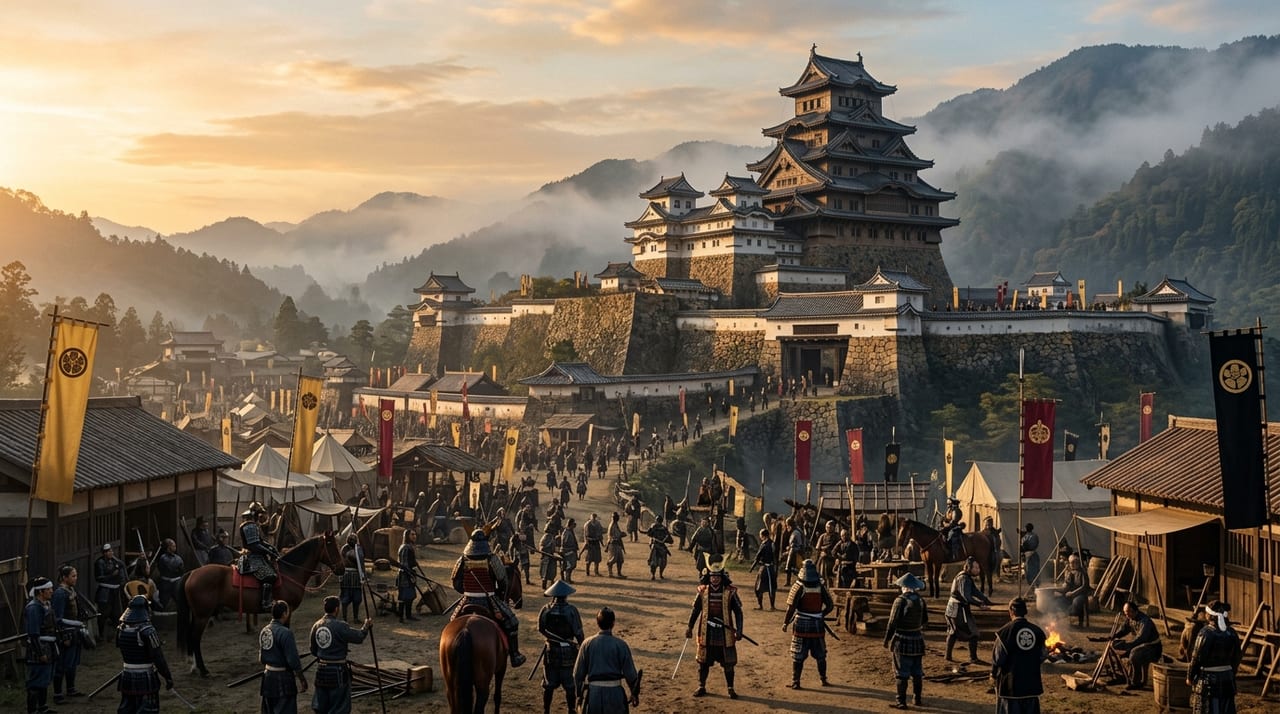
 * Image is for illustrative purposes only.
Imjin War Period
文禄・慶長の役期
The two Korean campaigns launched by Toyotomi Hideyoshi (the Bunroku campaign of 1592 and the Keichō campaign of 1597) created an unprecedented mass demand for swords in the history of the Japanese sword. It was a distinctive era in which swords circulated in many forms: used in combat at the front, seized as plunder, presented as offerings, and brought home as souvenirs.
Description
Korean Campaigns and the Mass Mobilization of Swords
In the fourth month of Bunroku 1 (1592), Toyotomi Hideyoshi sent more than 150,000 troops to the Korean Peninsula. This unprecedented large-scale expedition also generated an unprecedented mass demand for swords in the history of the Japanese sword. Most soldiers crossed the sea carrying tachi, wakizashi, and tantō for combat, and over prolonged fighting, swords were repeatedly worn out, lost, and replenished. During the seven years of the campaigns, including the Keichō campaign (1597–1598), swordsmiths across the country were mobilized for military production and were forced to adopt a mass-production system that prioritized quantity over quality. This experience had a complex influence on the later establishment of Keichō shintō.
Master Smiths' Experiences in Korea
It is said that swordsmiths from various regions also crossed the sea following the daimyō and worked on making and repairing swords in the field. It is also possible that swordsmiths in the employ of Toyotomi Hideyoshi accompanied the army to the Korean Peninsula and worked there on making or repairing swords. More important, the Korean campaigns fully overlapped with the period of activity of the master smiths of Keichō shintō, beginning with Horikawa Kunihiro. Kunihiro traveled through the provinces from Hyūga, and after passing through places such as Ashikaga in Shimotsuke, from around Keichō 4 (1599) he settled in Ichijō Horikawa in Kyoto and produced pioneering works of shintō. The wartime military boom brought by the Korean campaigns, together with the social upheaval that followed, namely the arrival of taihei (lasting peace) through the Battle of Sekigahara and the establishment of the Edo shogunate, served as an important external condition that prompted the transition from kotō to shintō.
“Mimikiri” and the Outflow of Swords to Korea
Historical records show that, as a cruel custom in the Bunroku and Keichō campaigns, hanasogi (nose-cutting) and mimikiri (ear-cutting) were carried out on enemy commanders in place of kubi-jikken (inspection of heads). These were brought back as proof of achievement, with the ears or noses sliced off. On the other hand, many expensive tachi were used in offerings to Hideyoshi and in diplomatic settings, and there are records that famous swords flowed out as gifts to high officials of Korea and Ming. Korean historical sources also mention the sharpness of Japanese swords, which conveys how highly Japanese swords were regarded internationally in this period.
Korean Swordsmiths and Technical Exchange
It is known that during the Korean campaigns, some Korean craftsmen were taken to Japan. Just as the ceramics industries of Satsuma and Hizen, famous in Japan as the “abduction of potters,” were influenced by this, it is possible that the sword field was also influenced by the arrival of Korean technicians. Current research offers only limited evidence of concrete technology transfer.
A Bridge to Keichō Shintō
After the Bunroku and Keichō campaigns, large-scale internal conflict came to an end with the Battle of Sekigahara in Keichō 5 (1600), and the establishment of the Edo shogunate by Tokugawa Ieyasu (1603) brought an era of taihei. Swordsmiths who had been overworked in the mass military production of the Korean campaign period sought, with the arrival of peace, a shift from quantity to quality, and this led to the flourishing of Keichō shintō. Horikawa Kunihiro, Iga-no-kami Kanemichi, and Rai Kanemichi were active from the Keichō to the Genna eras and produced outstanding works that fused the tradition of kotō with the spirit of the new age. The Bunroku and Keichō campaigns fully coincide with the historical turning point that transformed the history of the Japanese sword from kotō to shintō, and their contextual significance is great.
Demand for Military Swords and Ceremonial Swords
During the Korean campaigns, demand was high not only for military swords as pure weapons, but also for ceremonial swords that the daimyō presented to Hideyoshi, and for famous swords commemorating turning points of the era.
Characteristics of This Era
- A mass-production system running from sue-kotō to early shintō, driven by military mass production. Traces of wartime production that prioritized quantity over quality are reflected in the average standard of swords of this period.
- The budding of a shintō-style aesthetic led by Horikawa Kunihiro. While inheriting the traditional techniques of kotō, new forms and hamon began to be attempted in response to changing times, a transitional aspect.
- Swordsmithing in Kyūshū (Hizen, Buzen, Satsuma) became active because the region became the front line of the Korean campaigns. It overlapped with the rise of Hizen swords and laid the foundations for later Hizen smiths such as Tadayoshi and Masahiro.