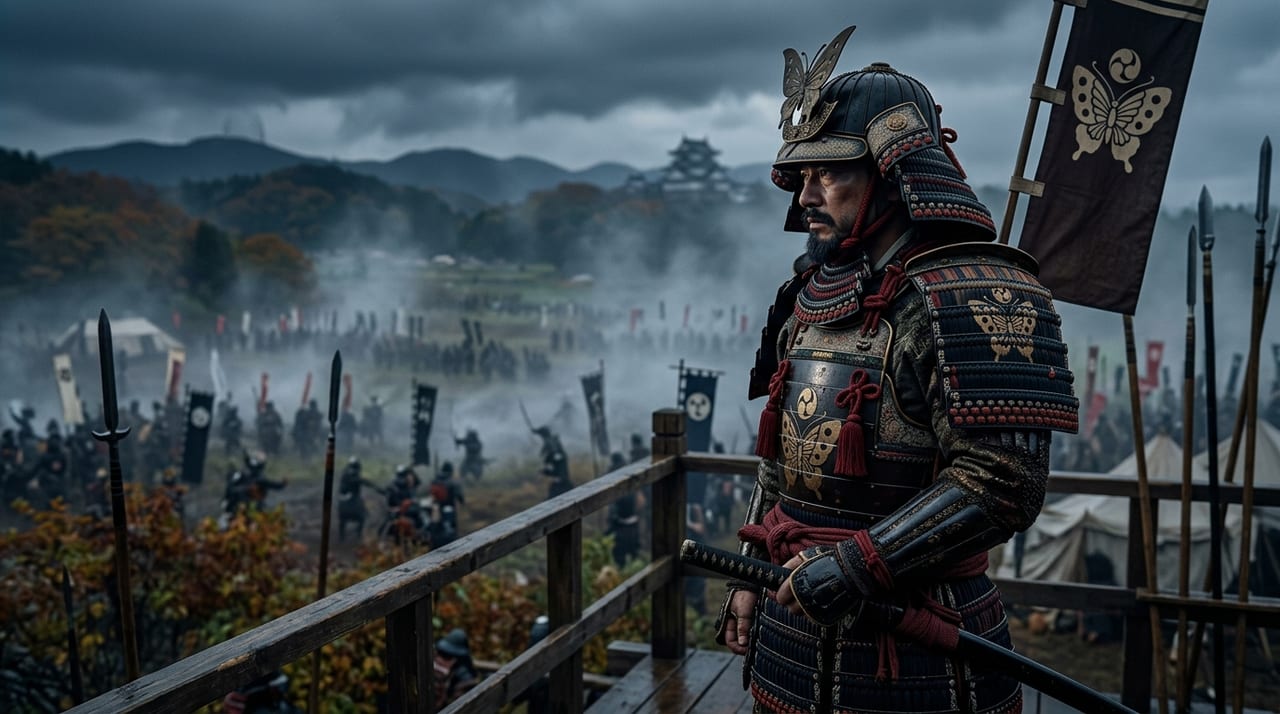
 * Image is for illustrative purposes only.
Ukita Hideie
宇喜多秀家
Commander of the Western Army's Main Force at Sekigahara — Toyotomi's Beloved General Who Survived Exile to Die at Eighty-four
Description
A Daimyo Who Enjoyed the Full Favor of the Toyotomi
Ukita Hideie, born in Genki 3 (1572), was one of the senior councilors of the Toyotomi regime. He led a domain of 574,000 koku centered on Bizen, Mimasaka, and Harima, the largest domain in western Japan. After the death of his father, Ukita Naoie, Hideie succeeded to the family headship at a young age. Hideyoshi protected him as if he were his own son, and Hideie received the unusual favor of taking as his principal wife Gōhime, Hideyoshi's adopted daughter and the daughter of Maeda Toshiie. Receiving Hideyoshi's favor, Hideie grew into a powerful daimyo of the Toyotomi regime and also distinguished himself militarily in the Japanese invasions of Korea. However, the defeat at Sekigahara would bring an irreversible fall to this glorious life.
Fighting Valiantly at Sekigahara
At the Battle of Sekigahara on the 15th day of the 9th month of Keichō 5 (1600), Ukita Hideie, together with Ishida Mitsunari and Ōtani Yoshitsugu, formed the core of the Western army and faced the Eastern army with a large force of 17,000 men. In the Battle of Sekigahara, the Ukita forces fought fiercely against the Tokugawa side until the end, and they are recorded as one of the units that showed the most tenacious resistance within the Western army. However, as the entire Western army collapsed through the betrayal of Kobayakawa Hideaki, Hideie was forced to withdraw. Having fled in defeat, Hideie went into hiding, relying on the Shimazu clan of Satsuma. However, in Keichō 8 (1603), he was handed over by the Shimazu clan to the Tokugawa side and was moved to Kunō in Suruga Province.
Exile to Hachijō-jima and Longevity
After the defeat at Sekigahara, Ukita Hideie was exiled to Hachijō-jima in Keichō 11 (1606). This was a grave offense that would ordinarily have merited execution, but his life was spared through petitions for clemency by Shimazu Tadatsune and others. There is also a theory that efforts on the part of the Maeda family, Gōhime's natal family, were involved. Exiled to Hachijō-jima, Hideie spent about fifty years there amid the island's harsh nature and impoverished living conditions, and he died in Meireki 1 (1655) at the age of 84, an astonishing longevity for the time. The dramatic contrast between 'a life of luxury as a daimyo' and 'life as an exile on a remote island,' along with Hideie's vitality in continuing to live despite it, demonstrates the tremendous mental strength of the samurai.
Hideie's Swords and Martial Arts
Bizen Province has been, since ancient times, Japan's largest sword-producing region, a place where many renowned swordsmiths, led by the Osafune school, were active. In the Japanese invasions of Korea, he defeated the Ming army at the Battle of Byeokjegwan, while in the assault during the Siege of Haengju he himself suffered an arrow wound. This valor is also reflected in the fighting spirit of the Ukita forces at Sekigahara.
Osafune in Bizen and the Ukita Family
In Bizen Province, the base of the Ukita family, there were swordsmiths of Osafune. Bizen Osafune flourished as a center of Japanese sword production from the Kamakura through the Sengoku periods, producing many renowned swordsmiths such as Osafune Kagemitsu and Osafune Kanemitsu.
Swords of an Exile: A Symbol of Lost Glory
How Hideie, exiled to Hachijō-jima, related to swords in his life on the island is an intriguing question when considering the samurai spirit. How a former great daimyo kept the samurai's soul, the sword, alive within his heart during his life in exile is an important perspective for considering Hideie's longevity and mental resilience. The fifty years on Hachijō-jima can be interpreted as the years in which the warrior Ukita Hideie continued to preserve the spirit of the sword, his pride as a samurai and his indomitable will, in an intangible form.