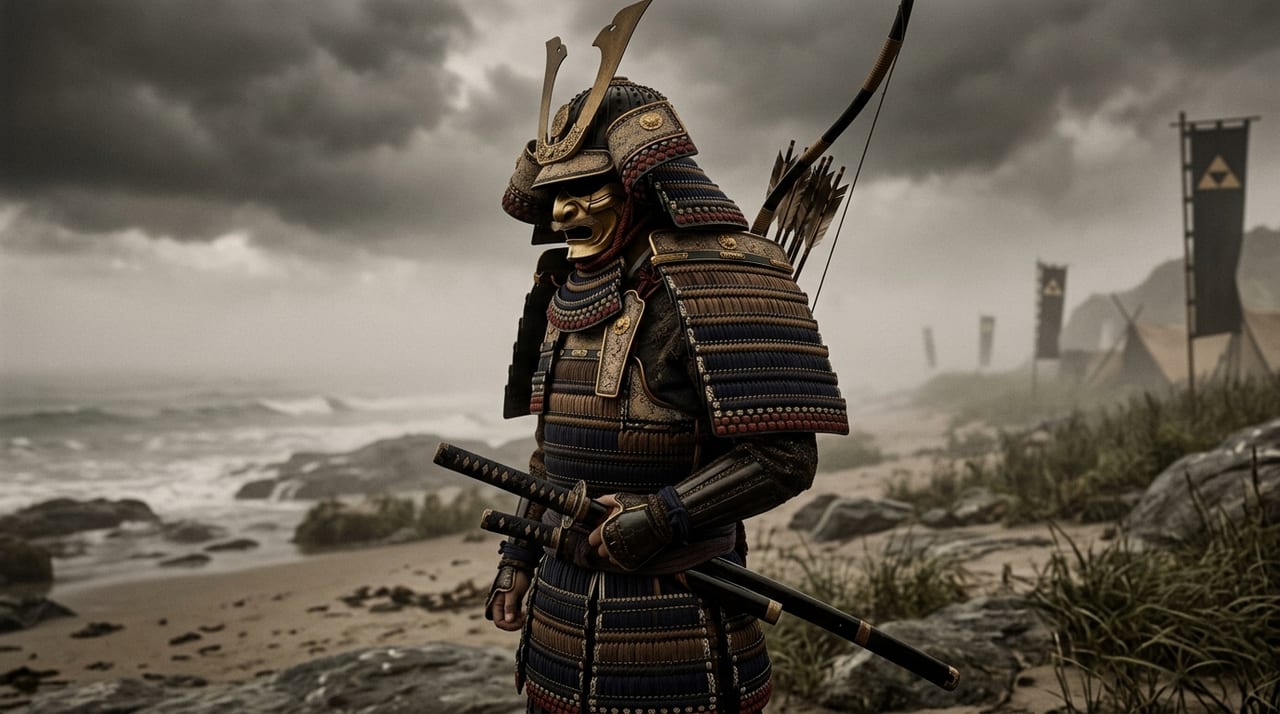
 * Image is for illustrative purposes only.
Kuroda Nagamasa
黒田長政
Lord of Chikuzen — Son of the Great Strategist Kanbei, Key Architect of the Tokugawa Victory at Sekigahara
Description
As Kanbei's Son
Kuroda Nagamasa, born in Eiroku 11 (1568), was the eldest son of Kuroda Kanbei (Yoshitaka), celebrated as a master strategist of renown. He walked a path as a "warrior" that differed from his father's during the transition from the Toyotomi regime to the Tokugawa regime. Whereas his father, Kanbei, made his name in Sengoku history through overwhelming strategic acumen, Nagamasa showed his talent in direct martial achievement and political maneuverability. He is remembered as one of the principal architects, in effect, of the Eastern Army's victory at the Battle of Sekigahara. As the first lord of the Fukuoka Domain, with 520,000 koku in Chikuzen Province, Nagamasa carried on his father's legacy through his record as a warrior.
The Korean Campaigns and Military Feats
The Bunroku–Keichō campaigns (the invasions of Korea) were the occasion on which Nagamasa's worth as a military commander was first clearly demonstrated. In particular, his distinguished service in the Keichō campaign (1597–98) was remarkable. He served as the vanguard of the Kuroda forces in numerous fierce battles, including the Battle of Jiksan, and distinguished himself in combat. The military experience Nagamasa gained on the Korean peninsula became the foundation for the calm judgment and decisive action he showed later at Sekigahara. Where his father designed campaigns as a strategist, Nagamasa was a martial-minded commander who drew his sword and stood at the front line himself. This difference brought a complex shading to the relationship between father and son.
A Key Figure at Sekigahara
At the Battle of Sekigahara in Keichō 5 (1600), Kuroda Nagamasa sided with the Eastern Army as one of the daimyō closest to Tokugawa Ieyasu. He played an important role in the diplomatic maneuvering that drew Kikkawa Hiroie and Kobayakawa Hideaki into the Eastern Army. In particular, Kobayakawa Hideaki's defection to the Eastern Army is said to have been brought about by Nagamasa, who had reached out to him beforehand. This became the greatest determining factor in the Eastern Army's victory at Sekigahara. After the battle, Nagamasa was presented with a gokanjō (letter of commendation) by Ieyasu and was treated as the foremost contributor to the Battle of Sekigahara. He demonstrated outstanding ability not only in arms but also in politics and diplomacy.
Nagamasa's Swords and Patronage of Swordsmiths
In the era of Kuroda Nagamasa, the foundations of the sword-making culture of the Fukuoka Domain were laid. Swordsmiths of the Nobukuni school, who had served the Kuroda family since the Buzen period, moved to Chikuzen along with the Kuroda transfer to Chikuzen. They became the mainstream of Chikuzen swordsmiths.
Feud with Gotō Matabei
Among the most dramatic episodes in Kuroda Nagamasa's life is his feud with his retainer Gotō Matabei. In Keichō 11 (1606), two years after the death of his father, Jōsui, Matabei fled the Kuroda household. Nagamasa took a "hōkō-gamae" measure so that other households could not employ Matabei, which shows the gravity of the rift between the two. A strong view holds that the main cause of the flight was that Matabei did not comply with Nagamasa's prohibition on dealings with the Hosokawa family, with whom the Kuroda were on bad terms.
Foundations and Legacy of the Fukuoka Domain
Kuroda Nagamasa died in Genna 9 (1623) at the age of 56, but during his reign he firmly built up the foundations of the Fukuoka Domain. His measures, including the construction of Fukuoka Castle (Maizuru Castle), the organization of domain governance, and the invitation of swordsmiths and cultural figures, consolidated the foundations of the Fukuoka Domain. The foundations of present-day Fukuoka City were built by Nagamasa, and his legacy continues to be seen today in castle ruins, museums, and cultural properties. Swords handed down in the Kuroda family are preserved at the Fukuoka City Museum and other locations. They quietly bear witness to the turbulent life of a man who sought to surpass his father as "Kanbei's son."