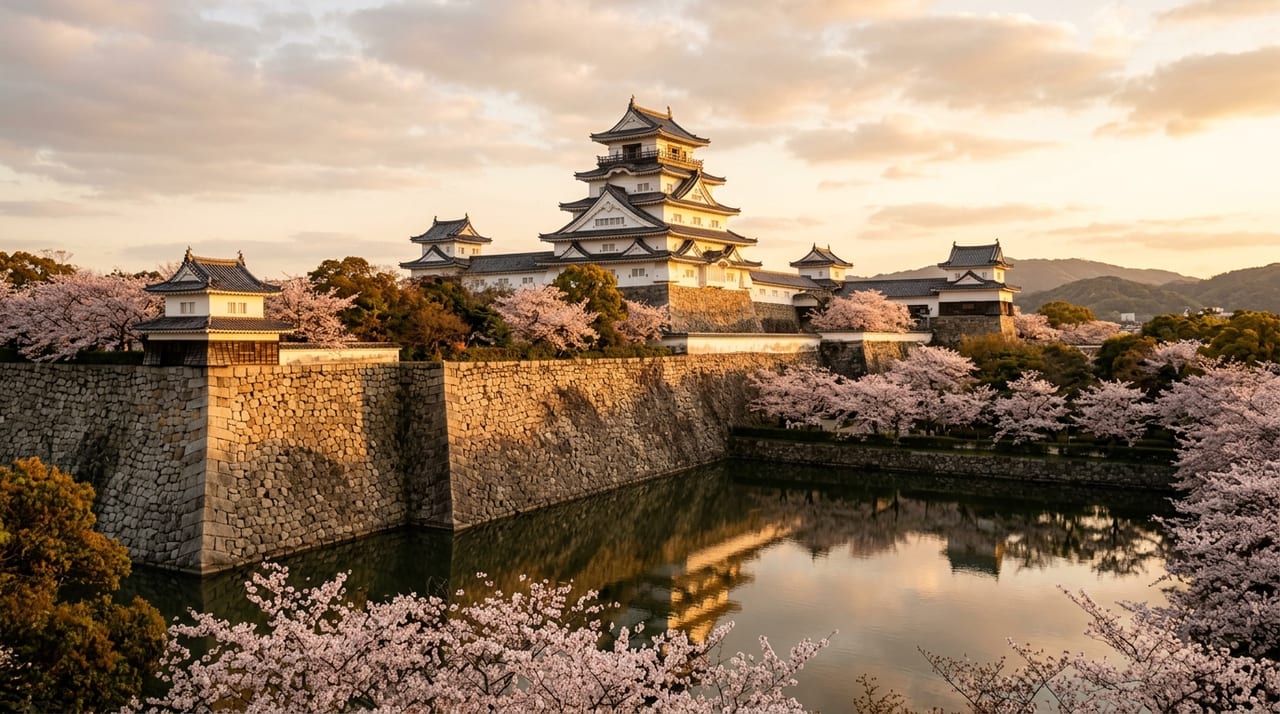
 * Image is for illustrative purposes only.
Fukuoka Castle (Maizuru Castle)
福岡城(舞鶴城)
Fukuoka Castle (Maizuru Castle) is a historic castle in the Kyūshū region (Built in 1601 (Keichō 6)). Its lord was Kuroda Nagamasa.
Overview
About the Castle
Fukuoka Castle was built in Keichō 6 (1601) by Kuroda Nagamasa, who sided with the Eastern Army at the Battle of Sekigahara and was granted Chikuzen Province with 520,000 koku. It is one of the largest castles in Kyushu. It sits on a plateau between the Nakagawa River and Hakata Bay, and has a three-part structure of Honmaru, Ninomaru, and Sannomaru. At its peak it boasted 47 turrets. Nagamasa inherited the military strategy of his father, Kuroda Kanbei (Josui / Yoshitaka), and designed the castle as a practical military base. He also made it an administrative center that supported the prosperity of Hakata as a commercial city.
History of the Kuroda Family
The history of the Kuroda family begins in Harima Province. Kuroda Kanbei (Josui / Yoshitaka) served as a strategist for Toyotomi Hideyoshi, wielding great skill in the campaigns against the Chūgoku region and the pacification of Kyushu. He was such a strategist of rare genius that Hideyoshi is said to have feared, “If anyone were to seize the realm, it would be only Kanbei.” Kanbei devised many unusual strategies, including the plan for the flood siege of Bitchū Takamatsu Castle, and became one of the greatest contributors to Hideyoshi's rise to supreme power. His son Nagamasa carried out secret-agreement negotiations with the Eastern Army commanders at Sekigahara and was deeply trusted by Tokugawa Ieyasu. Fukuoka Castle stood in Chikuzen as a symbol of the military achievements and wisdom of the Kuroda family.
Legend of the Famous Sword Heshikiri Hasebe
Among the famous swords held by the Kuroda family, “Heshikiri Hasebe” is one of the most dramatic swords in the history of Japanese swords. This sword was originally owned by Oda Nobunaga. According to the anecdote, Nobunaga cut down the tea attendant Kannai, who had behaved rudely, by pressing the blade against him as Kannai fled under a food shelf. This is said to be the origin of the name “Heshikiri” (pressed-cut). It was made by Hasebe Kunishige. Its magnificent form from the Nanboku-chō period and its hamon full of vigor were seen as a symbol of Nobunaga's almost violent power. The sword later passed to the Kuroda family (there are various theories about how this happened). As a famous sword handed down in the Kuroda family, it is now held by the Fukuoka City Museum and is one of the most recognized masterpieces among Japanese swords.
Hakata and Sword Culture
Since ancient times, Hakata has been a hub of exchange with the continent. It was also a distribution center for materials used in swords, such as metals, whetstones, and lacquer. In Chikuzen Province there was a lineage of master smiths known as Chikuzen Samonji (Sa), who shine in the history of Japanese swords. Samonji swords, with their powerful forms and distinctive hamon from the Nanboku-chō period, had a great influence on later swordsmiths. After Hideyoshi's “Kyushu Campaign,” Hakata rapidly recovered as a center of commerce and industry. Under the protection of the Kuroda family, craftsmen and merchants gathered there.
Maizuru Park and the Present Day
The present-day site of Fukuoka Castle has been developed as Maizuru Park, and many citizens visit in spring, when it is famous for its cherry blossoms. Minamimaru Tamon Turret has been designated an Important Cultural Property by the national government. Kinen Turret, (attributed) Shiomi Turret, Shimonohashi Gate, and others have been designated Cultural Properties of Fukuoka Prefecture. The Fukuoka City Museum holds swords, armor, and materials related to the Kuroda family, including Heshikiri Hasebe. It is an indispensable facility for understanding the sword culture of Kyushu. Even today, Fukuoka continues to develop as the economic and cultural center of Kyushu. It is a city with deep historical layers, together with ancient and medieval heritage such as Dazaifu and Dazaifu Tenmangū.
Connection to Swords
The greatest treasure in the sword history of Fukuoka Castle and the Kuroda family is undoubtedly “Heshikiri Hasebe.” Its maker, Hasebe Kunishige, was a swordsmith of Yamashiro Province (Kyoto) in the Nanboku-chō period. He left many works, including swords with hitatsura or ō-midare hamon and hira-zukuri sunnobi tantō and tantō. How this sword came into the hands of Oda Nobunaga is not clear. There are also various theories about how it came to the Kuroda family. It is said that Kanbei was given it as a reward for proposing to Nobunaga the strategy for the Chūgoku campaign (the campaign against the Mōri), or that it was bestowed on Nagamasa through Hideyoshi. This sword was handed down through successive generations of the Kuroda family. Even after the Meiji Restoration it was kept under strict protection as a former Kuroda family possession, and in the Shōwa era it was donated to Fukuoka City. It is now designated a National Treasure and held by the Fukuoka City Museum, and it is displayed for about one month, from January to February, every year. With a blade length of 64.8 cm and a shallow curve and bold, imposing form, Heshikiri Hasebe is a masterpiece that typically shows the characteristics of Yamashiro swords of the Nanboku-chō period. Its hamon is hitatsura. The upper half is notare mixed with some ko-midare, and the lower half is mainly ō-midare. The bōshi is midare-komi and turns back. Because the Kuroda family had deep ties to Harima and Bizen, Bizen-den swords were also included among the family treasures. Among the swordsmiths of Chikuzen Province, Samonji (Saemon Saburō), founder of the Chikuzen Samonji school who was active in the Nanboku-chō period, is especially famous, and he is said to have been a disciple of Masamune. Heshikiri Hasebe, held by the Fukuoka City Museum, is a must-see masterpiece that draws sword enthusiasts from across Japan as the greatest sword sanctuary in Kyushu.
Highlights
- Heshikiri Hasebe (Fukuoka City Museum) — a National Treasure sword said to have passed from Nobunaga to the Kuroda family. It is on public display for about one month, January to February, every year
- Tamon Turret and Shiomi Turret — Edo-period castle structures. Minamimaru Tamon Turret is an Important Cultural Property designated by the national government
- Cherry blossoms in Maizuru Park — views of the Fukuoka city center from the tenshudai (castle keep base), with many cherry trees brightening the spring
- Kōrokan Ruins Exhibition Hall — remains of diplomatic facilities from the Nara and Heian periods. Visitors can experience the historical layers of the castle site
- Dazaifu Tenmangū — an ancient shrine enshrining Sugawara no Michizane, the god of learning. About 30 minutes by train from the castle
* Opening hours and admission fees are subject to change. Please check the official website before visiting.