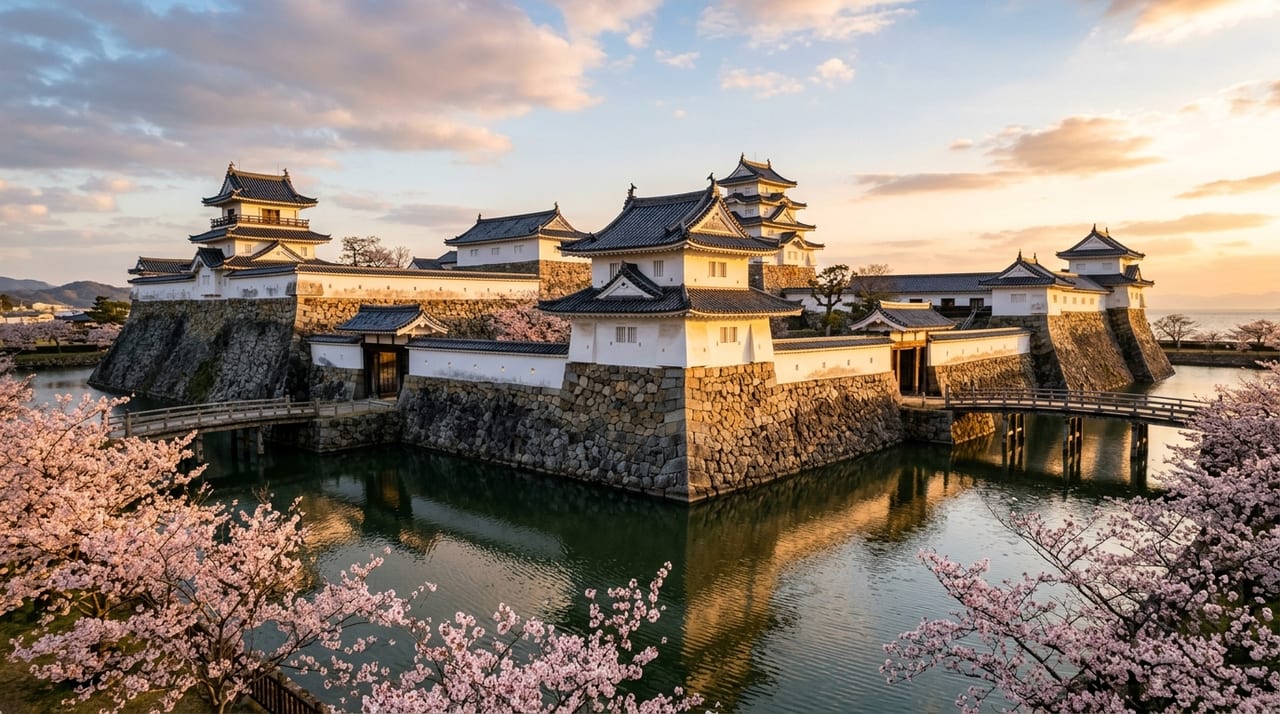
 * Image is for illustrative purposes only.
Tonokōri Castle
都於郡城
Tonokōri Castle is a historic castle in the Kyūshū region (1337 (Kenmu 4) to 1615 (Genna 1), when it was abandoned). Its lord was The Itō clan (from founder Itō Suketamochi onward); briefly occupied by Shimazu Yoshihisa.
Overview
Overview and Location
Tonokōri Castle is the principal castle of the Itō clan of Hyūga Province and is located in Saito City, Miyazaki Prefecture. Viewed from a distance, its castle area appears like a ship floating on water, earning it the nickname "Ukifune-jō" (Floating Ship Castle). It was designated a National Historic Site on September 6, 2000.
Construction and the Itō Clan's Base
Tradition holds that the castle was built in 1337 (Kenmu 4) by Itō Suketamochi. For roughly 240 years thereafter it served as the residence of successive heads of the Itō clan. At its height under Itō Yoshisuke, the Itō controlled nearly all of Hyūga Province, and as the center of a network of branch castles known as the "48 Castles of Itō," it fulfilled the clan's main seat functions together with Sadowara Castle.
The Shimazu Invasion and Itō Mancio
In 1577 (Tenshō 5), under pressure from the Shimazu clan, Itō Yoshisuke fled to Bungo (an episode known as the "Itō Kuzure"), and Shimazu Yoshihisa entered Tonokōri Castle. Thereafter, it was used as a forward base during Toyotomi Hideyoshi's pacification of Kyūshū and the Battle of Takajō. The castle town of Tonokōri is also known as the birthplace of Itō Mancio, who served as chief envoy of the Tenshō Embassy to Europe.
Structural Features
The castle complex comprises five principal enclosures — the main citadel (approximately 3,500 tsubo), second enclosure (1,200 tsubo), third enclosure (600 tsubo), western citadel, and rear citadel — surrounded by more than ten terraced sub-enclosures. A large mountain castle, its layout uses steep ravines as natural moats and is regarded as a representative example of medieval mountain castles in southern Kyūshū.
Current State and Highlights
The site is now developed as the ruins of Tonokōri Castle, with earthen ramparts and dry moats around the main and second enclosures surviving in good condition. In June 2024, the Tonokōri History Museum opened at the foot of the mountain, presenting exhibits on the history of the Itō clan and the life of Itō Mancio.
Highlights
- National Historic Site (2000) — the Itō clan's principal seat, nicknamed the 'Floating Ship Castle'
- Large mountain castle with five main enclosures and over ten terraced sub-enclosures
- Birthplace of Itō Mancio, chief envoy of the Tenshō Embassy to Europe
- Tonokōri History Museum (opened 2024) on-site for Itō clan history
* Opening hours and admission fees are subject to change. Please check the official website before visiting.