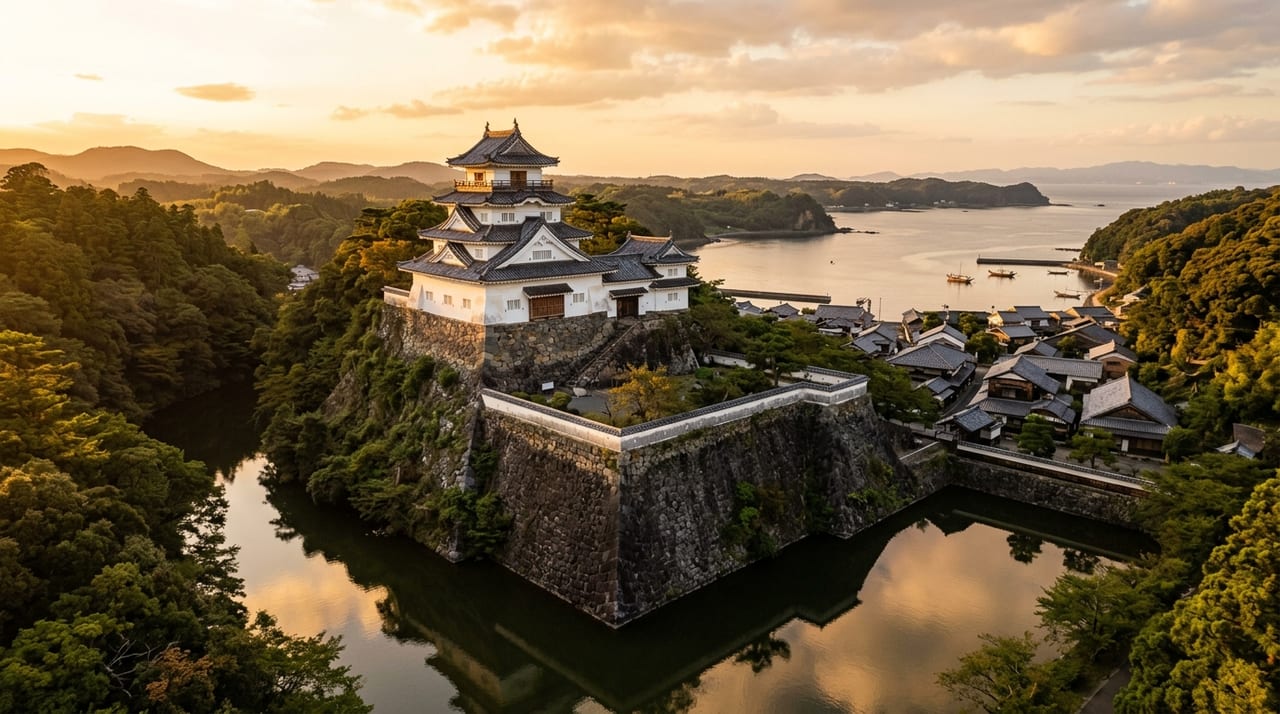
 * Image is for illustrative purposes only.
Kitsuki Castle
杵築城(木付城)
Kitsuki Castle is a historic castle in the Kyūshū region (Founded 1394 by Kitsuki Yorinao; Matsudaira clan became lords in the Edo period). Its lord was Kitsuki clan / Matsudaira (Nomi) clan.
Overview
Kitsuki Castle is a yamashiro (mountain castle) located in Kitsuki, Oita Prefecture, with the character of a kaisho (sea castle) built on a plateau jutting into Moriye Bay. The castle plan, with its main citadel positioned at the tip of a plateau flanked on the north and south by ravines, is known for its skillful design that maximizes the use of natural topography. The castle town is also called a "sandwich-type castle town" (sandoitchi-gata jōkamachi), and the unique topography—where the merchant quarter is sandwiched between two elevated areas lined with samurai residences—creates a landscape that is rare throughout Japan.
It is said that Kitsuki Yorinao founded the castle in Ōei 1 (1394). The Kitsuki clan, as senior retainers of the Ōtomo clan, long supported Bungo Province, and during the Sengoku period the castle's importance increased further. During the Shimazu invasion of Bungo in Tenshō 14 (1586)—the Hōsa War—Kitsuki Castle suffered from warfare but held firm and functioned as a defensive stronghold for the Ōtomo.
After the Battle of Sekigahara, the castle passed through the Hosokawa and Ogasawara clans, supporters of the Tokugawa, before the Matsudaira (Nomi) clan was granted the domain in Shōhō 2 (1645) and served as the seat of Kitsuki Domain until the Meiji Restoration. Under Matsudaira rule, the castle town underwent development and the landscape of samurai residences visible today was formed.
The current keep is a reconstructed castle tower built in Shōwa 45 (1970), but the stone walls, moat, and samurai residences retain much of the Edo period character, and the castle town as a whole is designated as a National Important Preservation District for Historic Buildings. The views from the castle overlooking Moriye Bay are considered among Oita's most spectacular scenery, and it is also called the "Little Kyoto of Bungo."
Connection to Swords
Kitsuki Castle's connection to Japanese swords cannot be discussed apart from the presence of Ōtomo Sōrin, the mightiest warlord of Sengoku-era Kyushu. The Kitsuki clan long served as senior retainers of the Ōtomo, and at the peak of the Ōtomo domain (mid-16th century) when they controlled six provinces—Bungo, Buzen, Chikuzen, Hizen, Higo, and Chikugo—Kitsuki Castle also played a role in their military and logistics network. Ōtomo Sōrin actively advanced Southern Barbarian trade with Portugal, exporting Bungo swords, lacquerware, and mineral resources in exchange for firearms and gunpowder. Bungo Province had long been known as a source of superior iron, and Bungo swords (Bungo-tō) were a major production center for practical fighting blades that circulated nationwide from the Muromachi period onward. The Ōtomo warlords who governed the various castles of Bungo, including Kitsuki Castle, carried practical fighting blades forged by Bungo smiths as they contended for dominance over Kyushu. The Shimazu invasion of Bungo in Tenshō 14 (1586) exerted a major impact on Kyushu's sword culture. Many Bungo smiths fled the devastation of war and relocated to other provinces, and the Bungo sword tradition faced a temporary crisis of discontinuity. However, when Kitsuki Domain achieved stability in the Edo period, Bungo smiths resumed their work to meet the sword needs of the domain's samurai, and the collection of daimyo Matsudaira included excellent Bungo swords. Armor, swords, and old documents continue to be preserved in private collections among the samurai residences of Kitsuki Castle. The Kitsuki Castle Town Museum displays materials related to Kitsuki's castle town and samurai culture, allowing visitors to encounter historical materials connected to both the Ōtomo and Matsudaira families. In understanding the cultural lineage of Bungo swords, Kitsuki Castle remains an indispensable point of reference.
Highlights
- Kitsuki Castle Keep (reconstructed) — panoramic views of Moriye Bay with Bungo history exhibits
- Sandwich Castle Town — sole example in Japan, National Preservation District for Historic Buildings
- Suyanosakashita & Shionoyasaka slopes — cobblestone paths linking samurai and merchant quarters
- Hitotsumatu Residence (former Matsudaira villa) — preserved Meiji-Taisho garden architecture
- Kitsuki City History Museum — Bungo sword, Ōtomo and Matsudaira clan artifacts
- Moriye Bay panorama — sweeping views of Bungo's sea and castle town from the hilltop
* Opening hours and admission fees are subject to change. Please check the official website before visiting.