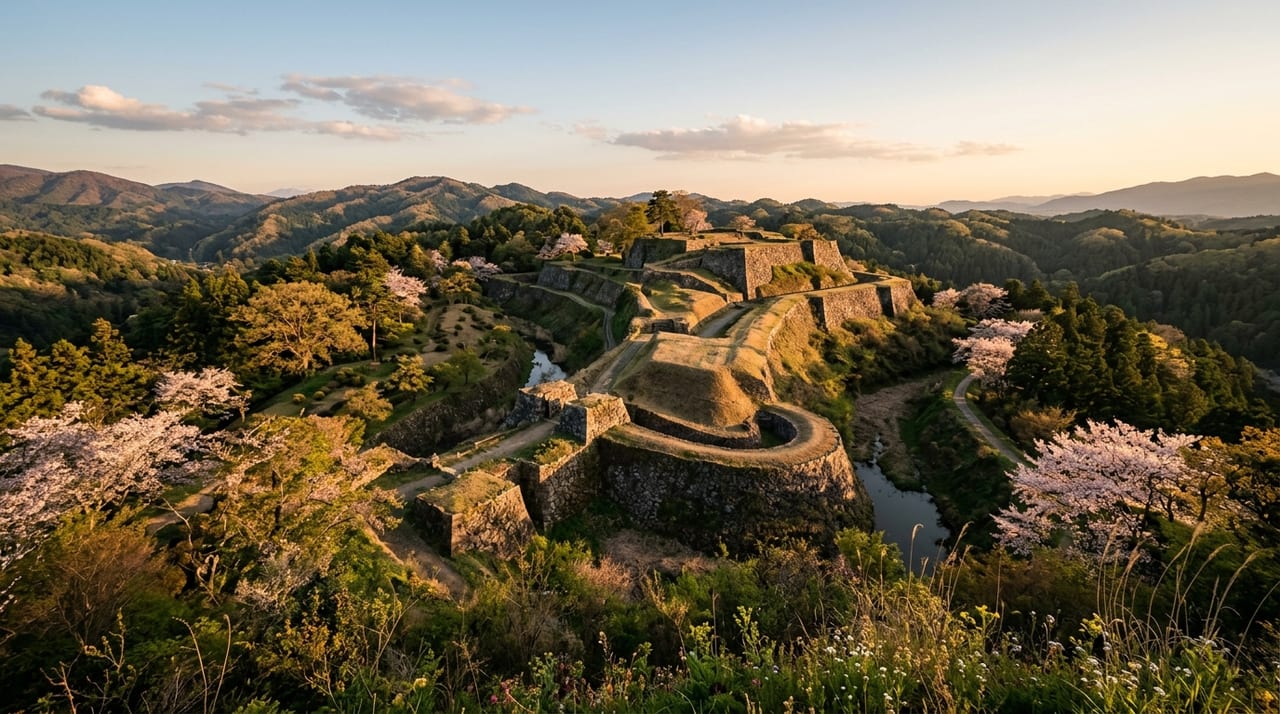
 * Image is for illustrative purposes only.
Iwaya Castle
岩屋城
Iwaya Castle is a historic castle in the Kyūshū region (Traditionally built during the Tenbun era (1530s to mid-1550s) by Takahashi Akitane; demolished in 1587 (Tenshō 15)). Its lord was Takahashi Akitane (founder); Takahashi Shigetane (Jōun).
Overview
Overview
Iwaya Castle was a mountain castle built on Mount Iwaya (281m, roughly 230m of relative elevation), part of the Shiōji mountain range north of Dazaifu City, Fukuoka Prefecture. Positioned to guard the approach to Dazaifu, it was an important stronghold in the Ōtomo clan's control of Chikuzen Province, and is best known as the site of castellan Takahashi Jōun's desperate last stand against a Shimazu army in 1586.
History and Succession of Lords
The castle is traditionally said to have been built during the Tenbun era (roughly the 1530s to mid-1550s) by the Ōtomo retainer Takahashi Akitane, who served as castellan of both Hōman Castle and Iwaya Castle as deputy military governor of Chikuzen. Akitane later defected to the Mōri clan, turned against Ōtomo Sōrin, and was driven from the castle. A member of the Ōtomo retainer Yoshihiro family then inherited the Takahashi name, becoming Takahashi Shigetane (later known as Jōun), and took command of Iwaya and Hōman castles. Jōun, alongside Tachibana Dōsetsu, worked to sustain the declining Ōtomo clan. On July 14, 1586 (Tenshō 14), a Shimazu army led by Shimazu Tadanaga, Ijūin Tadamune, and Akizuki Tanezane — numbering anywhere from 20,000 to 50,000 according to differing accounts — besieged Iwaya Castle as part of the Shimazu bid to conquer Kyushu. Jōun and 763 defenders held out for about two weeks, inflicting heavy losses on the besiegers, before the castle fell on July 27; Jōun and his entire garrison are said to have died in the fighting. Their resistance is credited with buying time before the arrival of Toyotomi Hideyoshi's pacification forces, and it burnished the reputation of Jōun's own son, Tachibana Muneshige (Dōsetsu's son-in-law and heir). The castle was demolished the following year, 1587.
Structure
A belt-shaped secondary enclosure (obikuruwa) surrounds the main enclosure, with an earthen rampart and dry moat (horikiri) remaining behind it to the north. The second enclosure to the southwest contains Takahashi Jōun's grave. The ridge extending to the southeast is cut by numerous horikiri and vertical trenches, the eastern side is lined with a staircase-like sequence of enclosures, and rows of obstacle trenches survive at the southern end.
Present Condition
The site carries no official cultural property designation. The remains of the main enclosure offer a commanding view over the town of Dazaifu and are a well-known local historical attraction; Takahashi Jōun's grave near the former second enclosure continues to draw visitors today.
Connection to Swords
Highlights
- Traditionally built during the Tenbun era by Takahashi Akitane to guard the approach to Dazaifu
- Later held by Takahashi Jōun, who alongside Tachibana Dōsetsu sustained the declining Ōtomo clan's hold on Chikuzen
- In 1586, Jōun and 763 defenders withstood a Shimazu siege for about two weeks before the entire garrison perished
- Jōun's resistance is said to have bought time before Hideyoshi's pacification army arrived, burnishing the reputation of his son Tachibana Muneshige
- Remains of the main enclosure, secondary enclosure, dry moats, and obstacle trenches survive, with sweeping views over Dazaifu
* Opening hours and admission fees are subject to change. Please check the official website before visiting.