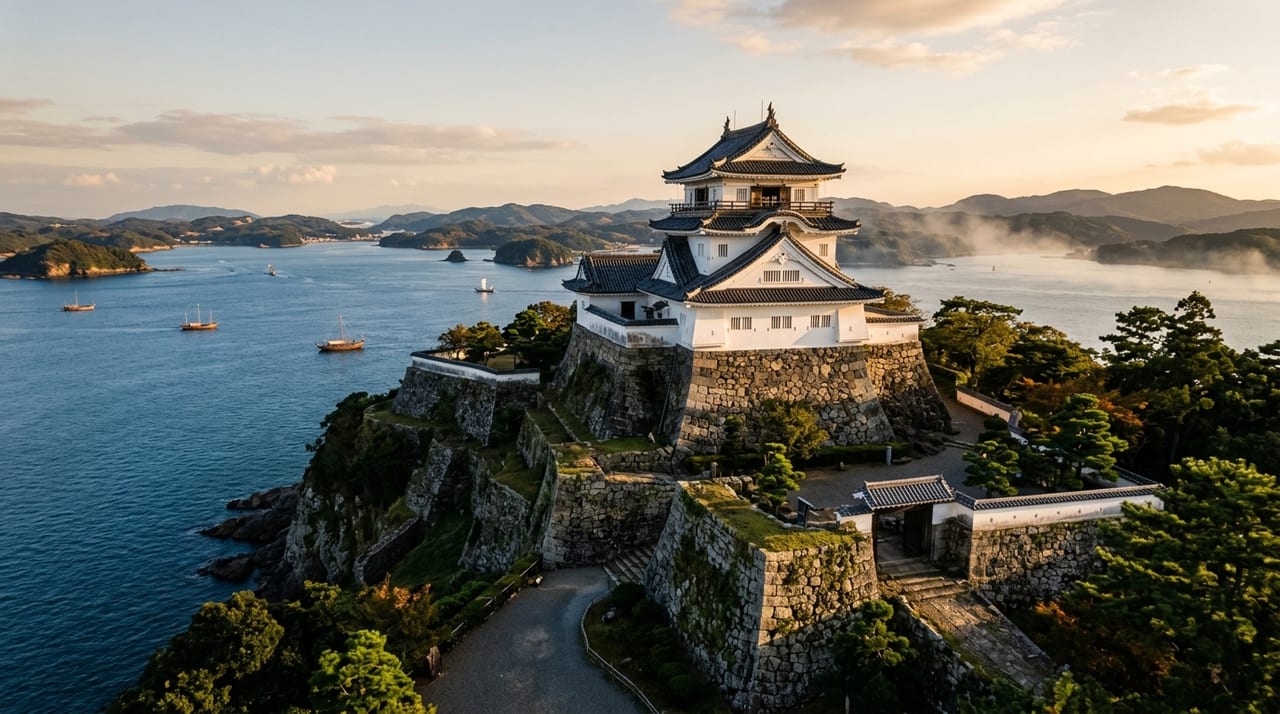
 * Image is for illustrative purposes only.
Hirado Castle
平戸城
Hirado Castle is a historic castle in the Kyūshū region (Construction began in Keichō 4 (1599); rebuilt in Hōei 4 (1707)). Its lord was Matsuura Shigenobu / Matsuura clan.
Overview
About the Castle
Hirado Castle is a seaside castle (umijiro) located in the northern part of Hirado Island, which floats in the Genkai Sea off the western tip of Kyushu. The Matsuura clan has been a powerful family in northwestern Kyushu since the late Heian period, and their home base of Hirado has long functioned as a gateway for trade with China, Korea, and Southeast Asia. Matsuura Shigenobu began building the castle in Keichō 4 (1599), but it burned down just before completion (it is also said that Shigenobu himself set the fire). In Genroku 16 (1703), the clan obtained permission from the bakufu, and construction began the following year. By Hōei 4 (1707), the castle was nearly complete, but no tenshu was built at that time; the Inui sanjū yagura was used in place of a tenshu. The current three-story tenshu is a replica built of reinforced concrete in Shōwa 37 (1962). In the castle town, temples and churches stand side by side. This scene is known as the “Landscape Where Temples and Churches Can Be Seen,” and it symbolizes the history of Hirado, where different cultures coexisted.
International Trading Hub
From the 16th to the 17th century, Hirado was at the forefront of international trade in Japan. Portuguese ships arrived in 1550, and Francis Xavier also visited Hirado, making it a base for Christian missionary work. The English and Dutch East India Companies then opened trading posts, and Hirado became an international commercial hub in East Asia. After William Adams (Miura Anjin) gained the trust of Tokugawa Ieyasu, he spent his later years in Hirado and died there. This is an important fact in the history of Japan–England relations. Under the sakoku (national isolation) policy, the Dutch trading post moved to Dejima in Nagasaki in 1641. Until then, Hirado flourished as an international trading port.
Matsuura Family Culture
Although the Matsuura family were samurai, they had exceptionally high cultural attainments, and successive generations enjoyed waka poetry, renga, the tea ceremony, and Noh theater. In particular, the daimyo of Hirado, Matsuura Seizan (Kiyoshi), is known as an enlightened lord. He had deep knowledge of swordsmanship, military strategy, and literature. His essay collection “Kasshiyawa” (甲子夜話), written in his later years, is highly valued as a first-class cultural document of the Edo period. Seizan studied the Shinkeitō swordsmanship school and is also known for writing books on swordsmanship. Hirado's culture had a unique duality: while it came into contact with foreign cultures through the sea, it firmly maintained Japan's own samurai culture.
Architecture and Structure
The three-story replica tenshu built in Shōwa 37 (1962) is small, but its white form reflected on the sea of Hirado Seto has exceptional beauty. The castle was built on a hill jutting into Hirado Seto and is surrounded by the sea on three sides. Within the castle grounds are the Tanuki Yagura and the Kita-koguchi Gate, which remain from the Edo period. The Inui Yagura and other structures were restored in Shōwa 37.
Tourism and Experience
From the tenshu of Hirado Castle, visitors can enjoy a magnificent view of the deep blue sea of Hirado Seto and the mainland of Kyushu. The “Landscape Where Temples and Churches Can Be Seen” is especially popular with photography enthusiasts as a signature view representing Hirado. The Matsuura Historical Museum (former residence of the domain lords) displays swords, armor, trade goods, and diplomatic documents handed down by the Matsuura family.
Connection to Swords
The sword culture of the Hirado Matsuura clan has a unique depth, nurtured by both the samurai culture of northwestern Kyushu and international trade. As a samurai family, the Matsuura clan long encouraged martial arts. Hizen Province (present-day Nagasaki and Saga prefectures) was one of Japan's leading sword-producing regions throughout the Edo period. Hizen-tō, the lineage of smiths such as Tadayoshi and Masahiro who were retained by the Nabeshima clan of Saga, was famous across the country for its orderly hamon and the beauty of its jigane. The Hirado domain lord Matsuura Seizan was renowned as a master of the Shinkeitō swordsmanship school, and his book Kasshiyawa contains many valuable passages on swordsmanship and swords. Within the Hirado castle's replica tenshu, the Kantō tachi (ring-pommel sword), an Important Cultural Property held by Kameoka Shrine, is also on display. The Matsuura Historical Museum holds swords, armor, and sword fittings handed down by the Matsuura family. It is one of the rare museums in Japan where visitors can experience a unique sword culture shaped by Hirado's history as an international trading port.
Highlights
- Landscape of Temples and Churches — a scene of cultural coexistence that symbolizes Hirado, where temples and churches stand side by side
- Matsuura Historical Museum (former domain lord's residence) — holds 800 years of Matsuura family swords, armor, Nanban trade goods, and diplomatic documents
- Hirado Dutch Trading Post Site (reconstructed) — trading post of the Dutch East India Company, a legacy of Japan–Europe exchange
- Grave of William Adams (Miura Anjin) — the burial site of Anjin, who spent his later years in Hirado
- Views of Hirado Seto — a magnificent view of the Genkai Sea and the Kyushu mainland from the tenshu
- Hirado champon and kasudōsu — Hirado's unique food culture brought by Nanban trade
* Opening hours and admission fees are subject to change. Please check the official website before visiting.