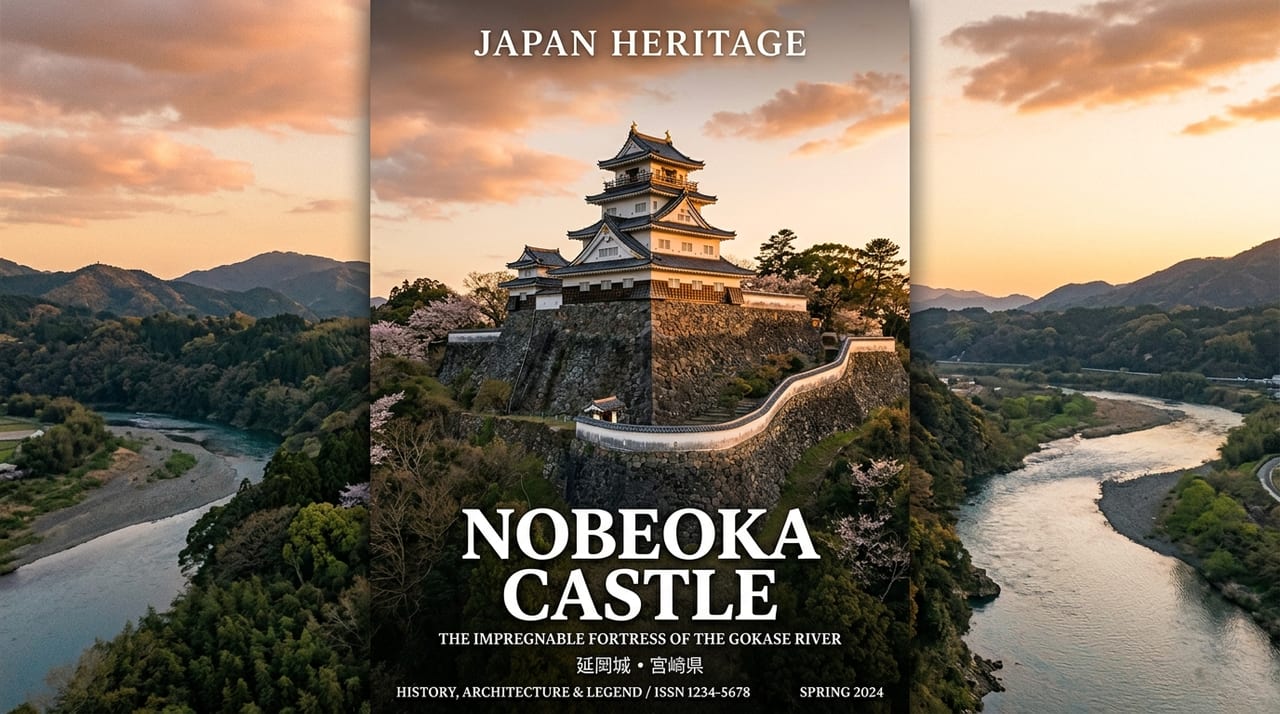
 * Image is for illustrative purposes only.
Nobeoka Castle
延岡城
Nobeoka Castle is a historic castle in the Kyūshū region (Built in 1603 (Keichō 8)). Its lord was Takahashi Mototane.
Overview
About the Castle
Nobeoka Castle was built in Keichō 8 (1603) by Takahashi Mototane on a plateau (Shiroyama) surrounded by the Gokase River and the Ōse River. It is a hirayama-style castle with a sturdy castle complex, including a three-story turret (sankai-yagura) used in place of a main keep (tenshu). It functioned as the political center of the Nobeoka domain, with 50,000 koku. The Arima family traces its lineage to the Christian daimyo Arima Harunobu, whose role was a remote cause of the Shimabara Rebellion, and the complex historical background of the Arima family is strongly reflected in Nobeoka, Hyūga. From the mid-Edo period onward, the Makino and Naitō clans served as castle lords, and the castle remained the center of domain governance until the Bakumatsu period.
Arima Family and the Shadow of Christianity
Arima Harunobu was known as a Christian daimyo, and in Tenshō 10 (1582) he sent the Tenshō Embassy of boys to Rome together with Ōtomo Sōrin and Ōmura Sumitada. The transfer of the Arima family from Hizen to Hyūga reflects the complex political position of the Arima family, which was a remote cause of the Shimabara Rebellion. Arima Naozumi abandoned Christianity and chose to serve the Tokugawa house.
Senningoroshi no Ishigaki
The greatest highlight of Nobeoka Castle is the massive stone wall on the east side of the honmaru, called the 'Senningoroshi no Ishigaki' (Thousand-Kill Stone Wall). This stone wall, about 19 meters high, has a legend that if enemies attacked, removing the stones at the very top would cause the entire wall to collapse, burying even a thousand attackers climbing up. Whether or not this mechanism is true, various carved marks remain on the surface of the stone wall, which extends about 70 meters in total length.
Naitō Family and Promotion of Culture
The Naitō family, which served as lords of the Nobeoka domain from the mid-Edo period until the Bakumatsu period, was a daimyo family with cultural refinement. It devoted itself to promoting learning and martial arts within the domain. At the domain school Kōgyōkan, martial arts and learning were taught, and people from Nobeoka were active in various fields in the late Edo and Meiji periods.
Swordsmanship Culture of Southern Kyushu
Hyūga Province, where Nobeoka is located, occupies a distinctive position within the warrior culture of southern Kyushu. Nobeoka is known even today as a chemical industry city, but the stone walls of Shiroyama and the landscape of the Gokase River vividly convey the memory of the warrior-era castle town.
Connection to Swords
The sword culture of Nobeoka Castle is made up of two distinctive elements: the intense warrior culture of southern Kyushu and the Christian background of the Arima family. Arima Naozumi's father, Arima Harunobu, was known as a Christian daimyo and came into contact with European weapon culture through Portuguese and Spanish ships. Sword fittings incorporating Christian designs are called 'kirishitan tsuba' and 'nanban tsuba', and they are recognized as having special value even in today's world of sword fitting collections. Hyūga Province (Miyazaki Prefecture), to which Nobeoka belongs, lay within the sphere of influence of southern Kyushu swordsmanship, and the influence of Jigen-ryū (Satsuma domain) and Yakumaru Jiken-ryū (lower-ranking samurai of the Satsuma domain) reached Hyūga as well. Jigen-ryū is a swordsmanship style characterized by a powerful diagonal downward strike (kesagiri) delivered from the 'tonbo' (dragonfly) stance, and it is a representative practical swordsmanship practiced by samurai of Kagoshima and Miyazaki. From the mid-Edo period onward, when the Naitō family governed the domain, the practical use of swords was encouraged through sword practice at the domain school Kōgyōkan. The castle buildings of Nobeoka Castle no longer survive, but the stone walls of Shiroyama (especially the 'Senningoroshi no Ishigaki') still have a power that overwhelms visitors today. Nobeoka City holds armor and armaments handed down by the Naitō family, which are designated as city cultural property.
Highlights
- Senningoroshi no Ishigaki — a massive stone wall about 19 m high, and the greatest highlight of Nobeoka Castle
- Shiroyama Park (Nobeoka Castle Ruins) — a castle ruin park on a high plateau overlooking the Gokase River. The view from the tenshu platform is superb
- Nobeoka Castle Naitō Memorial Museum — holds and exhibits materials related to the Naitō family
- Takachiho Gorge — about 1 hour by car from Nobeoka. The greatest tourist resource of Hyūga, the land of myth
* Opening hours and admission fees are subject to change. Please check the official website before visiting.