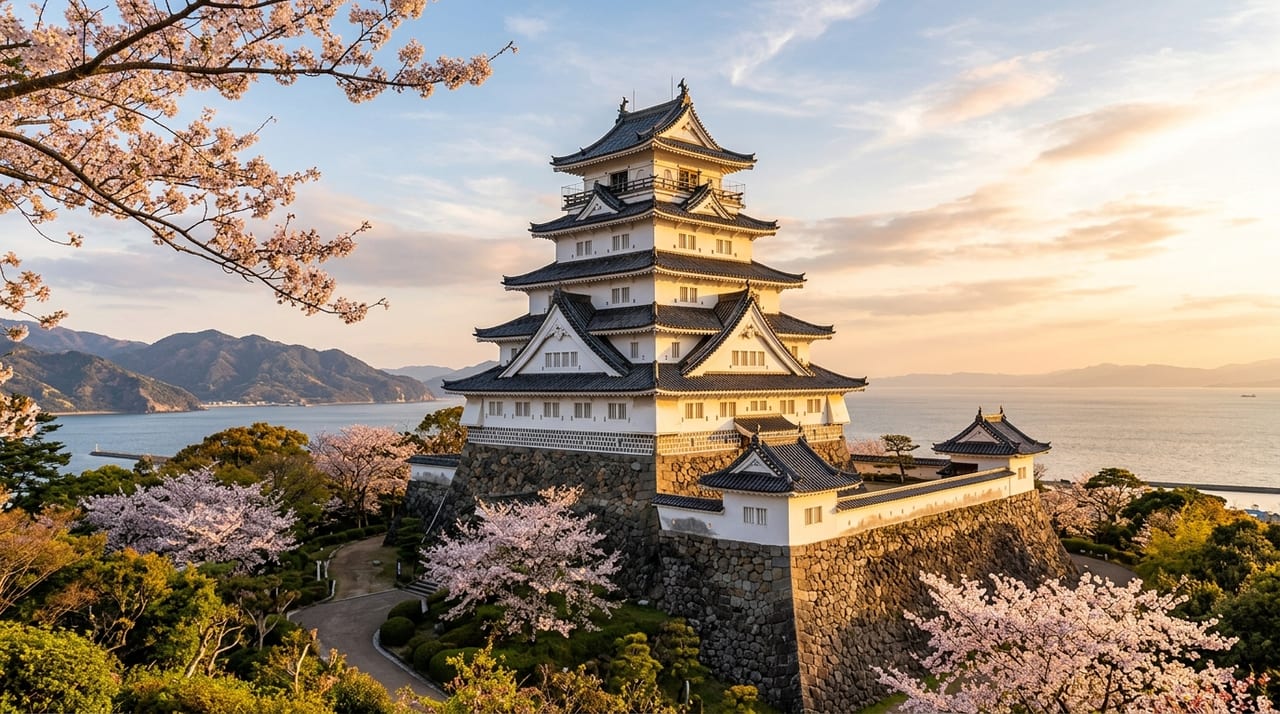
 * Image is for illustrative purposes only.
Shimabara Castle
島原城
Shimabara Castle is a historic castle in the Kyūshū region (Built in 1618 (Genna 4)). Its lord was Matsukura Shigemasa.
Overview
About the Castle
Shimabara Castle is an early-modern castle built on the Shimabara Peninsula in Hizen Province by Matsukura Shigemasa between Genna 4 (1618) and Kan'ei 1 (1624). It is a strongly fortified castle, centered on a five-story keep and protected by outer and inner moats, and it stands on high ground overlooking Shimabara Bay. The Matsukura family were daimyō who had been transferred from Yamato Province. They imposed harsh annual tribute and excessive labor on the people of Shimabara, and became the object of deep resentment. In particular, the combination of persecution of Kirishitan under the ban on Christianity and heavy taxation became the direct cause of the 'Shimabara Rebellion,' which later became the largest uprising in Japanese history.
The Shimabara Rebellion
The Shimabara-Amakusa Uprising (Shimabara Rebellion), which took place from Kan'ei 14 (1637) into the following year, is one of the largest civil wars in Japanese history: some 37,000 Kirishitan farmers and rōnin holed up in Hara Castle and clashed with a shogunate army of over 120,000. With the 16-year-old Amakusa Shirō (Masuda Tokisada) as commander-in-chief, the rebel forces held off the fierce assault of the shogunate army, which received bombardment support from Dutch ships, for some three months, but they were ultimately destroyed when their food supplies ran out. After this rebellion, the Edo shogunate completed its sakoku policy and moved to thoroughly suppress Christianity. Matsukura Katsuie (a son of Shigemasa) was held responsible for the rebellion and was stripped of his domain and beheaded, and Kōriki Tadafusa was newly enfeoffed at Shimabara Castle.
Kirishitan Culture and Swords
The Shimabara Peninsula and its surroundings were one of the regions in Japan where Christianity penetrated most deeply, and there were also several 'Kirishitan daimyō' who had themselves been baptized. The rebel forces who holed up in Hara Castle during the Shimabara Rebellion carried in weapons, ammunition and food they had seized from the domain's storehouses to prepare for the suppression army.
Reconstruction and Tourism of Shimabara Castle
The present keep of Shimabara Castle is a concrete structure rebuilt in Shōwa 39 (1964), and its interior has been developed as a museum on the Kirishitan, the Shimabara Rebellion, and Matsudaira culture. Within the castle, there is a rich collection of valuable materials on the Shimabara Rebellion, along with exhibits on the nature and history of Shimabara and Unzen. Around the castle, the 'samurai residence street' (Bukeyashiki-dōri) has been preserved, and its stone-paved townscape along the waterway conveys the atmosphere of an Edo-period castle town to the present day. Shimabara City spreads at the foot of Unzen-dake, and is a distinctive area with the memory of the eruption of Fugen-dake (1990–1995) and a rich hot spring culture.
Symbol of Shogunal Power
Through its construction process and the dramatic history of the Shimabara Rebellion, Shimabara Castle became a symbolic castle of the Edo shogunate's centralization and religious control. The historical sequence of harsh government, religious persecution, peasant resistance, and the shogunate's military suppression occupies an important place in history education as the case that most vividly illustrates the tension between power and the common people in the formation of the early-modern Japanese state.
Connection to Swords
The Shimabara and Amakusa region was an area where Christianity had penetrated deeply, and it was also the domain of Kirishitan daimyō such as Arima Harunobu. In the Shimabara Rebellion, the rebel forces carried weapons, ammunition and food they had seized from the domain's storehouses into Hara Castle and held out there, fighting for about three months against a shogunate army of more than 120,000. Today, the museum in the Shimabara Castle keep displays Kirishitan historical documents and materials on the Shimabara Rebellion, allowing visitors to learn about this region's distinctive history.
Highlights
- Shimabara Castle keep — museum displaying Kirishitan (Christian) materials, local history and folk materials
- Samurai district (Bukeyashiki-dōri) — preserved Edo-period streetscape with stone water channels
- Hara Castle ruins — UNESCO World Heritage Site; the Shimabara Rebellion's final siege location
- Unzen Hot Springs and Hell Valley — famous volcanic hot springs on the peninsula
- Shimabara spring water district — the 'city of water' with abundant natural springs
* Opening hours and admission fees are subject to change. Please check the official website before visiting.