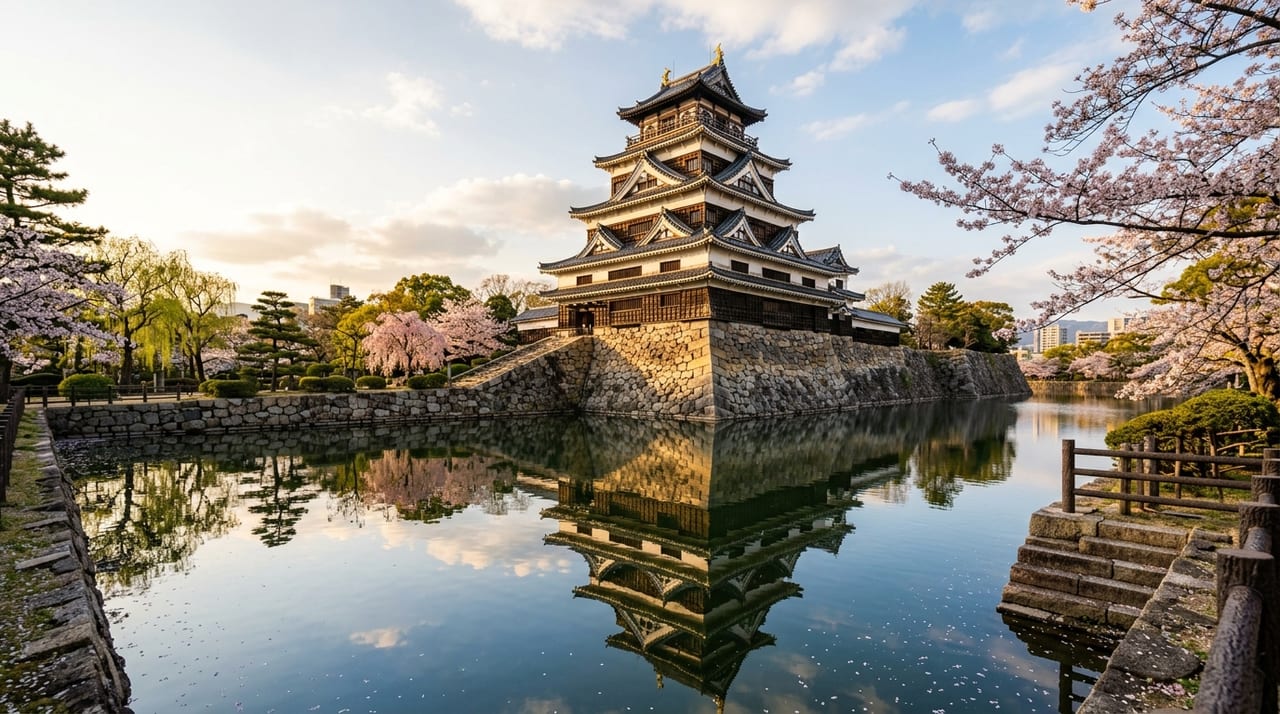
 * Image is for illustrative purposes only.
Saiki Castle
佐伯城
Saiki Castle is a historic castle in the Kyūshū region (Edo period (construction begun in 1602; completed in 1606); abolished in 1871). Its lord was Mōri Takamasa (first domain lord and builder); successive generations of the Mōri clan as lords of Saiki Domain.
Overview
Construction
Saiki Castle was begun in 1602 (Keichō 7) after the Battle of Sekigahara by Mōri Takamasa, who became the first lord of the Saiki Domain, and was completed in 1606 (Keichō 11). The castle layout was handled by Ichida Sukesada, a former retainer of Oda Nobunaga, and the stone wall construction is said to have been carried out by Hayama Kanzaemon, who had also taken part in the construction of Himeji Castle. The castle is also known by the alternative name “Tsuruya-jō,” and there are various theories about its origin, including that many cranes lived in the area and that the shape of the castle resembles a crane with its wings spread.
Succession of Lords
From its construction until the Meiji Restoration, the Mōri clan governed the Saiki Domain without interruption. In 1637 (Kan'ei 14), under the third lord, Mōri Takanao, the San-no-maru was added at the foot of the mountain, and the lord's residence was moved from the summit to the foot.
Structure
Built entirely of stone walls on the summit of Mount Hachiman at an elevation of 144 meters, it is a mountain castle with a connected-enclosure (renkaku-shiki) layout centered on the honmaru (main enclosure). It once had a three-tier, three-story main keep. Its distinctive feature is that it combines the terrain of medieval mountain castles with the advanced stone wall techniques of early modern castles.
Present Condition
After the castle was abolished in 1871 (Meiji 4), the buildings on the summit were removed in the early Meiji period, but the stone wall remains and the San-no-maru Yagura-mon gate at the foot of the mountain survive. The San-no-maru Yagura-mon gate is designated as a Tangible Cultural Property of Ōita Prefecture. Part of the San-no-maru palace has been moved within the city and preserved. The castle is designated as a national Historic Site, and in 2017 it was selected as No. 194 in the Continuation of Japan's Top 100 Castles.
Highlights
- Entirely stone-walled mountain castle built by Mōri Takamasa, who employed Hayama Kanzaemon and others who had worked on the stone walls of Himeji Castle
- Also known as “Tsuruya-jō” (various theories exist regarding its origin)
- The San-no-maru Yagura-mon gate survives as a Tangible Cultural Property designated by Ōita Prefecture
- National Historic Site; selected in 2017 as No. 194 in the Continuation of Japan's Top 100 Castles
* Opening hours and admission fees are subject to change. Please check the official website before visiting.