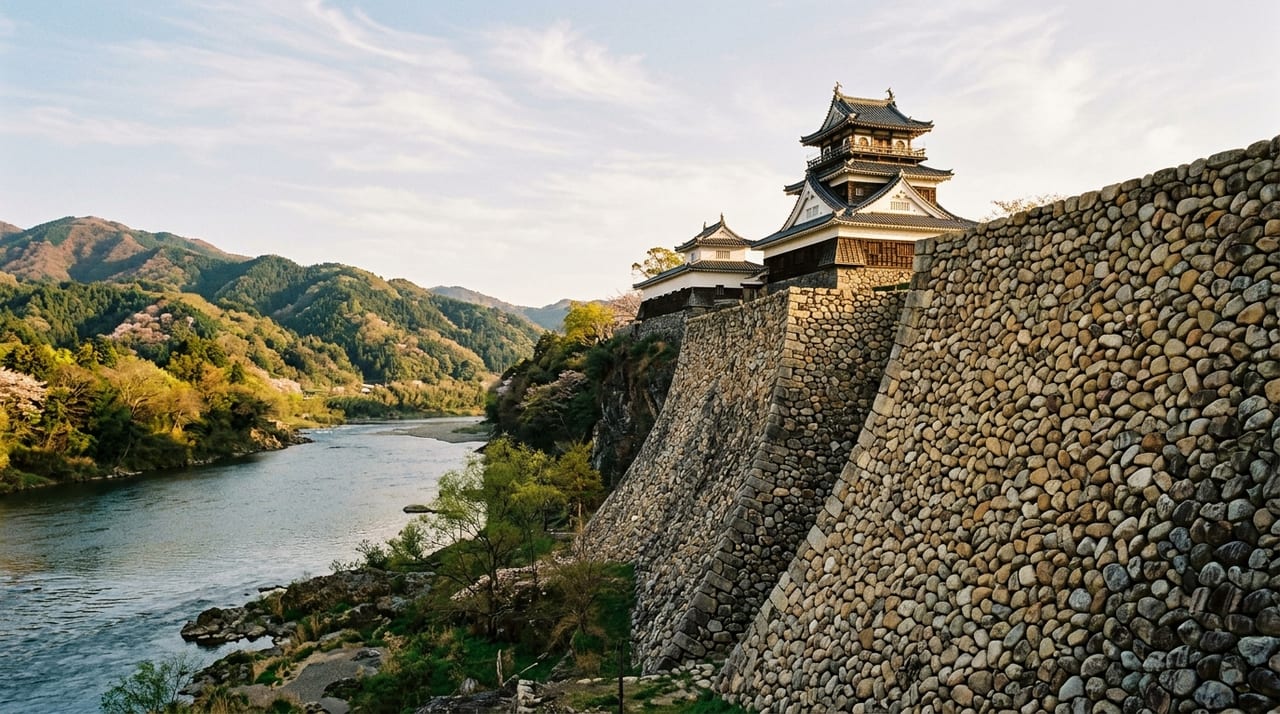
 * Image is for illustrative purposes only.
Hitoyoshi Castle
人吉城
Hitoyoshi Castle is a historic castle in the Kyūshū region (Established in the early Kamakura period when the Sagara clan entered the domain). Its lord was Sagara clan.
Overview
About the Castle
Hitoyoshi Castle is a hirayama-jo (hill castle) located at the confluence of the Kuma River and the Mune River, at the southern tip of Kumamoto Prefecture. It was ruled by the Sagara clan for approximately 670 years, from the Kamakura period until the Meiji Restoration, and is a castle that boasts one of the longest single-clan dominations in Japanese history. The Sagara clan entered Higo and Hitoyoshi as gokenin of the Kamakura shogunate and, weathering many historical storms, including the Nanboku-chō turmoil, the Shimazu invasions, and the Battle of Sekigahara, continued to rule the Hitoyoshi-Kuma region until the Meiji Restoration. The stone walls that remain on the banks of the Kuma River are rare stone-wall structures that employ the 'musha gaeshi' technique and the 'hanedashi' overhang construction, and they are highly valued as precious remains in the history of castle architecture.
670 Years of Sagara Clan Rule
The Sagara clan's rule of Hitoyoshi began in the early Kamakura period and continued until the abolition of the feudal domains and establishment of prefectures (haihan chiken) in Meiji 4 (1871). This was one of the longest continuous single-clan rules in Japan's regional history, and it vividly demonstrates the skill of the Sagara clan's diplomatic, military, and religious policies in surviving the Sengoku period. During the Sengoku period, the Sagara clan was surrounded by powers such as the Shimazu and the Ōtomo, and in Tenshō 9 (1581) it surrendered to the Shimazu. However, after Toyotomi Hideyoshi pacified Kyushu in Tenshō 15 (1587), negotiations led by the retainer Fukami Nagatomo secured confirmation of their ancestral domain, and the clan survived as an early modern daimyo.
Buddhism and Shinbutsu Shūgō
The Sagara clan were devout Buddhists for generations, and many Buddhist temples were built in the castle town of Hitoyoshi. The Hitoyoshi-Kuma region retains a rich legacy of shinbutsu shūgō (the syncretism of kami and buddhas) dating from the medieval period, and many of the Buddhist statues known as 'Kuma no Hotoke' have been designated National Important Cultural Properties. On the other hand, the Sagara clan strictly prohibited Jōdo Shinshū (Ikkō sect) throughout the early modern period, and although the area was also affected by haibutsu kishaku in the early Meiji period, many Buddhist cultural properties were protected and passed down by local people. The landscape of Hitoyoshi as a 'castle town with many temples' is a legacy of this layered history of faith.
Technical Distinctiveness of the Stone Walls
The most noteworthy feature of Hitoyoshi Castle's stone walls is the distinctive stone-wall structure known as 'hanedashi.' This rare technique projects the uppermost stones of the wall outward, and it can be seen in the stone walls of the Oyakata, built at the end of the Edo period, among others. This technique is one of the few examples nationwide, and it makes the stone walls of Hitoyoshi Castle unique. The stone walls that remain along the Kuma River are illuminated at night, so visitors can also enjoy a fantastical nighttime view.
Kuma River Rafting and Reconstruction
Hitoyoshi suffered severe damage in the heavy rain disaster of Reiwa 2 (2020), but recovery is progressing thanks to the efforts of local residents and support from across the country. The Kuma River is known as a sacred site for rafting, and boat sightseeing that views the Hitoyoshi Castle stone walls from the river is also being revived. Hitoyoshi Onsen is also known as one of Japan's leading hot spring resorts, and together with the restored inns and restaurants of the castle town, Hitoyoshi's tourism is gradually regaining its vitality.
Connection to Swords
The connection between Hitoyoshi Castle and swords can be discussed from two perspectives: the swordsmen who served the Sagara family, and the battles of the Satsuma samurai in the Seinan War. Marume Kurōdo-no-suke Nagayoshi, a retainer of the Sagara family, is known as a swordsman who, after studying Shinkage-ryū under Kamiizumi Nobutsuna, founded Taisha-ryū and spread it throughout Kyushu. Hitoyoshi Castle became the last battlefield in the Seinan War of Meiji 10 (1877). After failing to take Kumamoto Castle, the Satsuma army led by the samurai Saigō Takamori withdrew to Hitoyoshi, made it their base, and continued to resist. The Satsuma samurai who took part in this fighting still wore Japanese swords even in an era of modern firearms, and fought with a combination of swords and guns. Many of the Satsuma-koshirae swords worn by the Satsugun warriors had the robust, practical style of Satsuma swordsmiths, and sturdy blades able to withstand the powerful strike of Jigen-ryū were chosen. Saigō Takamori, who escaped from Hitoyoshi and ultimately met his end at Shiroyama in Kagoshima, has continued to be revered to the present day as a symbol of the spirit of Japanese bushidō, and that spirit is inseparably linked to the spirituality of the Japanese sword as 'shikon' (samurai-tamashii). For sword enthusiasts visiting Hitoyoshi Castle, we strongly recommend combining a visit to the castle ruins with a look at the history of the Sagara family at the Hitoyoshi Castle History Museum, and a tour of the Seinan War battlefield sites.
Highlights
- 'Hanedashi' stone walls — a rare musha gaeshi stone-wall structure, even by national standards. Built in the late Edo period
- Illuminated stone walls along the Kuma River — the nighttime scenery is fantastical, and the stone walls reflected on the river's surface are exceptionally beautiful
- Hitoyoshi Castle History Museum — displays materials that convey the 670-year history of the Sagara family; stone underground chamber remains are also preserved
- Kuma no Hotoke — a group of Buddhist statues that the Sagara clan continued to protect, reflecting shinbutsu shūgō. Many are National Important Cultural Properties
- Kuma River rafting — a descent of rapids of Japan's highest class. Also a luxurious route that views the castle ruins from the river
- Hitoyoshi Onsen — abundant hot spring flow and gentle water quality. Enjoy a relaxed stay at a hot spring inn in the restored castle town
* Opening hours and admission fees are subject to change. Please check the official website before visiting.