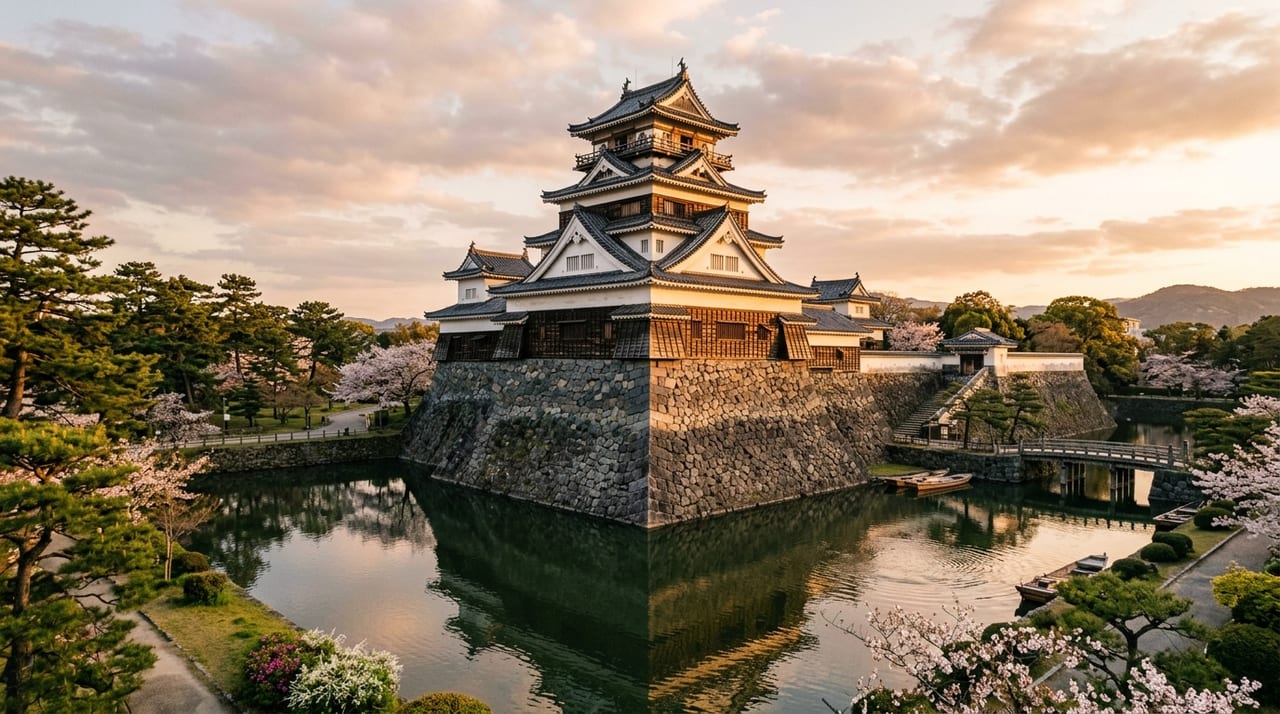
 * Image is for illustrative purposes only.
Uto Castle
宇土城
Uto Castle is a historic castle in the Kyūshū region (Preceded by the medieval Uto Castle (Nishioka-dai); from around Tenshō 17 (1589) Konishi Yukinaga built a new castle on Shiroyama; abandoned in Keichō 17 (1612)). Its lord was Nawa clan (medieval Uto Castle) / Konishi Yukinaga / Katō Kiyomasa.
Overview
Uto Castle is a hirayama-jō (a castle built on a hill rising from flat land) located in Uto City, Kumamoto Prefecture. It is an early-modern castle built on Shiroyama, just east of the medieval Uto Castle (Nishioka-dai), by Konishi Yukinaga, who was granted the southern half of Higo Province by Toyotomi Hideyoshi in Tenshō 16 (1588). Yukinaga was active as one of the principal commanders of the Korean campaigns (Bunroku-Keichō campaigns), and Uto Castle became the base of his military and cultural activities.
Konishi Yukinaga was a Christian (baptismal name Dom Agostinho), and it is said that there were many Christians in the castle town of Uto.
At the Battle of Sekigahara in Keichō 5 (1600), Yukinaga sided with the Western Army (on the side of Ishida Mitsunari) and, after the victory of the Eastern Army (led by Tokugawa Ieyasu), he was executed. Uto Castle surrendered after an attack by Katō Kiyomasa, and Kiyomasa carried out a major renovation of it as his own retirement castle; however, after Kiyomasa's death the castle was abandoned in Keichō 17 (1612). Even when the Uto branch domain of the Hosokawa family was established in the Edo period, no castle was built, and a jinya (administrative office) was installed instead. Today the Honmaru site has been developed as Shiroyama Park.
It is said that a three-story keep stood on the Honmaru of Uto Castle, and there is a tradition that this keep was moved to Kumamoto Castle; however, a survey carried out in connection with repairs to the Uto Yagura in Shōwa 2 (1927) is said to have found no traces of relocation. Stone walls and traces of moats remain at the Honmaru site, and a statue of Yukinaga has been erected there.
Connection to Swords
The relationship between Uto Castle and swords is condensed into the complex historical position of the figure Konishi Yukinaga and the development of sword culture in Kyūshū. Yukinaga is known as a Christian, but at the same time he was one of the foremost generals of the Toyotomi regime, and he fought on the front lines in the Bunroku-Keichō campaigns.
Kyūshū (especially Higo, Satsuma and Chikuzen) is a region that has had its own distinctive sword culture since the Sengoku period, and the Hizen-mono (swordsmiths around Saga Prefecture) earned high esteem throughout the Edo period.
Katō Kiyomasa, who succeeded to Uto Castle, is counted among the Seven Spears of Shizugatake and made Kumamoto Castle, to the north, his main castle.
In Keichō 5 (1600), when Yukinaga sided with the Western Army at the Battle of Sekigahara, Kiyomasa attacked Uto Castle, and the castle's deputy, Konishi Hayato, agreed to surrender in the 10th month of Keichō 5 (1600).
Highlights
- Stone walls of the Honmaru site — Stone walls and traces of moats remain at the Honmaru, where a three-story keep is said to have stood
- Bronze statue of Konishi Yukinaga — Statue of Yukinaga standing on the Honmaru site in Shiroyama Park
- Medieval Uto Castle ruins (Nishioka-dai) — National Historic Site where building remains, yokobori (horizontal moats), castle gates and the like have been reconstructed and maintained
* Opening hours and admission fees are subject to change. Please check the official website before visiting.