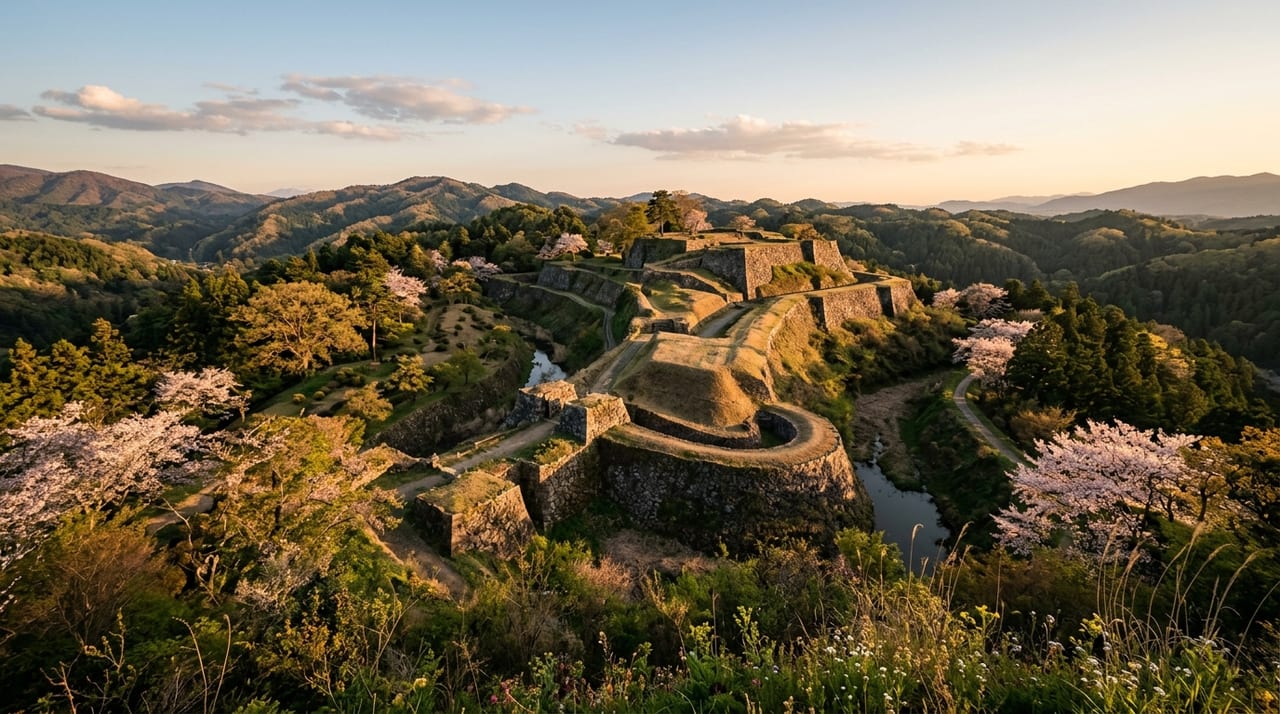
 * Image is for illustrative purposes only.
Ono Castle (Chikuzen Ono Castle)
大野城(筑前大野城)
Ono Castle (Chikuzen Ono Castle) is a historic castle in the Kyūshū region (Built in 665 CE (4th year of Emperor Tenji's reign)). Its lord was Yamato Dynasty (constructed under the direction of Baekje refugee engineers).
Overview
Background of Construction: The Battle of Baekgang and Military Defense System Reorganization
Ono Castle is an ancient mountain fortress constructed in 665 CE (4th year of Emperor Tenji's reign) by the Yamato Dynasty on Mount Shiōji (elevation approximately 410 meters) in Chikuzen Province (present-day Fukuoka Prefecture). The direct catalyst for its construction was the defeat of the allied Japanese-Baekje forces by the combined Tang-Silla forces at the Battle of Baekgang in 663 CE (2nd year of Emperor Tenji's reign). This defeat made it urgent to establish defensive measures against potential invasions by Tang and Silla.
Design and Construction
According to the Nihon Shoki (Chronicles of Japan), Ono Castle and Kii Castle (Saga Prefecture) were constructed under the direction of military experts who had fled from Baekje: Okurai Fukuru and Shibi Fukubu. This represented a typical example of a Korean-style mountain fortress built under the guidance of Baekje refugee engineers, marking a watershed moment in Japanese castle history. The castle's perimeter was enclosed by defensive walls (earthen and stone ramparts) spanning approximately 6.8 kilometers, with total defensive wall length reaching approximately 8.4 kilometers including the double-layer structure. The fortress covered a vast area of approximately 1.5 kilometers east-west and 3 kilometers north-south.
Structure and Remains
Within the castle, archaeologists have identified 9 gate sites, approximately 70 building remains across 8 districts, and well sites. The earthen and stone ramparts combined rammed-earth construction techniques (compacting successive layers of soil) with unmortared stone masonry, creating a structure that maximized the use of natural topography. Excavations have revealed numerous warehouse and food storage facilities, indicating the fortress also served as a logistical hub prepared for extended siege. Historical records document repairs to Ono Castle, Kii Castle, and Kikuchi Castle in 698 CE (2nd year of Emperor Monmu's reign), evidence of continuous maintenance.
As a Defensive Stronghold of Dazaifu
Ono Castle served as a key element in the defensive line protecting Dazaifu, the administrative center of Kyushu. While Mizuki, constructed during the same period, functioned as a defensive wall in the plains, Ono Castle served roles of surveillance from the mountain summit and as an emergency refuge point during crises. This integrated three-part defensive system of Ono, Mizuki, and Kii Castles represented the most critical defensive infrastructure in western Japan during the 7th and 8th centuries.
Present Day
The castle site is maintained and open to the public as the Fukuoka Prefectural Shiōji Citizens' Forest, with hiking trails and historic site viewing paths. In 1953, it was designated a National Special Historic Site, and in 2006, it was selected as the 86th castle of Japan's Top 100 Castles. In 2020, it was also recognized as a component cultural property of Japan Heritage titled "The 'Western Capital' of Ancient Japan—A Hub of Exchange with East Asia." Excavations continue to the present day, with ancient pottery, iron implements, and architectural remains being unearthed in succession.
Connection to Swords
Ōno Castle was an ancient military stronghold that protected Dazaifu. Smithing techniques of continental origin spread through Kyūshū as the gateway during this period, and are said to have contributed to the foundation of sword-making techniques that became the source of the Japanese sword.
Highlights
- Designated National Special Historic Site · 86th of Japan's Top 100 Castles
- Ancient mountain fortress built after the Battle of Baekgang
- Korean peninsula-style mountain fortress technology designed by Baekje refugee engineers
- Surviving earthen and stone ramparts spanning approximately 6.8 kilometers in perimeter
- 2020 Japan Heritage component property: "The 'Western Capital' of Ancient Japan"
* Opening hours and admission fees are subject to change. Please check the official website before visiting.