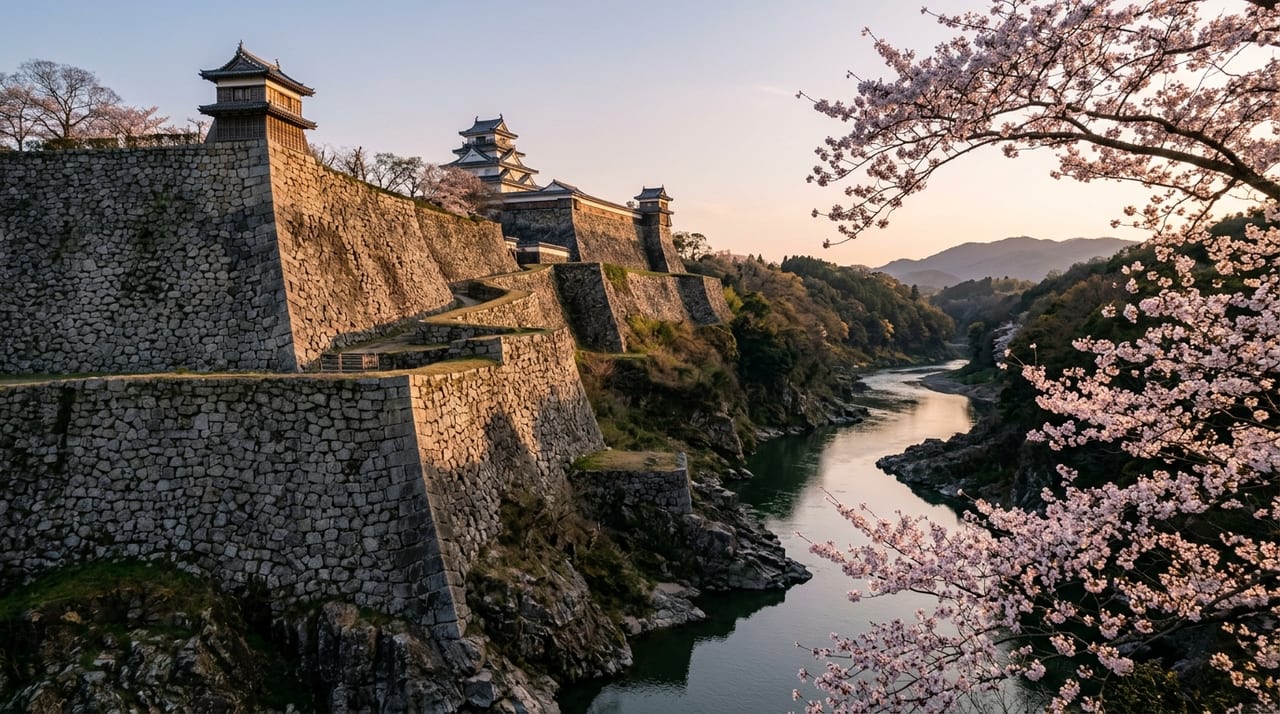
 * Image is for illustrative purposes only.
Kurume Castle (Shinoyama Castle)
久留米城(篠山城)
Kurume Castle (Shinoyama Castle) is a historic castle in the Kyūshū region (Origins as a fortress from the Eishō era (1504–1521); rebuilt into an early modern castle by Kobayakawa (Mōri) Hidekane after Tenshō 15 (1587)). Its lord was Kobayakawa (Mōri) Hidekane / Tanaka Yoshinobu / Arima Toyouji (first lord of the Kurume domain).
Overview
About the Castle
Kurume Castle is a hirayama-jō (flatland-hill castle) built on the diluvial plateau on the south (left) bank of the Chikugo River, in the northwest part of the city of Kurume, Fukuoka Prefecture. It was once also called Shinoyama Castle. The origins of the castle are said to lie in a stronghold built in the Eishō era (1504–1521) in the late Muromachi period. In Tenshō 15 (1587), Kobayakawa (Mōri) Hidekane, who entered the domain, rebuilt it into a castle equipped with stone walls and a tenshu (keep). In Keichō 6 (1601), Tanaka Yoshimasa, who had distinguished himself at the Battle of Sekigahara, was granted the whole of Chikugo Province. He made Yanagawa Castle his main castle, made Kurume Castle a branch castle, and installed his second son, Tanaka Yoshinobu, as its lord. Then, in Genna 6 (1620), Arima Toyouji entered as the first lord of the Kurume domain with 210,000 koku, and from then on the Arima family governed Kurume for 11 generations until the Meiji Restoration. The Arima family of the Kurume domain was the Settsu Arima clan, descended from the Akamatsu clan, beginning with the domain founder Arima Norimori (a separate line from the Hizen Arima clan of Shimabara, the Christian daimyō family).
History of the Arima Family and the Kurume Domain
Arima Toyouji was a warlord who sided with the Eastern Army at the Battle of Sekigahara and also distinguished himself in the Siege of Osaka. Under Arima rule, Kurume developed as the central city of Chikugo Province, and many artisans and merchants gathered in the castle town, nurturing a distinctive industrial culture. The famous Kurume kasuri (kasuri) is a cotton ikat fabric created in Kurume in the late Edo period, and it is still known today as one of Japan's three great kasuri. The delicate patterns and practical material quality of Kurume kasuri are a product unique to a castle town where samurai culture and commoner culture merged. In addition, Meizendō, the han school established by the Arima family, is the origin of today's Fukuoka Prefectural Meizen High School.
Chikugo River and the Castle's Terrain
Kurume Castle had the natural defenses of the Chikugo River at its back, and in some places its stone walls were built directly on cliffs along the river, combining the features of a water castle with the sturdiness of a hirayama-jō. Today the Honmaru site is the precincts of Shinoyama Shrine, and parts of the stone walls and moats from that time are preserved in good condition. Shinoyama Shrine enshrines the domain founder Arima Toyouji and is still beloved by citizens as a spiritual pillar of Kurume's samurai culture. From the castle ruins, the majestic flow of the Chikugo River and views of the Kurume city center open up, allowing visitors to relive the rich scenery of the Chikugo Plain that the warlords who ruled this area would have seen.
Samurai Culture of Kyushu
Although the Kurume domain was a medium-sized domain of 210,000 koku, it boasted a high standard in both martial arts and scholarship. In swordsmanship, schools such as Katōda Shinkage-ryū were transmitted. Armor and other items handed down in the Arima family are displayed at Arima Memorial Hall on the Honmaru site, conveying to the present day the depth of Kyushu's samurai culture.
Legacy of Modern Kurume
After the Meiji era, Kurume developed as a military city, and an army division headquarters was installed there. In modern Kurume, the rubber and textile industries developed and became the foundation of its industry. Kurume, with its diverse cultural heritage of Kurume kasuri, scholarship, and martial arts, is one of the cities that best embodies the richness of Kyushu's castle-town culture.
Connection to Swords
The sword culture of Kurume Castle is closely tied to the distinctive martial spirit of Kyushu itself. In the Sengoku period, Kyushu was a fiercely martial land where three major powers, the Shimazu, Ōtomo, and Ryūzōji, competed for supremacy, and the warrior spirit forged in those battles gave Kyushu's sword culture a unique robustness. In Sengoku Kyushu there also appeared individualistic warlords who came into contact with Western civilization, such as Arima Harunobu, known as a Christian daimyō (of the Arima clan of Hizen Hinoe and Shimabara, a separate line from the Arima family of the Kurume domain), which speaks to the open cultural climate of Kyushu. One of the most renowned lineages of Kyushu swordsmiths is the Tadayoshi school of Hizen Province (Saga and Nagasaki). The first-generation Hizen Tadayoshi was a master smith representing the early Edo period, and the beauty of his clear hamon and fine jihada made the name Hizen-tō resound across the country. Hizen-tō was widely favored by everyone from samurai to commoners, and its reputation especially as a practical blade remained unshaken throughout the Edo period. Arima Memorial Hall exhibits armor, crafts, and other items handed down in the Arima family. The sword culture of Kyushu developed in a unique way different from that of Honshu, and its vitality and diversity further enrich the world of Japanese swords.
Highlights
- Shinoyama Shrine (Honmaru site) — enshrines the domain founder Arima Toyouji; castle ruins where stone walls and moats from that era remain
- Stone walls along the Chikugo River — the defenses of a hirayama-jō that make use of the river and cliffs; impressive remains
- Arima Memorial Hall — located on the Honmaru site, exhibits armor, crafts, and other items handed down in the Arima family
- Kurume kasuri — one of Japan's three great kasuri, a traditional textile born in the late Edo period
- Suitengū (nationwide head shrine) — head shrine of Suitengū nationwide, a prestigious shrine that Kurume is proud of
- Birthplace of Kurume ramen — a castle-town gourmet known nationwide as the birthplace of tonkotsu ramen culture
* Opening hours and admission fees are subject to change. Please check the official website before visiting.