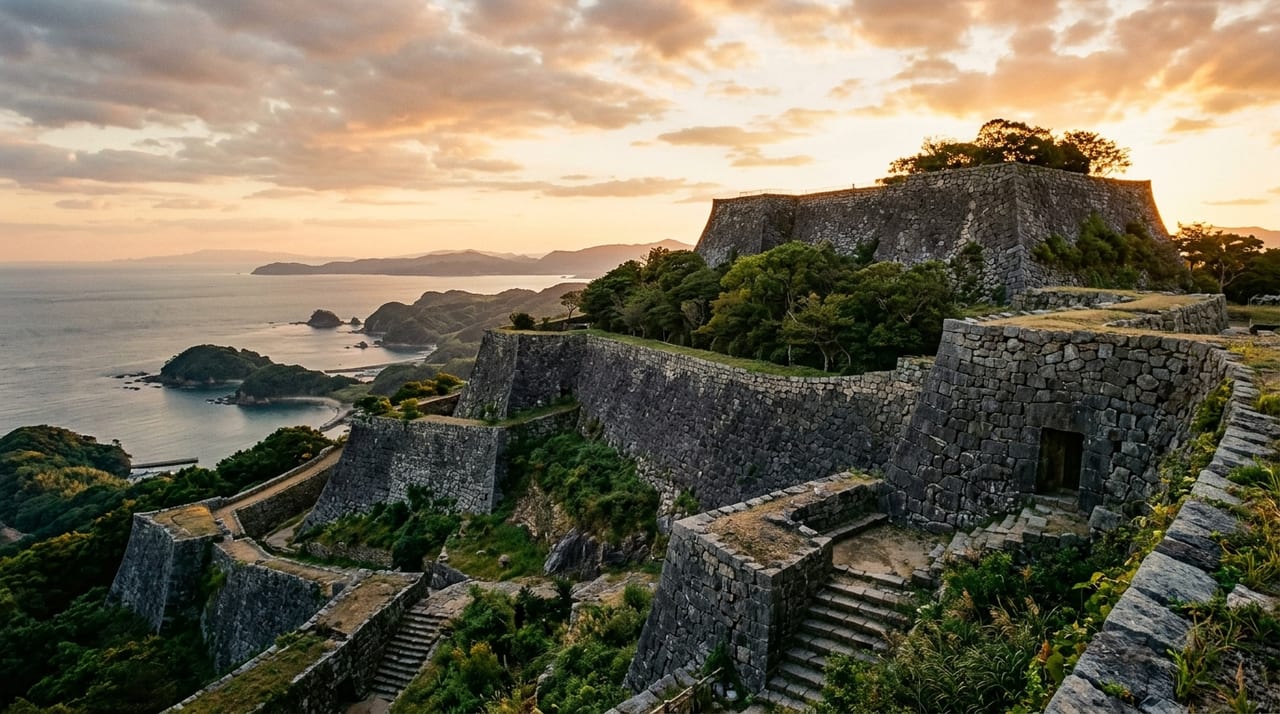
 * Image is for illustrative purposes only.
Hizen Nagoya Castle
肥前名護屋城
Hizen Nagoya Castle is a historic castle in the Kyūshū region (Construction began in Tenshō 19 (1591), completed in Bunroku 1 (1592); functioned as the base for the Bunroku-Keichō military campaigns). Its lord was Toyotomi Hideyoshi.
Overview
Hizen Nagoya Castle is located in Karatsu City, Saga Prefecture. It was a massive military base built by Toyotomi Hideyoshi for his invasion of Korea (the Bunroku-Keichō Campaigns). Construction began in the 10th month of Tenshō 19 (1591), and the castle was completed in the 3rd month of Bunroku 1 (1592), the following year, through a short, rush construction project. For a castle of its time, its scale was second only to Osaka Castle. Daimyo from across the country set up encampments around the castle, and some 100,000 soldiers, merchants and craftsmen gathered in the castle town, temporarily forming one of the largest cities in Japan.
The layout of the castle makes skillful use of hilly terrain with differences in elevation, and it has a grand structure with several enclosures (kuruwa), including the Honmaru, Ninomaru, Sannomaru and Yamazatomaru. The stone walls of the tenshudai were built using the nozura-zumi technique of rough-stone masonry, and the stone walls that remain today convey the majesty of that time. After Hideyoshi's death in Keichō 3 (1598), the year the Bunroku-Keichō Campaigns ended, the castle was abandoned, and its buildings are said to have been relocated by Terazawa Hirotaka to Karatsu Castle. Key sections of the stone walls were also dismantled after the Shimabara Rebellion of the Edo period.
The castle site is now designated as a National Special Historic Site, and the Saga Prefectural Nagoya Castle Museum has been built adjacent to the castle ruins. The museum centers on the Bunroku-Keichō Campaigns and conveys the history of exchange between the Japanese archipelago and the Korean Peninsula, from prehistoric and ancient times through the modern era. The castle ruins lie within Genkai Quasi-National Park, where a spectacular view overlooking the Genkai Sea overwhelms visitors.
Connection to Swords
Hizen Nagoya Castle was the castle that served as the staging base for the Bunroku-Keichō Campaigns.
Toyotomi Hideyoshi had the armies of daimyo from across the country gather at this castle, and the samurai led by each daimyo crossed over to the Korean Peninsula wearing uchigatana and wakizashi. Kato Kiyomasa, Konishi Yukinaga, Kuroda Nagamasa and other Kyushu daimyo also took part in the construction work (fushin) of Nagoya Castle.
Hizen Province (Saga and Nagasaki) developed as a major production center of Hizen blades throughout the Edo period, and the illustrious names of Hizen swordsmiths, such as Tadayoshi and Masahiro, were handed down until the late Edo period. Nagoya Castle was built in Matsura District of that same Hizen Province.
Highlights
- Honmaru Tenshudai Stone Walls — National Special Historic Site where the stone walls of the tenshudai (main tower base) survive
- Saga Prefectural Nagoya Castle Museum — comprehensive museum on the Bunroku-Keichō Campaigns and cultural exchange with Korea
- Remains of more than a hundred daimyo encampments — encampment remains of individual daimyo scattered around the castle
- Views of the Genkai Sea — spectacular vistas over the sea that was the route to the Korean Peninsula
* Opening hours and admission fees are subject to change. Please check the official website before visiting.