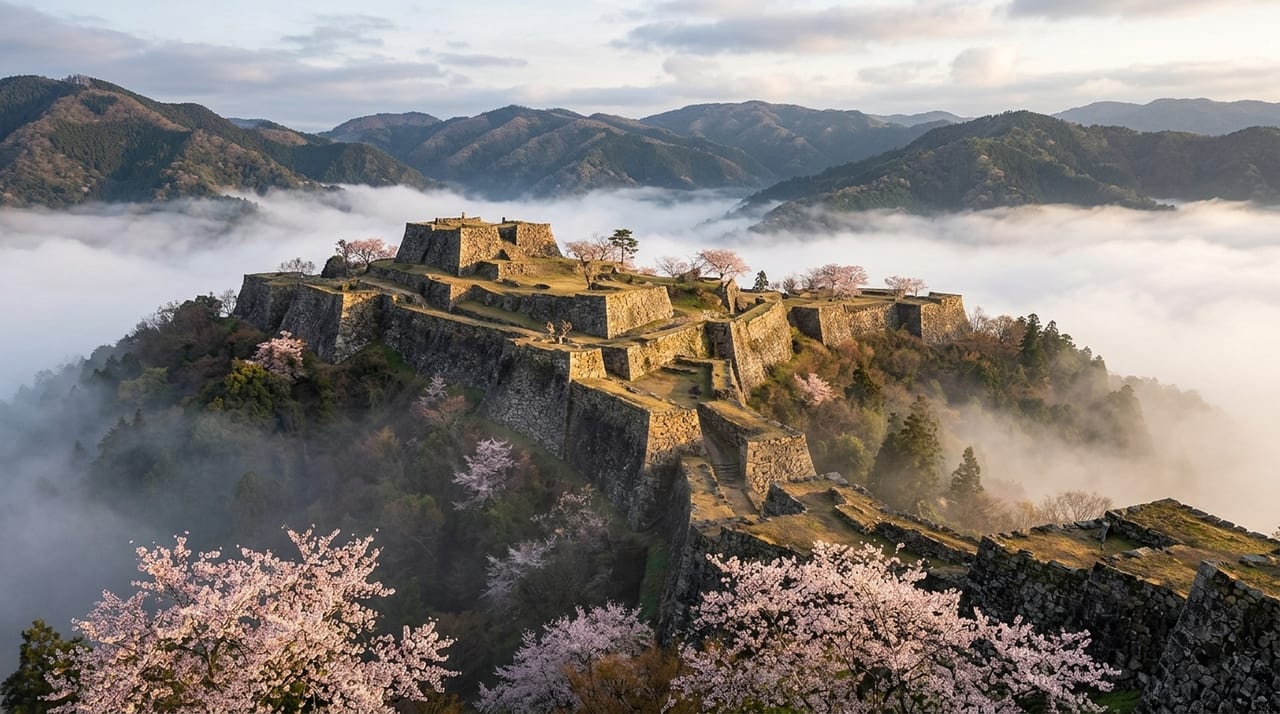
 * Image is for illustrative purposes only.
Oka Castle
岡城
Oka Castle is a historic castle in the Kyūshū region (Founded ca. 1185 (Bunji 1)). Its lord was Nakagawa Hidenari.
Overview
About the Castle
Oka Castle is a mountain castle located in Taketa, Ōita Prefecture. It was built on a plateau (Shiroyama) at an elevation of 325 meters, a naturally formidable site where the Inaba River and the Shirataki River, flowing along the foot of Mount Aso, have carved deep gorges. It is a medieval mountain castle. According to tradition, it was built by Ogata Saburō Koreyoshi to welcome Minamoto no Yoshitsune in the first year of Bunji (1185). Afterward, under the rule of the Ōtomo and Shiga clans, Nakagawa Hidenari entered the castle in the third year of Bunroku (1594), and it was developed into an early-modern castle. The tall stone walls stacked in layers along the mountaintop are highly regarded as the finest castle landscape in Ōita.
Taki Rentarō and 'The Moon over the Ruined Castle'
The greatest reason Oka Castle is known throughout Japan is 'Kōjō no Tsuki' (The Moon over the Ruined Castle), which the composer Taki Rentarō wrote inspired by the ruins of this castle. Rentarō spent his boyhood in Taketa, where his father was posted, and enjoyed the ruins of Oka Castle as a playground. In Meiji 34 (1901), he set to music a poem by the lyricist Doi Bansui. 'Kōjō no Tsuki' remains widely sung today as one of the masterpieces of modern Japanese song. The lyrics, beginning with 'Spring at the high tower, a banquet of flowers...', express the impermanence of glory and decline through the light of the moon, and they match the scenery of Oka Castle's ruins perfectly. Today, a bronze statue of Taki Rentarō stands at the Oka Castle ruins, and stone monuments inscribed with 'Kōjō no Tsuki' are placed in various locations. The castle site is one where the melody of this famous song flows through the spring cherry blossoms, the autumn leaves, and the winter snowscapes.
The Nakagawa Family and the Culture of Oka Domain
Nakagawa Hidenari entered Oka in the third year of Bunroku (1594). He had been transferred from Miki Castle in Harima, and he carried out a major renovation of Oka Castle into an early-modern castle. The Nakagawa family was a line of warriors who served as retainers of Hashiba Hideyoshi and were active under the Toyotomi regime. In governing the 70,000-koku Oka domain, the family devoted great effort to promoting scholarship and the martial arts. The domain school of Oka, 'Yugakukan,' was of high standard even among the domain schools of Kyushu, and in the late Edo period it produced many patriots who joined the movement to overthrow the shogunate and the movement for imperial loyalty. Among people from Oka domain, there were also outstanding figures in culture, such as the late-Edo literati painter Tanomura Chikuden, who also served as head of the domain school Yugakukan.
Stone Walls and the Castle of the Clouds
The stone walls of Oka Castle reflect a high level of technical skill. The landscape of tall stone walls stacked in layers along the mountain ridgeline takes on a mystical beauty, especially on misty days and in winter snowscapes. The castle is also introduced as a castle floating above a sea of clouds, and from early morning, photography enthusiasts gather to photograph the castle walls floating within the clouds. In spring, the contrast between the cherry blossoms and the stone walls is exquisite, and many tourists visit during the Oka Castle Cherry Blossom Festival.
Ōita's Hot Spring Culture and Oka Castle
Taketa City is located in one of the hot spring regions of Ōita Prefecture. Nearby are Nagayu Hot Spring, one of Japan's leading carbonated springs, and the Kuju Highlands. Hot spring trips that combine sightseeing at Oka Castle are popular. The castle town of Taketa retains a retro streetscape. By visiting the Taki Rentarō Memorial Hall together with the Taketa City History and Culture Hall 'Yugakukan,' you can deeply appreciate the history and culture of Oka Castle and Oka domain.
Connection to Swords
Oka Castle's connection to swords can be discussed from three perspectives: the sword culture of Bungo, the promotion of the martial arts by the Nakagawa family, and the samurai aesthetic symbolized by 'Kōjō no Tsuki.' The warriors of Oka domain were shaped by the sword culture of Kyushu, and in the Bungo region (Ōita Prefecture) in particular, distinctive sword schools existed. In the era of the Ōtomo clan, which ruled Bungo, firearms introduced by the Southern Barbarians (Portuguese and Spanish traders) spread rapidly, and a unique weapon culture in which swords and firearms coexisted took root in Bungo. Nakagawa Hidenari was a warrior who inherited the headship of the family after his elder brother Hidemasa died on the battlefield during the Bunroku campaign, and who moved to Oka on the orders of Toyotomi Hideyoshi. Materials related to the Nakagawa family are introduced at the Taketa City History and Culture Hall 'Yugakukan,' and they convey the Nakagawa family's pride and sense of beauty as warriors. Bungo, where Oka Castle stands, is also known as a production center of 'Bungo smiths.' Among Bungo blades, the Takada school is known for producing many practical swords from the Nanboku-chō period to the Muromachi period. Even earlier, Bungo no Kuni Yukihira (Ki no Shin-daiyū Yukihira), who was active from the late Heian period to the early Kamakura period, is said to have been one of the go-ban smiths (rotating imperial sword smiths) of Emperor Go-Toba, and he is a master craftsman. Bungo swords are characterized by their rugged construction and sharp edges, and they are considered a typical example of the swords that Kyushu warriors preferred in actual combat. What 'Kōjō no Tsuki' symbolizes is the spirit of samurai beauty amid the impermanence of rise and fall. It deeply resonates with the Japanese sensibility that the Japanese sword is a work of art that goes beyond a mere weapon and embodies 'mono no aware.' The moonlight pouring onto the stone walls of the abandoned castle and the clear, bright hamon of a blade forged by a craftsman with his whole spirit are two expressions born from the same source of Japanese aesthetic sense. Sword enthusiasts who visit Oka Castle, humming 'Kōjō no Tsuki' as they walk along the stone walls, will be able to most intuitively sense the spiritual soil of samurai culture from which the Japanese sword was born.
Highlights
- Magnificent tall stone walls — tall stacked stone walls line the mountain ridge. The finest castle landscape in Ōita Prefecture
- Taki Rentarō Statue and 'Kōjō no Tsuki' Monuments — the birthplace of a famous song. A spectacular combination with cherry blossoms in spring and snowscapes in winter
- Castle in the Mist, Stone Walls in the Clouds — on early mornings during the misty season, the castle becomes a mystical castle above a sea of clouds
- Taketa City History and Culture Hall 'Yugakukan' — a history and culture hall presenting materials related to the Nakagawa family and Oka domain
- Taki Rentarō Memorial Hall — carefully introduces the composer's life and the story of the birth of 'Kōjō no Tsuki'
- Nagayu Hot Spring — about 30 minutes by car from Oka Castle. A healing hot-spring stay (tōji) to restore body and mind in one of Japan's leading carbonated springs
* Opening hours and admission fees are subject to change. Please check the official website before visiting.