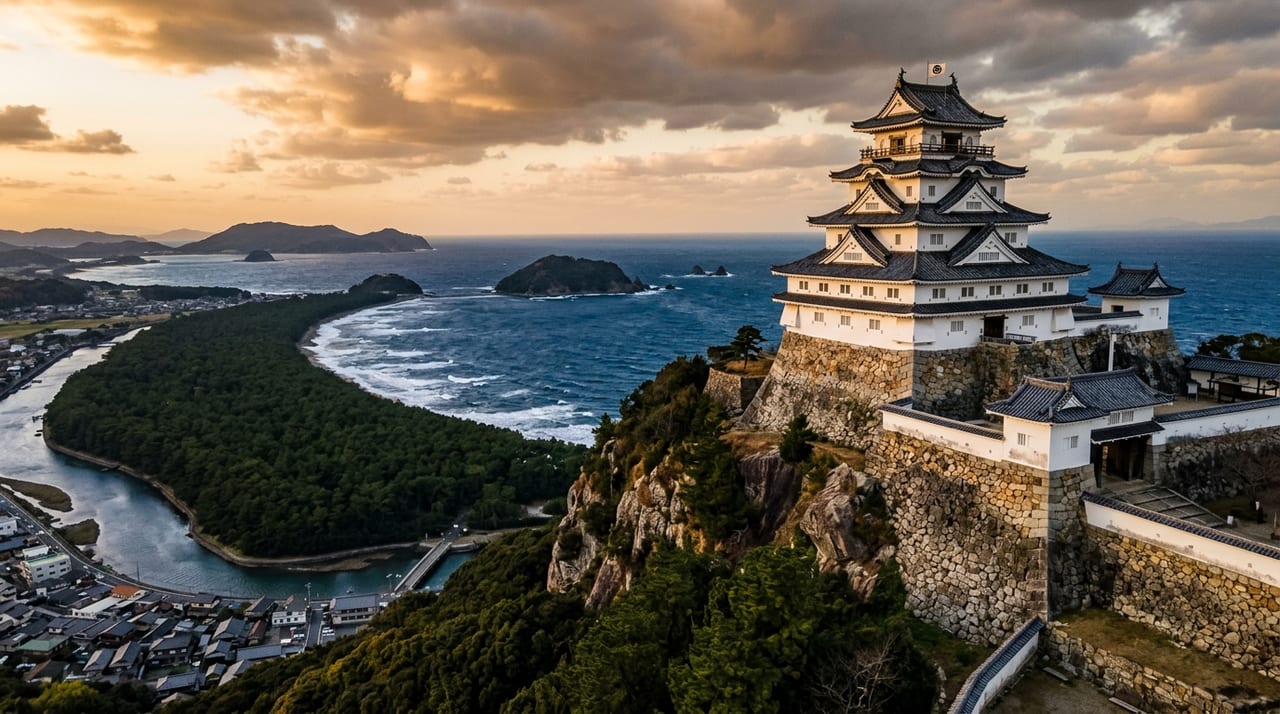
 * Image is for illustrative purposes only.
Karatsu Castle
唐津城
Karatsu Castle is a historic castle in the Kyūshū region (Built in 1602 (Keichō 7)). Its lord was Terazawa Hirotaka / Doi Toshizane / Ogasawara Nagamichi.
Overview
About the Castle
Karatsu Castle is a castle complex built in Keichō 7 (1602) by Terazawa Hirotaka, a retainer of Toyotomi Hideyoshi, on the hilltop of Mitsushima Hill facing the Genkai Sea. It is also affectionately known by the alternate name “Maizuru Castle (Maizuru-jō),” because the sandy beaches spreading to the left and right of the castle resemble a crane spreading its wings. The place name Karatsu means “crossing port to Tang (China and Korea),” and it succinctly reflects the history of this harbor town facing the Genkai Sea, which flourished since ancient times as a key junction for traffic with the continent. The keep, standing atop Mitsushima Hill, is positioned to take in at once the mouth of the Matsuura River and the blue expanse of the Genkai Sea, and the castle's site itself served as a natural stronghold. The castle complex makes use of the Matsuura River as its outer moat and adopts a distinctive structure with strong characteristics of a sea castle.
Connection to the Korean Campaigns
Terazawa Hirotaka served Toyotomi Hideyoshi and governed Karatsu. He received additional territory for his military achievements in the Bunroku and Keichō Campaigns (1592–1598), and after the Battle of Sekigahara he was granted the 40,000 koku of Amakusa, bringing his total holdings to 123,000 koku. Nagoya Castle, which served as the base for the Korean campaigns, was one of the largest castles in Japan at that time, and it was built with daimyō mobilized from across the country. Its remains still stand today in northern Saga Prefecture, and they are an important heritage that shows both Hideyoshi's grand ambition for continental expansion and the technical level of Japanese castle architecture. Karatsu was the place where many military commanders gathered as the forward base for the Korean campaigns, and it still preserves in local memory the grim recollection of samurai carrying swords as they crossed the sea. During the Bunroku campaign, illustrious commanders such as Katō Kiyomasa and Konishi Yukinaga crossed over to the Korean Peninsula by way of Karatsu and Nagoya. Karatsu's role as a rear base supporting an expedition of such scale also had a major influence on the formation of the castle town. Functioning as a collection and distribution center for provisions, weapons, and ships, Karatsu developed rapidly during this period, and the foundations of the castle town were put in order.
Architecture and Scenery
It is said that no keep was built at Karatsu Castle during the Edo period; the present keep is a reinforced-concrete replica keep built in Shōwa 41 (1966) with the style of the Keichō era in mind. From the five-story keep, one can take in a panoramic view of the Genkai Sea, the Matsuura River, and the Niji-no-Matsubara. The Niji-no-Matsubara is counted among the three great pine groves of Japan and is a national Special Place of Scenic Beauty, with about one million black pines extending over a length of approximately 4.5 km. The pine grove was planted at the order of the first lord, Terazawa Hirotaka, for windbreak and sand control, and this man-made forest, with a history of more than 400 years, is now protected as a valuable natural heritage. The north side faces Karatsu Bay, and stone walls rising directly from the sea can still be seen today. The interior of the present replica keep is a display facility introducing the history and culture of the Karatsu domain.
Culture and Crafts
Karatsu is widely known among ceramics enthusiasts as a production center of Karatsu ware. Korean potters who were brought back during the Korean campaigns settled in Karatsu, and their advanced techniques blossomed as Karatsu ware. As Karatsu ware is praised as “first Raku, second Hagi, third Karatsu,” it is one of the pottery wares that receives the highest evaluation in the world of the tea ceremony. Its unadorned yet powerful beauty deeply resonates with the aesthetics of the samurai. The Karatsu Kunchi is the autumn annual grand festival of Karatsu Shrine, held every year in November, and it is one of the representative festivals of Japan, registered as an Important Intangible Folk Cultural Property designated by the national government. Fourteen hikiyama floats (yama) compete in the artistry of their forms, each modeled on a military commander or a divine beast, and they carry the tradition and pride of the castle town of Karatsu into the present day. The designs of these hikiyama reflect the aesthetic sense of samurai culture, and one can find in them a spirituality that shares a common thread with the decorative beauty of swords.
Passing on Samurai Culture
The Karatsu domain saw many changes throughout the Edo period, and its lords changed among the Terazawa, Ōkubo, Matsudaira, Doi, Mizuno, and Ogasawara families, yet the framework of the castle and castle town continued to be maintained. Ogasawara Nagamichi, heir of the Karatsu domain, held firmly to the position of the shogunate as a senior councillor (rōjū) in the late Edo period, and survived the upheaval of the Meiji Restoration. The spirit of the Karatsu samurai continued to be the spiritual pillar protecting Karatsu Castle, and this legacy of samurai culture is still passed on today in the swords, armor, and sword fittings displayed in the keep of Karatsu Castle. In the Karatsu domain during the Edo period, domain schools (the Eikadō of the Doi family, the Keigikan of the Mizuno family, and the Shidōkan of the Ogasawara family) were established, and the sons of samurai received an education in both the martial and literary arts. While practice in martial arts such as swordsmanship, spearmanship, and jujutsu was encouraged, scholarship in Confucianism and National Learning was also valued. The spirit of samurai culture that prized this balance of the martial and the civil has also been carried on in Karatsu's tradition of sword appreciation, nurturing an attitude of revering the sword not merely as a weapon but as a symbol of the spirit.
Legacy in the Present Day
Today Karatsu Castle welcomes many visitors as a sightseeing spot, while also functioning as a hub for transmitting the history and culture of the region. Inside the keep, samurai cultural heritage related to the Karatsu domain is on display, including swords, armor, and jinbaori (battle surcoats), allowing visitors to experience the changes of 400 years of history, from the Bunroku and Keichō Campaigns to the end of the Edo period. Visiting together with the nearby Saga Prefectural Nagoya Castle Museum (Chinzei-machi, Karatsu City) lets one learn about Karatsu's role in the Korean campaigns, a major event in Japanese history. The landscape of Karatsu, where sea, mountains, and castle form a single whole, embodies the essence of Japanese culture in which the aesthetic sense of the samurai and reverence for nature are fused, and it continues to convey to visitors the spirit of the samurai society of the past.
Connection to Swords
The connection between Karatsu Castle and sword culture is most vividly told through the great historical event of the Bunroku and Keichō Campaigns. The Korean campaigns launched by Toyotomi Hideyoshi were an unprecedented mobilization that gathered hundreds of thousands of soldiers from across Japan at Karatsu and Nagoya, and as a matter of course, swords of the highest standard in Japan at that time overflowed the port of Karatsu. Just as Karatsu ware received the highest acclaim as tea utensils, Karatsu's aesthetic sense is also deeply reflected in the appreciation of swords, showing a refined aspect of samurai culture in northern Kyushu. Inside the keep of Karatsu Castle, swords, armor, and jinbaori associated with successive lords of the Karatsu domain are on display, making it a valuable exhibit where one can survey the changes in Karatsu's samurai culture from the Bunroku and Keichō Campaigns to the end of the Edo period. In addition, the Saga Prefectural Nagoya Castle Museum (Chinzei-machi, Karatsu City, Saga Prefecture) displays materials such as swords, armor, and ceramics related to the Korean campaigns, functioning as the best place to understand Karatsu's sword culture in the context of its history of exchange with the continent. As a “port for crossing to Tang (foreign lands),” Karatsu is a witness to the history of Japanese swords crossing the sea.
Highlights
- Karatsu Castle keep — a five-story replica keep with views over the Genkai Sea and the Matsuura River, displaying swords and armor of successive domain lords
- Niji-no-Matsubara — one of the three great pine groves of Japan, a black pine forest of one million trees planted by the first lord, Terazawa Hirotaka (national Special Place of Scenic Beauty)
- Nagoya Castle ruins (Chinzei-machi, Karatsu City) — forward base of the Bunroku and Keichō Campaigns, one of Japan's largest castle sites
- Saga Prefectural Nagoya Castle Museum — displays swords, armor, and ceramics related to the Korean campaigns
- Karatsu Kunchi — festival of Karatsu Shrine held in November, a nationally designated Important Intangible Folk Cultural Property
- Karatsu ware kilns — renowned pottery of “first Raku, second Hagi, third Karatsu,” masterpieces of Japanese ceramic history born from the Korean campaigns
* Opening hours and admission fees are subject to change. Please check the official website before visiting.