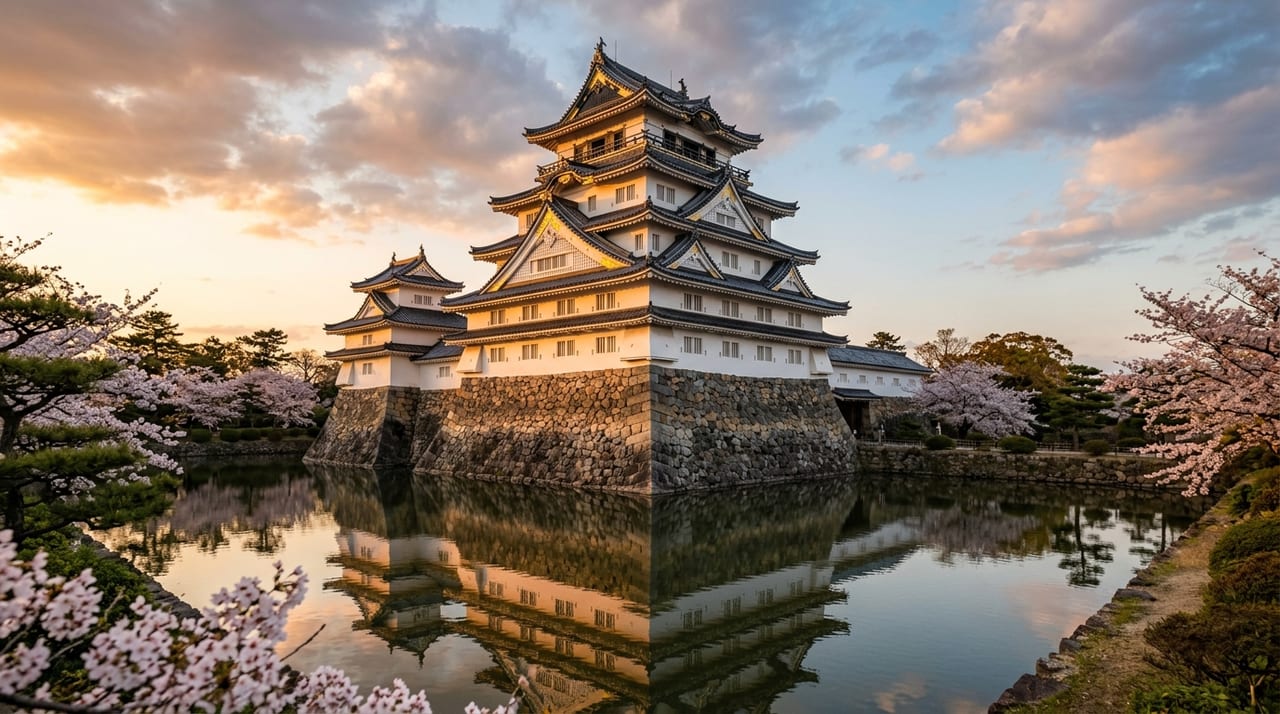
 * Image is for illustrative purposes only.
Saga Castle
佐賀城
Saga Castle is a historic castle in the Kyūshū region (Built in 1611 (Keichō 16)). Its lord was Nabeshima Naoshige / Nabeshima Katsushige.
Overview
About the Castle
Saga Castle was completed in Keichō 16 (1611) by Nabeshima Katsushige in the central part of Hizen Province. It is a flatland castle (hirajiro). Its predecessor, Muranaka Castle, was the residence of the Ryūzōji clan in the Sengoku period. Nabeshima Naoshige, who held real authority within the Ryūzōji clan, took over that power base, and his son Katsushige developed the site into an early modern castle suited to the new order of the Edo shogunate. Saga lies at the gateway to northwestern Kyushu, and its domain centered on the fertile Saga Plain, which faces the Ariake Sea. The Nabeshima domain (Saga domain), with 357,000 koku, was one of Kyushu's leading tozama daimyō and held considerable influence throughout the Edo period.
The Spirit of Hagakure
The relationship between the Saga domain and sword culture must be discussed first in terms of the spirit of the "Hagakure." The "Hagakure," dictated by Yamamoto Tsunetomo, recorded by Tashiro Tsuramoto, and compiled around Kyōhō 1 (1716), is a representative treatise on the samurai that expresses the essence of bushidō through the phrase "shinigurui" (frenzy of death). The passage "The Way of the Samurai is found in death" is known around the world and has been passed down to the present as a symbol of the Japanese samurai spirit. The Hagakure is not merely a book of morals. It is a practical work that records in detail the daily life of Saga domain retainers and the manner of their service to their lord, and it fundamentally defined the mindset and conduct of those who carried swords.
The Hizen Blade Tradition
Hizen Province was known as a major center of Japanese swordmaking, and the name "Hizen-tō" resounded throughout the country. It is said that Tadayoshi (first generation, Hashimoto Shinzaemon) began making swords in Hizen in the early Keichō era, and this is regarded as the origin of Hizen-tō. Building on techniques he learned from Umetada Myōju of Kyoto, Tadayoshi established an original style, and that style became synonymous with Hizen-tō. The first-generation Tadayoshi was employed by the Nabeshima domain as an official smith. Under the domain's full support, he established a mass-production system. The quality and supply capacity of his work were highly regarded by daimyō houses across the country, and his swords spread to Edo, Kyoto, and Osaka through the sankin-kōtai system.
Modernization and the Saga Rebellion
The Saga domain also played an important role in the late Edo period and the Meiji Restoration. Saga produced Meiji elder statesmen such as Ōkuma Shigenobu and Etō Shinpei, and it was a "key hub of the Restoration." It was also actively engaged in introducing Western technology. In Meiji 7 (1874), the Saga Rebellion, carried out by shizoku, broke out, and the discontent of the former samurai class erupted. The Saga Castle Honmaru Historical Museum, which in Heisei 16 (2004) restored part of the Honmaru palace in wood, is highly regarded as a valuable facility where visitors can experience the conduct of domain governance in the Edo period.
Saga Castle Today
The restored Honmaru palace, the Saga Castle Honmaru Historical Museum, has drawn attention as one of the largest wooden reconstructed buildings in the country. It offers a comprehensive exhibition of the politics, culture, and martial arts of the Saga domain. The tidal range of the Ariake Sea, used for nori (seaweed) farming; the porcelain culture of Imari and Arita; and the tradition of Hizen-tō together form the rich cultural soil of Saga.
Connection to Swords
The greatest legacy of Saga Castle's sword culture is concentrated in two pillars: Hizen-tō and the Hagakure. Tadayoshi (first generation, Hashimoto Shinzaemon), the founder of Hizen-tō, began making swords in Hizen in the early Keichō era and was favored as an official smith of the Nabeshima domain. The work of the first-generation Tadayoshi is characterized by itame-hada with masame mixed in, combined with a ko-gunome and ko-midare hamon that carries a faint nioi. It was evaluated as the most consistently high-quality group of smiths throughout the Edo period. Tadahiro (Ōmi Daijō) further refined the technique and established the national reputation of Hizen-tō. The finely packed jigane known as "konuka-hada," a feature of Hizen-tō, was highly valued by sword appraisers in Kamigata and Edo. The Nabeshima domain continued to patronize the Tadayoshi lineage as official smiths for generations and maintained the quality of Hizen-tō until the late Edo period. Today, Hizen-tō is on display at the Chōkokan museum and the Saga Prefectural Museum in Saga City, where visitors can see its high craftsmanship firsthand. Many treasure swords of the Nabeshima family are still held at the Chōkokan (Saga City), where outstanding examples of Hizen-tō can be appreciated.
Highlights
- Saga Castle Honmaru History Museum — one of Japan's largest wooden castle restorations
- Chōkokan Museum — Nabeshima family swords, armor, and cultural artifacts
- Hagakure historical sites — sites related to the authors of the world-famous bushidō text
- Arita and Imari ceramics — world-famous Hizen porcelain towns within day-trip distance
- Yoshinogari Historical Park — Japan's largest Yayoi-period moated settlement
* Opening hours and admission fees are subject to change. Please check the official website before visiting.