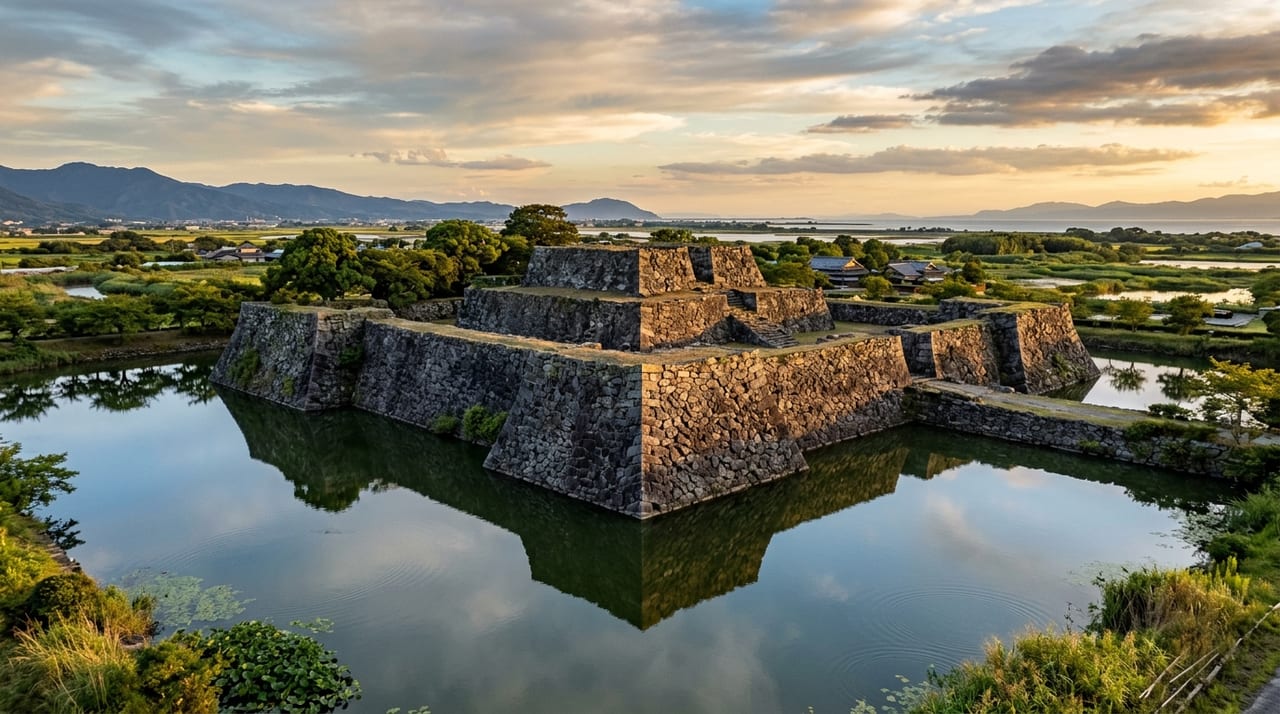
 * Image is for illustrative purposes only.
Yatsushiro Castle
八代城
Yatsushiro Castle is a historic castle in the Kyūshū region (Construction began in Genna 6 (1620) and was completed in Genna 8 (1622)). Its lord was Kato Masakata / Hosokawa clan (Matsui clan as castle governors).
Overview
About the Castle
Yatsushiro Castle is an early-modern castle built at Yatsushiro, a strategic point in southern Higo Province. On the orders of Katō Tadahiro (son of Katō Kiyomasa), lord of Kumamoto Domain, chief retainer Katō Masakata built it on the north bank of the Kuma River (Maekawa), and it was completed in Genna 8 (1622). It is a hirajiro (flatland castle). The castle that preceded it was Mugishima Castle, which Konishi Yukinaga had built on the Mugishima delta at the mouth of the Kuma River. However, it collapsed in an earthquake in Genna 5 (1619), so construction at the present site began the following year, Genna 6 (1620), after receiving permission from the shogunate.
Hosokawa Branch Castle
When the Katō family was stripped of its domain in Kan'ei 9 (1632), Hosokawa Tadatoshi became lord of Kumamoto Domain, and Hosokawa Tadaoki (Sansai), Tadatoshi's father, took up residence at Yatsushiro Castle. From Shōhō 3 (1646), the Matsui family, chief retainers of the Hosokawa family, guarded the castle as hereditary castellans and oversaw the administration of Yatsushiro until the bakumatsu period. Limestone was used for part of the stone walls of the honmaru (main enclosure), and because of its color the castle was also called Shirasagi-jō ('White Heron Castle').
The Kuma River and Yatsushiro Culture
Since ancient times, Yatsushiro has prospered as a hub for goods gathered along the Kuma River, and industries such as Yatsushiro igusa (rush for tatami mats) supported the castle town. Under the Hosokawa family, Yatsushiro also developed culturally, forming its own cultural sphere in the performing arts and crafts in coordination with Higo and Kumamoto. The Myōken Festival of Yatsushiro Shrine (Myōken-gū) is a UNESCO Intangible Cultural Heritage that has been designated as an Important Intangible Folk Cultural Property. It is known nationwide as a distinctive festival in which giant papier-mâché kida (turtle-snake floats) parade through the streets.
The Tenshu Platform and the Beauty of the Stone Walls
Yatsushiro Castle's main tenshu (keep) was destroyed by fire after being struck by lightning in Kanbun 12 (1672), and it was never rebuilt. After the castle was abandoned in the Meiji era, its buildings were also dismantled, and today only the honmaru stone walls and moats remain. The beauty of these stone walls has a distinctive atmosphere, making the site a popular spot among history enthusiasts and photographers.
Connection to Swords
Yatsushiro Castle was a branch castle of the Hosokawa family, guarded by the Matsui family, and it is deeply connected to the Hosokawa family's sword culture. The Matsui family descends from Matsui Yasuyuki, a senior retainer who served Hosokawa Yūsai (Fujitaka) and Tadaoki, and it was a house that faithfully inherited the Hosokawa family's samurai culture. Weapons, art crafts, and old documents passed down through the Matsui family are preserved and open to the public as the Matsui Bunko. Hosokawa Tadaoki (Sansai) is known for possessing the renowned sword Kasen Kanesada. Higo Province is singled out in sword culture as the place that nurtured a distinctive metalworking technique called Higo zōgan (Higo inlay). Higo zōgan is a decorative technique in which gold and silver are hammered into an iron ground, a distinctive expression that Higo metalworkers perfected during the Edo period. Higo tsuba (sword guards) is a stream of Higo sword-fitting metalwork established by master craftsmen including Hayashi Matashichi (Hayashi school), Hirata Hikozō (Hirata school), Nishigaki Kanshirō (Nishigaki school), Shimizu Jingo (Shimizu school), and Kamiyoshi Juhei (Kamiyoshi family), and it is known for its simple and powerful style. Among them, Shimizu Jingo moved to Yatsushiro in Kan'ei 9 (1632) together with his uncle Hirata Hikozō, following Hosokawa Tadaoki, so Yatsushiro is also a place with connections to Higo metalworkers. Shōhinken (National Place of Scenic Beauty), formerly the Matsui family's tea house and garden, had a treasure house displaying cultural properties handed down through generations of the Matsui family, but its buildings collapsed in the Kumamoto earthquake of July 2026 (Reiwa 8). The Yatsushiro Municipal Museum (Mirai no Mori Museum) also has a permanent display of weapons and art crafts owned by the Matsui family, the lords of Yatsushiro Castle. The Higo zōgan tradition refined in Yatsushiro is passed on to contemporary craft artists, and it still shines as one of the most distinctive styles in the world of Japanese sword guards.
Highlights
- Yatsushiro Castle Stone Walls and Moat — Honmaru stone walls partly made of limestone and a water moat; the castle is also known as Shirasagi-jō ('White Heron Castle')
- Shōhinken (National Place of Scenic Beauty) — The Matsui family's tea house and garden (its buildings were damaged in the Kumamoto earthquake of July 2026)
- Yatsushiro Municipal Museum (Mirai no Mori Museum) — Displays a model of Yatsushiro Castle, weapons and art crafts owned by the Matsui family, and the history of Yatsushiro
- Yatsushiro Shrine Myōken Festival (UNESCO Intangible Cultural Heritage) — A major Yatsushiro festival in which the kida (turtle-snake float) parades through the streets
* Opening hours and admission fees are subject to change. Please check the official website before visiting.