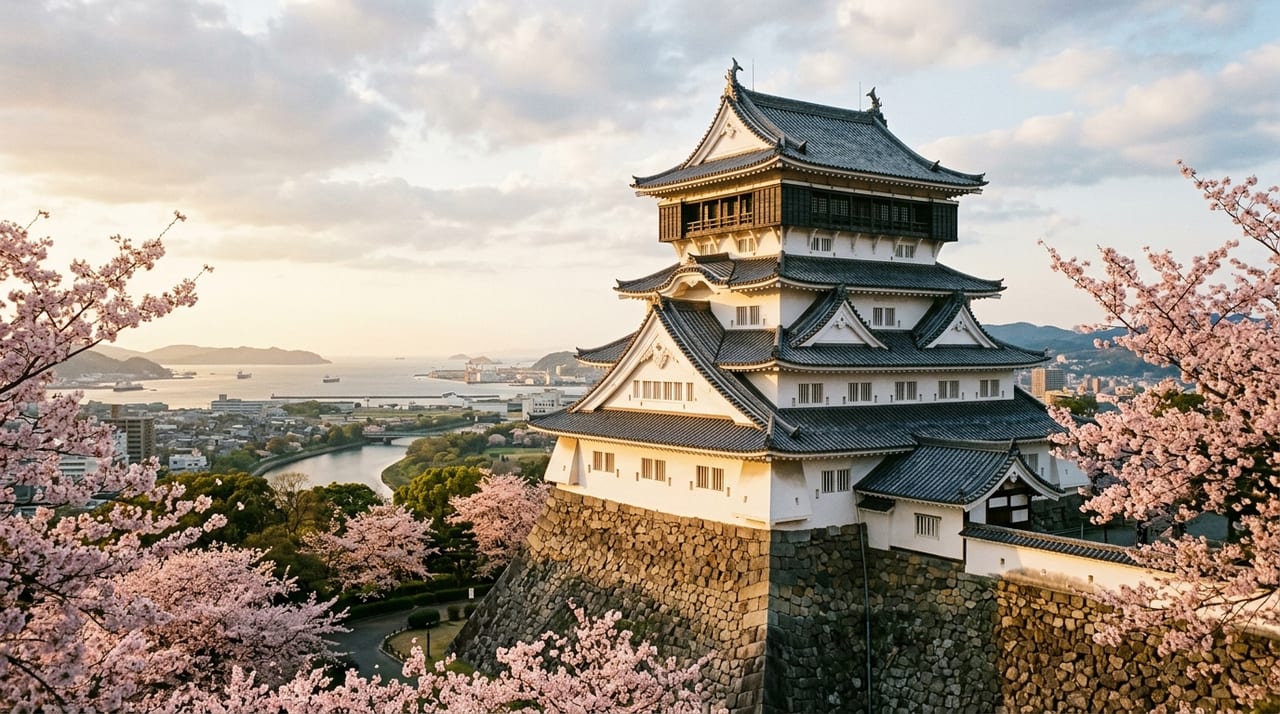
 * Image is for illustrative purposes only.
Kokura Castle (Katsuyama Castle)
小倉城(勝山城)
Kokura Castle (Katsuyama Castle) is a historic castle in the Kyūshū region (Built in 1602 (Keichō 7)). Its lord was Hosokawa Tadaoki / Ogasawara Tadazane.
Overview
Stronghold of Kyushu
Kokura Castle was built in Keichō 7 (1602) by Hosokawa Tadaoki, who had been installed in Buzen Province. As the gateway to northern Kyushu, it served as a key stronghold for logistics and military affairs in Kyushu. Kokura is a geographically important location facing Honshu across the Kanmon Strait, and since ancient times it was an important port town as a relay point for voyages to the Korean Peninsula and the Chinese mainland. The tenshu (main keep) is characterized by a simple exterior with no gables other than the irimoya gable on the top level. In particular, a distinctive design called “karazukuri,” in which the top floor is wider than the fourth floor, was handed down in later times as a unique feature of Kokura Castle.
Hosokawa Tadaoki and Swords
Hosokawa Tadaoki, the first lord of Kokura Castle, is known as one of the most important sword collectors from the Sengoku period into the early Edo period. Tadaoki lived a turbulent life serving the three unifiers of Japan, Oda Nobunaga, Toyotomi Hideyoshi, and Tokugawa Ieyasu, and the famous swords he acquired in the process were outstanding in both quality and quantity among the warlords of his time. His devotion to the tea ceremony (known as a senior disciple of Sen no Rikyū) was also deeply connected to his discerning eye for swords, and he viewed swords not merely as weapons but as works of art. His beloved sword, “Kasen Kanesada,” is a katana said to have received its name because he compared the retainers he had executed, thirty-six in number, to the Thirty-Six Immortal Poets. It is known as a sword of high distinction.
The Legend of Kasen Kanesada
“Kasen Kanesada” was made by Izumi-no-kami Kanesada (Nosada, the second-generation Kanesada of Seki in Mino). It is a katana of simple construction in the katate-uchi (one-handed) style, and its hamon (temper line) has a wavy pattern at the lower section and becomes a chū-jikitaba (medium straight temper) toward the upper section. Its name originates from the story that Tadaoki compared the thirty-six retainers he had executed to the Thirty-Six Immortal Poets. The comparison of the sword's sharpness and beauty to the world of poetry clearly shows the characteristics of Japanese culture, where the two extremes of martial and literary arts intersect. The sword is still housed at the Eisei Bunko Museum as a treasure of the Hosokawa family and is widely known as one of the most famous swords in Japan. Tadaoki's aesthetic approach, which viewed swords and culture (tea, poetry, and Noh) as one, became the source of the cultural tradition of the later Hosokawa family.
Ogasawara Family and Martial Arts
In Kan'ei 9 (1632), after the Hosokawa family was transferred to Higo Kumamoto, Ogasawara Tadazane was installed in Kokura in their place. The Ogasawara family was a prestigious warrior family known as the head family of the Ogasawara-ryū, a school of etiquette for archery and horsemanship, and it had a great influence on warrior society in the Edo period in both etiquette and martial arts. The Ogasawara-ryū was officially recognized as the etiquette instructor to the shogunal family and became the standard of courtesy for daimyo households. In martial arts as well, the Ogasawara family maintained a high level and passed down excellent techniques in archery, horsemanship, and swordsmanship. In the Kokura domain, the etiquette and martial arts of the Ogasawara-ryū became the foundation for educating domain retainers, and both samurai manners and combat skills were required.
Miyamoto Musashi and Kokura
Kokura is also known as a place associated with the swordsman Miyamoto Musashi. Musashi is known for his duel with Sasaki Kojirō at Ganryūjima in Keichō 17 (1612), and because his adopted son Miyamoto Iori later served the Ogasawara family, the lords of the Kokura domain, Musashi also stayed in Kokura for a period. The Gorin no Sho, which Musashi wrote in his later years, is still read around the world today as one of Japan's greatest military treatises that philosophically discusses the essence of swordsmanship. Musashi's path of the sword, pursued in Kyushu, has deep ties to the land of Kokura. The two-sword style he used, Niten Ichi-ryū, is a technique of using a regular long sword and a short sword at the same time, and it brought a revolution in the use of Japanese swords.
Kokura Castle Today
The present tenshu of Kokura Castle was rebuilt in 1959 as a reinforced concrete structure. While it recreates the karazukuri style, gables that did not exist on the historical tenshu were added at the request of local residents. The interior of the tenshu has been developed as a history museum that displays the history of Kokura and the cultural heritage of the Hosokawa and Ogasawara families. The castle site is also known as a cherry blossom spot, and in spring many citizens visit for hanami (flower viewing). Kitakyushu also developed as a city that drove the growth of modern industry through steel manufacturing, and Kokura Castle is a special place where the history of that modernization and the samurai culture of the Edo period coexist.
Connection to Swords
The sword culture of Kokura Castle began with the deep love of swords and discerning eye of its first lord, Hosokawa Tadaoki. Tadaoki was one of the few warlords who served all three unifiers, Nobunaga, Hideyoshi, and Ieyasu. The sword collection he gathered over his turbulent life was of the highest standard in both quality and quantity, encompassing everything from masterpieces of the Muromachi period to the finest swords of his era. Tadaoki, a senior disciple of Sen no Rikyū, refined his discerning eye through the tea ceremony, and that judgment was also reflected in his choice of swords. Even after the Ogasawara family was installed, the sword culture of Kokura continued to develop. The Ogasawara-ryū etiquette defined detailed rules on carrying swords, and everything from how to wear, draw, and sheathe a sword was systematized as part of etiquette. This tradition of etiquette contributed to a cultural perspective in Japan that regards swords not as mere weapons but as tools of ritual. After the duel at Ganryūjima, Miyamoto Musashi stayed for a time in the Kokura and Buzen area, researching the martial arts and teaching successors. Musashi's Niten Ichi-ryū (two-sword style) uses a long sword (katana) and a short sword (wakizashi) at the same time, and it has its own theoretical system of using two swords as independent weapons. The Gorin no Sho is a treatise on strategy in five scrolls, Earth, Water, Fire, Wind, and Void, and it is still read around the world today. In the tenshu of Kokura Castle, visitors can see a reconstructed suit of armor of Hosokawa Tadaoki and a life-size display recreating Musashi's wooden sword and Kojirō's beloved sword.
Highlights
- Kokura Castle tenshu (reconstruction) — a distinctive tenshu that recreates the karazukuri exterior. The interior is a history museum
- Kokura Castle Garden — a daimyo garden restored on the site of the Ogasawara family's secondary residence, with a recreated warrior shoin hall
- Matsumoto Seichō Memorial Museum — a memorial museum for the nationally beloved author from Kokura, adjacent to the castle site
- Ganryūjima (Funashima) — the site of the duel between Miyamoto Musashi and Sasaki Kojirō. About 10 minutes by Kanmon Kisen steamship
- Kitakyushu Municipal Museum of Natural History and Human History (Inochi no Tabi Museum) — exhibits local historical materials and armor
* Opening hours and admission fees are subject to change. Please check the official website before visiting.