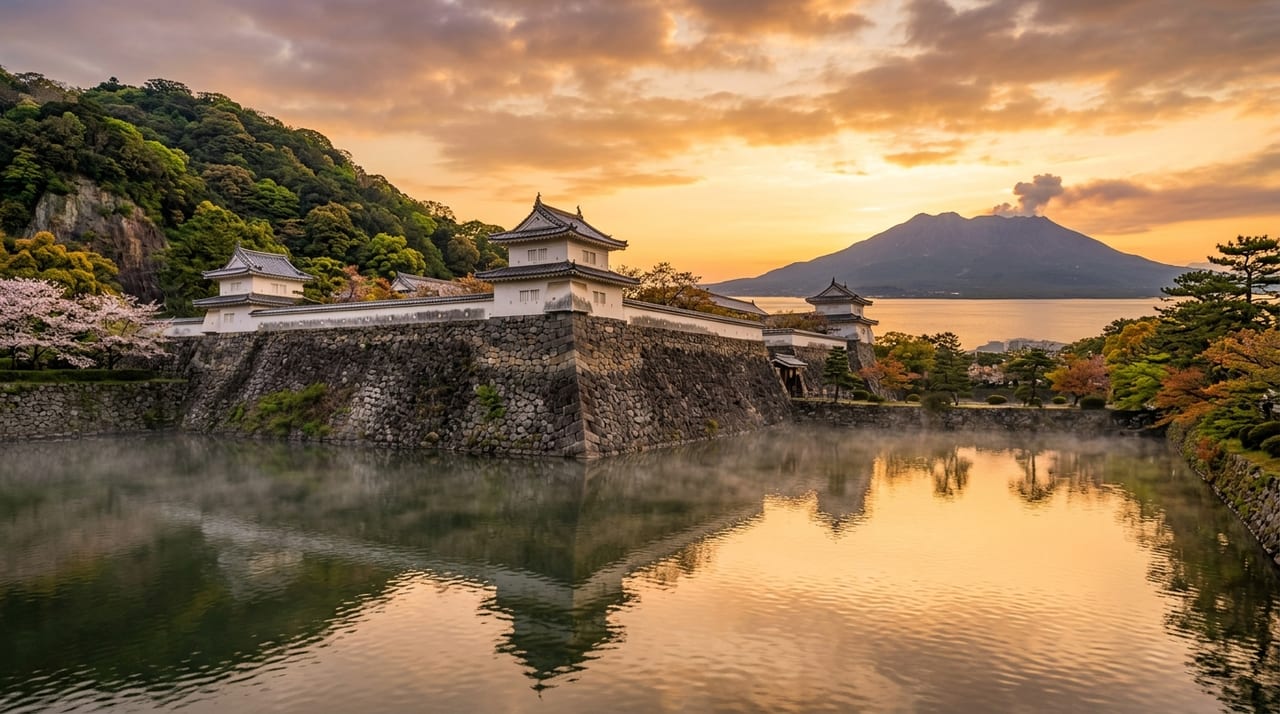
 * Image is for illustrative purposes only.
Kagoshima Castle (Tsurumaru Castle)
鹿児島城(鶴丸城)
Kagoshima Castle (Tsurumaru Castle) is a historic castle in the Kyūshū region (Built in 1601 (Keichō 6)). Its lord was Shimazu Iehisa (first domain lord) / Shimazu clan.
Overview
About the Castle
Kagoshima Castle (Tsurumaru Castle) was built in Keichō 6 (1601) by Shimazu Iehisa, the first lord of the Satsuma domain, as a hirayama-jō (flatland-hill castle). This castle, representative of Satsuma, the 'land of the martial arts,' is known for not having a tenshu (main keep), and this is said to have carried the meaning of submission to the Edo shogunate. The castle consisted of a simple Honmaru palace in yakata-style construction, along with moats and stone walls, and the domain established a tojō system, with retainers guarding various regions. Its location, embraced on all sides by Shiroyama, made maximum use of natural defenses, and the cliffs of Shiroyama functioned as the walls of the fortress in place of a tenshu. The Satsuma domain's 770,000 koku (nominal yield) was among the largest koku figures among tozama daimyo.
Architecture and Structure
The outer moat was extremely wide: water moats protected the east, south and north sides of the castle, while on the west side the cliffs of Shiroyama served as a natural barrier. In the Seinan War of Meiji 10 (1877), Shiroyama became the last stronghold of the Satsuma samurai led by Saigō Takamori. Saigō, who had holed up in a cave in Shiroyama, was struck by a bullet while advancing out of the cave, and died at the foot of Shiroyama. From the observation deck in Shiroyama Park, one can take in a panoramic view of Sakurajima and Kinkō Bay, and as a spectacular scenic view symbolizing Kagoshima it has captivated travelers from around the world.
Satsuma Culture
The Satsuma domain is known for its unique samurai education called gojū education. Boys learned martial arts in general, including kenjutsu, jūjutsu, kyūjutsu and swimming, under the guidance of senior students in each local community (gō), and were drilled in solidarity among peers and the etiquette of hierarchy. The mental toughness of the Satsuma samurai produced by this education was the driving force behind the anti-shogunate movement and the Meiji Restoration. Satsuma ware (Shiro-Satsuma and Kuro-Satsuma) maintained high technical standards as the domain's official kiln, and was prized at home and abroad as craftwork embodying the Shimazu family's sense of beauty.
The Late Edo Period and the Meiji Restoration
Shimazu Nariakira is known as a distinguished lord of the late Edo period, and he promoted advanced policies including the introduction of Western-style armaments, the Shūseikan project (modern factory complex) and the spread of photography. Nariakira's adopted daughter Atsuhime (Tenshōin) became the midaidokoro (consort) of the 13th shogun, Tokugawa Iesada, and worked to preserve the Tokugawa family amid the political affairs of the late Edo period. Satsuma, which produced first-rate talents of the late Edo and Meiji Restoration such as Saigō Takamori, Ōkubo Toshimichi and Komatsu Tatewaki, was the greatest driving force of Japan's modernization.
Sightseeing and Experiences
Shōko Shūseikan, which conveys 800 years of Shimazu family history, is located in the Iso district (next to Sengan-en), and displays swords, armor and fine art crafts handed down in the Shimazu family all together. The restored Gorōmon gate reproduces the castle's main entrance of the past, and shows the majestic appearance of Satsuma, revived in the Reiwa era.
Connection to Swords
As the largest samurai house in Kyūshū, the Shimazu family built up a distinctive sword culture. Swords from Satsuma are known as a school collectively called 'Satsuma shintō,' and throughout the Edo period, domain-retained swordsmiths continued to supply swords to the Shimazu family and Satsuma samurai. Renowned as the representative swordsmiths of Satsuma is the group of smiths in the Naminohira lineage. The Naminohira school is a major sword school that arose in Satsuma Province in the late Heian period, and over several hundred years it cultivated a distinctly Satsuma style. Naminohira swords are known for an archaic style connected to the Yamato tradition. Among the famous swords held by successive heads of the Shimazu family were many old famous swords from the Kamakura and Muromachi periods, and Hizen swords and Bizen swords were also collected. Shimazu Nariakira had a deep interest not only in swords but also in Western civilization, and launched the Shūseikan project to research Western-style iron-making technology. Satsuma samurai of the late Edo period were known for the one-blow-kill swordsmanship of Jigen-ryū, and their sharp first strike was feared. The Satsuma swords that supported this swordsmanship were excellent in the sturdiness of the blade and in an appropriate balance of width and weight, and practicality to withstand the impact of powerful overhead strikes was the foremost requirement. Shōko Shūseikan houses and exhibits materials handed down in the Shimazu family. Satsuma's sword culture forms a distinctive world in which the bold, open-hearted spirit of the southern land fuses with an extremely strict samurai spirit, and it offers a perspective indispensable for understanding the diverse appeal of Japanese swords.
Highlights
- Restored Gorōmon gate — restored in Reiwa 2 (2020), one of Japan's largest castle gates
- Shōko Shūseikan — treasures of 800 years of the Shimazu family, with swords, armor, Satsuma ware and Western art gathered in one place
- Shiroyama Observation Deck — panorama of Sakurajima and Kinkō Bay, one of Japan's representative scenic views
- Shiroyama Caves — Saigō Takamori's last stronghold, the site where the Seinan War ended
- Sengan-en (Iso garden) — the Shimazu family's villa and Japanese garden, a masterpiece of daimyo gardens that borrows the view of Sakurajima
* Opening hours and admission fees are subject to change. Please check the official website before visiting.