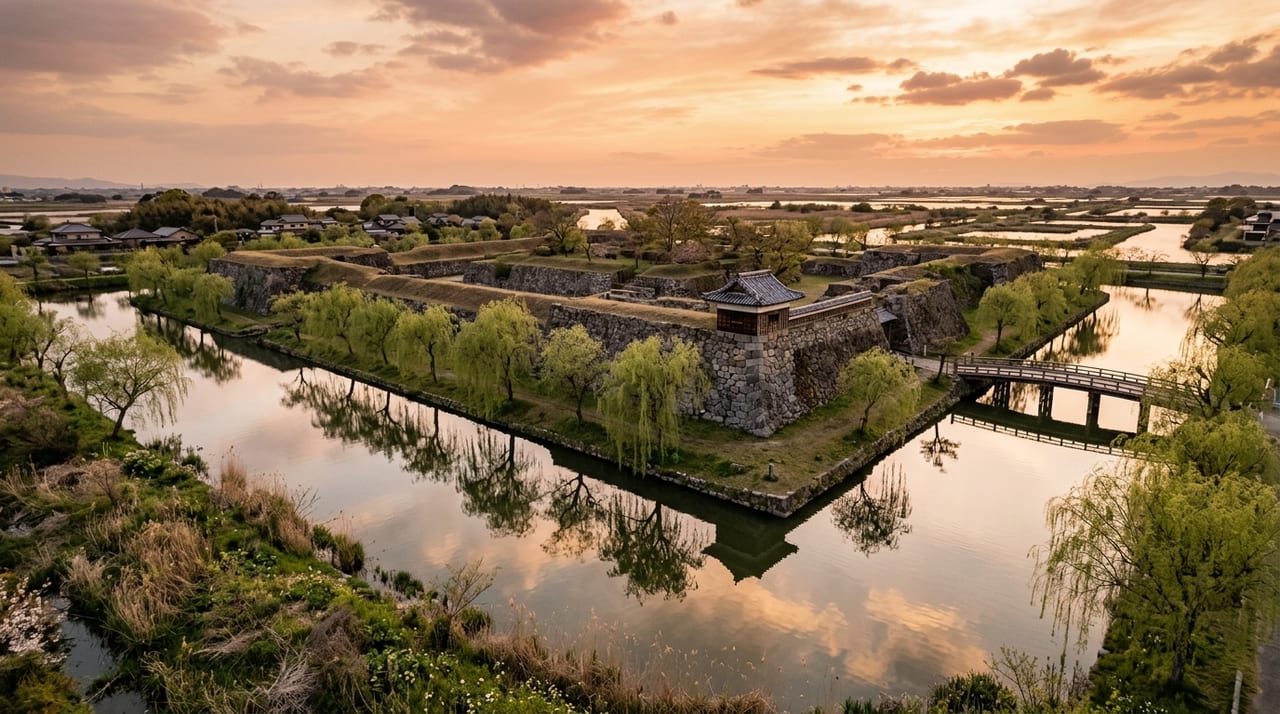
 * Image is for illustrative purposes only.
Yanagawa Castle
柳川城
Yanagawa Castle is a historic castle in the Kyūshū region (Sengoku period, built by Kamachi Haruhisa (later fully developed by Kamachi Akimori)). Its lord was Kamachi clan / Tachibana Muneshige.
Overview
About the Castle
Yanagawa Castle is a water castle built in the waterside region of Chikugo Province (present-day southern Fukuoka Prefecture), and is known as a distinctive castle in which countless moats and waterways, stretched criss-crossing in every direction, form a natural stronghold. The castle was built during the Sengoku period by the local chieftain, the Kamachi clan (Kamachi Haruhisa), and is said to have been fully developed by Kamachi Akimori. The waterways spreading like a net across the flat, low-lying wetlands of the Chikugo River delta formed a castle defense system that was difficult to attack and easy to defend. Yanagawa's waterways are still used today for sightseeing punt boat rides, and attract many tourists as the "City of Water, Yanagawa." Artificial waterways dug in the tributaries of the Chikugo River and in reclaimed land were connected to one another, creating a structure in which countless waterways enveloped the entire castle, realizing a defensive function unique to a flatland castle, different from the strongholds of mountainous terrain. As a water castle, Yanagawa functioned as a strategic military and economic hub in northern Kyushu during the Sengoku period, and numerous conflicts were fought over control of it.
The Era of Tachibana Muneshige
The most glorious page in the history of Yanagawa Castle is written by the renowned general Tachibana Muneshige (1567–1643), who was active across the eras of both Toyotomi Hideyoshi and Tokugawa Ieyasu. Muneshige became an adopted son of Tachibana Dōsetsu, a retainer of Ōtomo Yoshishige (Sōrin), and with his rare martial prowess and strategic wisdom, survived from the late Sengoku period into the early Edo period. Praised by Hideyoshi as "Honda Tadakatsu of the east, Tachibana Muneshige of the west, peerless in east and west," Muneshige made his name resound on the Korean battlefields during the Bunroku and Keichō campaigns as an invincible general. At the Battle of Sekigahara he fought valiantly on the Western Army side but was defeated, and after being stripped of his domain, he left Yanagawa. However, he was specially recognized by the Tokugawa shogunate and achieved a return to his former domain of Yanagawa. The unprecedented feat of a daimyō who, having once been stripped of his domain, returned to his former lands was proof of Muneshige's extraordinary character and ability. Muneshige's life symbolized the turbulent age from the Sengoku period to a time of peace, and his spirit as a warrior and his magnanimity were widely respected even in the samurai society of the early Edo period. After returning to Yanagawa, Muneshige devoted his energy to developing the castle town and to civil administration, showing himself as a wise lord of good governance.
Culture of the Tachibana Family
Tachibana Muneshige's sword teacher was Marume Kurandonosuke Nagayoshi, a senior disciple of Kamiizumi Nobutsuna and the founder of Taisha-ryū, and in Bunroku 5 (1596) Muneshige received full transmission of Taisha-ryū from Nagayoshi. Some of the swords handed down in the Tachibana family are preserved at "Ohana" (the former Tachibana villa), which is run by descendants of the Tachibana family, the lords of the Yanagawa domain, and are open to the public. The family treasure "Raikiri-maru," passed from Tachibana Dōsetsu to Muneshige, is a sacred sword with a legend that it cut away a lightning bolt with its blade, and it still commands reverence today as a treasure symbolizing the martial prestige of the Tachibana family. The Tachibana family had a household tradition of excellence in both the martial and literary arts, being accomplished across generations also in arts such as the tea ceremony, poetry, and painting, and its aesthetic sense was reflected in the selection and care of swords. Muneshige's wife, Ginchiyo, is also known as a woman accomplished in martial arts, and is passed down as an anecdote showing the richness of the Tachibana family's samurai culture.
Water Town Culture of the Castle Town
Yanagawa's waterways, going beyond their function in castle defense, developed into the foundation of transportation, logistics, and daily life in the castle town. Even today the waterway network functions fully, and as a "City of Water" with sightseeing punt boats running in every direction, it draws tourists from Japan and abroad. The atmosphere created by willow trees lining the rivers and white-walled storehouses forms Yanagawa's unique scenic beauty, in which the culture of the samurai and water are fused. Yanagawa, also known as the hometown of the poet Kitahara Hakushū, is also a rare cultural city where literature and samurai culture overlap. The popularity of punt boat sightseeing has not waned even in modern times; the waterside scenery of each season, including rapeseed flowers in spring, aquatic plants in early summer, autumn foliage, and white herons in winter, captivates travelers. Yanagawa's water-town landscape, in which the atmosphere of the castle town and the history of the samurai are blended as one, is etched into the hearts of many people as a special place even within Kyushu.
Architecture and Remains
Most of Yanagawa Castle's structures were lost after the Meiji period, and today only the remains of stone walls, earthen ramparts, and water moats survive. However, the framework of the castle as a water castle in its heyday still lives on, and the stone walls scattered throughout the waterway network speak of the scale and ingenious design of the castle at that time. The Tachibana Museum displays the history, swords, arms, and armor of the Tachibana family, and visitors can get close to the real image of Tachibana Muneshige. Part of the moat still remains at the castle site today, and within the distinctive landscape surrounded by waterways, traces of the castle can be found. Ohana, developed in the Edo period, was rebuilt as the former villa of the Tachibana family in the Meiji period, and is now open to the public together with the nationally designated scenic garden Shōtō-en. The contrast between the trees reflected on the water surface of Shōtō-en and the Western-style building creates Yanagawa's unique scenic beauty, embodying the intersection of samurai culture and modernization. The Tachibana Museum, which houses the Tachibana family's heirlooms, systematically displays Tachibana Muneshige's armor, letters, tea utensils, and sword fittings, and receives high praise as one of Kyushu's leading samurai history museums, where visitors can understand the figure of the general known as "Peerless in the West" from many angles. Yanagawa, where water and the samurai spirit intersect, will continue to be an irreplaceable, special place for all visitors who love both Japanese swords and water culture.
Connection to Swords
The presence of Tachibana Muneshige, an outstanding general, forms the core of the sword culture at Yanagawa Castle. Marume Kurandonosuke Nagayoshi, Muneshige's sword teacher, was a swordsman who inherited the Shinkage-ryū directly transmitted by Kamiizumi Nobutsuna, developed it further, and founded Taisha-ryū; Muneshige received full transmission of Taisha-ryū from Nagayoshi. The Battle of Byeokjegwan during the Bunroku campaign is said to have been so fierce that Muneshige's sword became warped and could not be returned to its scabbard. The "Raikiri-maru" passed from Tachibana Dōsetsu to Muneshige stands in a class of its own among the swords transmitted to the present day as the greatest family treasure of the Tachibana family. According to legend, when Tachibana Dōsetsu was struck by lightning, he cut the lightning away with his sword, and from then on this blade came to be called "Raikiri-maru." Dōsetsu kept this legendary sword as his favorite blade throughout his life, and even after it was passed down to Muneshige, it was treasured as a protective sword of the Tachibana family. Raikiri-maru is currently preserved at a facility in Fukuoka Prefecture associated with the Tachibana family, and as a sacred sword of the samurai, it still commands reverence today. At the Tachibana Museum and "Ohana" (former Tachibana villa), swords, armor, and battle surcoats (jinbaori) handed down in the Tachibana family are displayed, and visitors can see actual pieces of armor and equipment that Muneshige himself used. The sword culture of the Tachibana family embodies the aesthetic sense of a general who lived through the turning point of Japanese sword culture from the late Sengoku period to the early Edo period, and its legacy still lives on along Yanagawa's waterside.
Highlights
- Yanagawa canal punt boat tours (romantic waterway through the castle town)
- Ohana estate and garden (Tachibana family swords, armor, and historic residence)
- Tachibana Family Museum (Muneshige relics and domain history)
- Kitahara Hakushū birthplace and museum
- Yanagawa steamed eel (mushi unagi) cuisine
* Opening hours and admission fees are subject to change. Please check the official website before visiting.