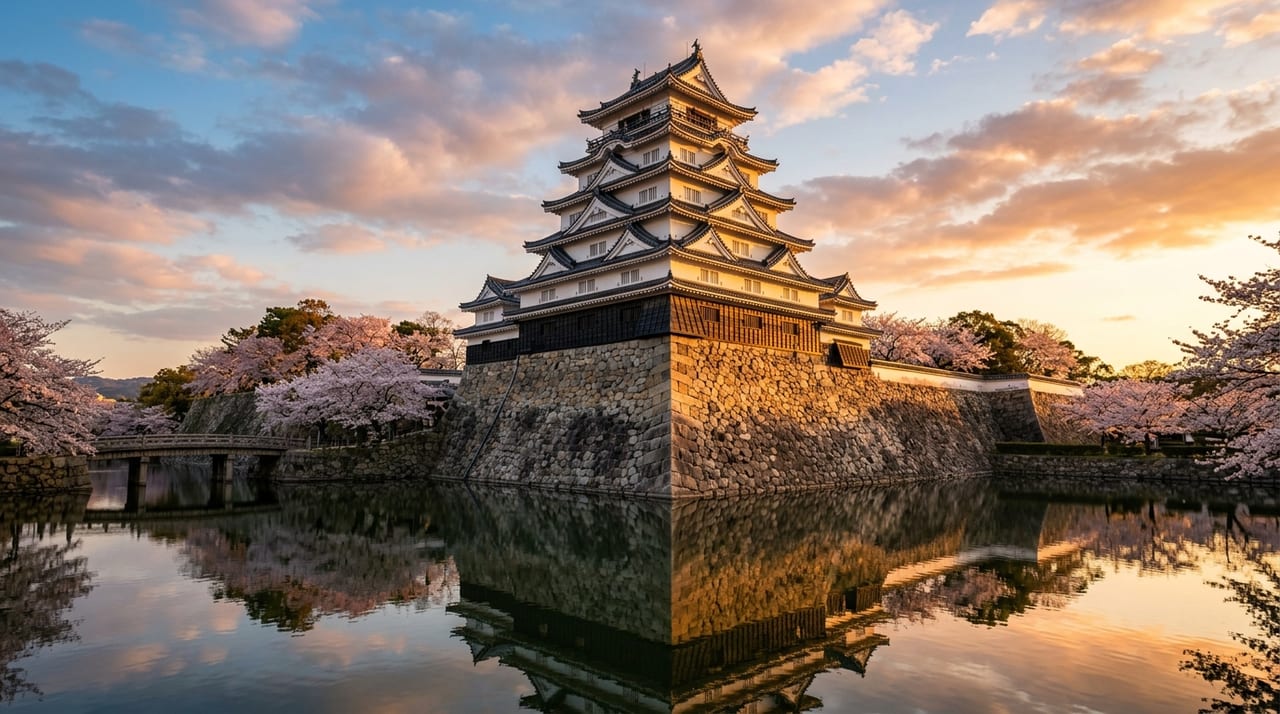
 * Image is for illustrative purposes only.
Mizuki (Water Fortress)
水城(みずき)
Mizuki (Water Fortress) is a historic castle in the Kyūshū region (Built in 664 AD (3rd year of Emperor Tenji)). Its lord was Yamato Court.
Overview
Background of Construction
Mizuki (Water Fortress) was built in the 3rd year of Emperor Tenji (664) by the Yamato court in Chikuzen Province (present-day Dazaifu, Ōno, and Kasuga in Fukuoka Prefecture). Although it bears the character for "castle," it is closer to a linear defensive embankment than to a castle in the usual sense, and it is known as one of Japan's oldest and largest linear defensive structures. Its direct background was the crushing defeat of the combined Japanese and Baekje forces at the Battle of Baekgang in the 2nd year of Tenji (663). To guard against invasion by Tang and Silla, a defense line protecting Dazaifu, the administrative center of Kyushu, became an urgent priority.
Structure and Scale
Mizuki is an earthen rampart built with the hanchiku method (layering and tamping earth), with a total length of about 1.2 kilometers, a base width of about 80 meters, and a height of about 9 meters. The width of its top is about 25 meters. On the north side of the rampart (toward Hakata Bay), a moat about 60 meters wide and about 4 meters deep was dug, and several large wooden conduits (mokuhi) were used to channel water. Castle gates were set at the east and west ends of the rampart, the East Gate and the West Gate, which also served to control traffic and logistics. The structure crossed the Fukuoka Plain from the mountains to the coast and functioned as a "defensive wall" that cut off invasion routes to Dazaifu.
Role in the Dazaifu Defensive Line
Mizuki formed part of a combined defense system together with Ōno Castle (a mountain castle on Mount Shiōji, 665) and Kii Castle (Saga Prefecture, 665). Mizuki was responsible for stopping invasion on the plain, while Ōno and Kii Castles served as bases for surveillance and for holding out against attacks from the mountains. This three-dimensional defense system was built against the backdrop of international tension in East Asia in the 7th and 8th centuries, and it is an important historical record of the national sense of crisis in Japan at the time.
Record in the Nihon Shoki
Mizuki appears in the entry for the 3rd year of Emperor Tenji (664) in the Nihon Shoki, which states: 'A great embankment was built in Tsukushi to store water. It was named Mizuki.' This brief record is the basic historical source that transmits the name and construction year of Mizuki, and it is especially noted as military infrastructure of ancient Japan.
Present Day
The earthen rampart remains in good condition, and in 1953 (Shōwa 28) it was designated a Special Historic Site at the national level. In 2017 it was selected as the 182nd site in the Zoku Nihon 100 Castles list. The site has been developed across Dazaifu, Ōno, and Kasuga, and the facility Mizukikan, which explains Mizuki, is located near the site of the East Gate in Dazaifu. JR Mizuki Station takes its name from Mizuki and is loved as a local landmark. In addition, in 2020 Mizuki was certified as a constituent cultural property of Japan Heritage under the title 'The Western Capital of Ancient Japan: Exchange Hub with East Asia.'
Connection to Swords
The late 7th century, when Mizuki was built, was a period when smithing techniques from the continent (Tang and Baekje) entered the Japanese archipelago through Kyushu as its gateway. Baekje aristocratic exiles who arrived after the Battle of Baekgang are recorded in the Nihon Shoki as having directed the construction of Ōno Castle and Kii Castle, which together with Mizuki protected Dazaifu. This suggests that technology from the continent and the Korean Peninsula was flowing into Wa at this time.
Highlights
- National Special Historic Site; 182nd site in the Zoku Nihon 100 Castles list
- The oldest linear defensive structure, built the year after the Battle of Baekgang (663)
- Giant rammed-earth rampart: about 1.2 km long with a base width of 80 m
- Construction recorded in the Nihon Shoki under the 3rd year of Emperor Tenji
- Japan Heritage constituent property, 'The Western Capital of Ancient Japan' (2020)
* Opening hours and admission fees are subject to change. Please check the official website before visiting.