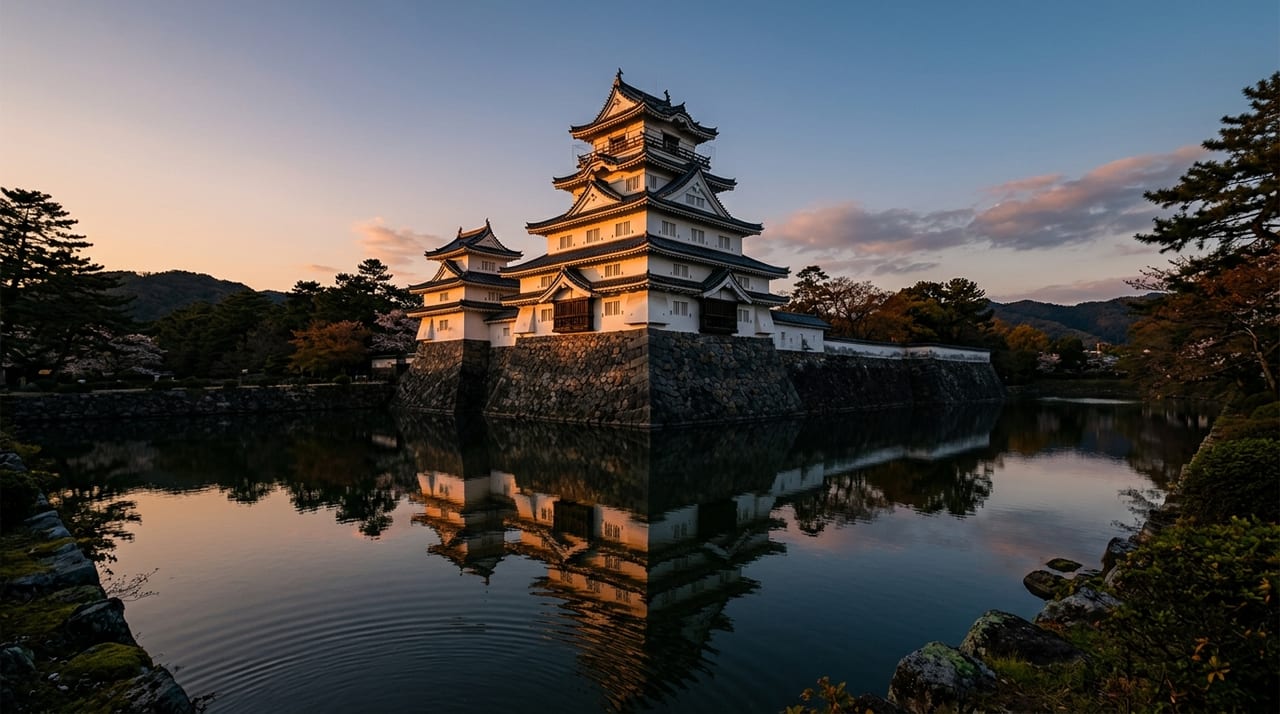
 * Image is for illustrative purposes only.
Nakatsu Castle
中津城
Nakatsu Castle is a historic castle in the Kyūshū region (Built in 1588 (Tenshō 16)). Its lord was Kuroda Yoshitaka (Kanbei).
Overview
About the Castle
Nakatsu Castle is a flatland castle located in Nakatsu City, Oita Prefecture, built as a celebrated "water castle" (mizujiro) utilizing seawater from the Nakatsu River and Suō-nada Bay (part of the Seto Inland Sea). In Tenshō 16 (1588), Kuroda Yoshitaka (Kanbei Josui), known as a strategist serving Toyotomi Hideyoshi, began its construction, and Hosokawa Tadaoki, who later entered the domain, completed it. It is counted as one of Japan's Three Great Water Castles (alongside Takamatsu Castle and Imabari Castle), and the castle's structure, with seawater from Suō-nada Bay drawn directly into its moats, reflects Kanbei's characteristic rational design aimed at maritime defense and the effective use of naval forces. The present main tower is a reinforced concrete replica built in Shōwa 39 (1964); its interior serves as the Okudaira Family History Museum, displaying armor, old documents, and other items associated with the Okudaira family.
The Life of Kuroda Kanbei / Yoshitaka
Kuroda Yoshitaka (1546–1604) was born into a samurai family of Harima during the Sengoku period and, as the strategist of Hashiba Hideyoshi, supported the unification of Japan with countless brilliant stratagems, making him the greatest military strategist of the Sengoku period. When Araki Murashige rebelled, Kanbei went as an envoy of persuasion and endured the harsh experience of being imprisoned for about a year in Settsu's Arioka Castle, yet remained unwavering in his loyalty to Hideyoshi. He took part in Hideyoshi's major campaigns, including the Chūgoku Reversal, the Battle of Yamazaki, the Battle of Shizugatake, and the Siege of Odawara. At the Battle of Sekigahara, he remained in Kyushu and carried out a lightning-fast campaign across the power vacuum there, capturing many castles; however, because the main battle of Sekigahara was decided early, he was ultimately ordered by Tokugawa Ieyasu to cease hostilities and withdrew his forces.
Fukuzawa Yukichi's Hometown
Nakatsu is a castle town with ties to Kuroda Kanbei, and is also known nationwide as a place associated with the thinker Fukuzawa Yukichi, who made great contributions to Japan's modernization. Yukichi was born as the child of a Nakatsu domain samurai at the domain's Osaka warehouse compound (and moved to Nakatsu soon after birth), studied Dutch learning in Nagasaki and at the Tekijuku in Osaka, later turned to English studies, and founded Keio Gijuku. "An Encouragement of Learning" (Gakumon no Susume), which opens with the words "Heaven neither creates a man above others nor below others," is a monument of modern Japanese thought, and many tourists who visit Yukichi's hometown of Nakatsu make the Fukuzawa Former Residence and the Fukuzawa Memorial Museum their destination. The depth of Nakatsu's history, where two great figures coexist, Fukuzawa Yukichi, long familiar as the face of the 10,000-yen note, and Kuroda Kanbei, is truly noteworthy.
The Hosokawa and Okudaira Clans and Nakatsu Domain
After the Kuroda family was transferred to Fukuoka Domain, the Hosokawa family, famous for Tadaoki and Gracia, entered Nakatsu, and under Hosokawa Tadaoki's rule the development of Nakatsu Castle progressed. Afterward, following the Ogasawara family, in Kyōhō 2 (1717) the Okudaira family became lords of the 100,000-koku Nakatsu Domain and governed until the Bakumatsu period. The Okudaira family were fudai daimyo descended from Tokugawa Ieyasu's daughter, Princess Kame, and while maintaining deep ties with the shogunate, they worked to promote industry and culture in Nakatsu.
Nakatsu's Food Culture and Tourism
Today, Nakatsu is nationally famous as the "Holy City of Karaage," and Nakatsu karaage, with its soy sauce-based marinade and distinctive frying method, draws food-hopping fans from across the country. The scenic rock formations and autumn foliage of Yabakei Gorge are also among Nakatsu's representative tourist resources, making it a sightseeing destination that combines castle, food, and nature.
Connection to Swords
The connection between Nakatsu Castle and swords can be understood through the sword culture of Kuroda Kanbei and his son Nagamasa, and through the link to the Hosokawa family, the most important daimyo family in the history of Japanese swords. Kuroda Yoshitaka (Kanbei) is known as a strategist and tactician. The most famous sword transmitted in the Kuroda family is the "Heshikiri Hasebe," now designated a National Treasure. The Heshikiri Hasebe is a masterpiece by Hasebe Kunishige, a swordsmith of the Nanbokuchō period, and is an uchigatana with a blade length of approximately 64.8 centimeters (a little over 2 shaku 1 sun). The name comes from an anecdote that Nobunaga "press-cut" (heshikiri) a tea servant hiding beneath a tray shelf, and the sword was later passed down to the Kuroda family. In Shōwa 53 (1978), the Heshikiri Hasebe was donated by the Kuroda family to Fukuoka City, and it is now held by the Fukuoka City Museum, making it one of the most widely known swords among Japan's National Treasure swords. Hosokawa Tadaoki was the daimyo who entered Nakatsu Castle and, as the tea master Hosokawa Sansai, is counted among the Seven Disciples of Sen no Rikyū. Tadaoki was also renowned as a discerning judge of swords, and the sword collection passed down in the Hosokawa family is still housed at Eisei Bunko in Tokyo and consists of outstanding pieces. In particular, the "Kasen Kanesada," transmitted in the Hosokawa family, is celebrated among sword enthusiasts; the legend that Tadaoki executed 36 retainers with this blade is said to be the origin of the name derived from the 36 Poetry Sages, and together with that fearsome anecdote it enjoys tremendous renown. The Okudaira family were fudai daimyo descended from Tokugawa Ieyasu's daughter, Princess Kame. At the Okudaira Family History Museum within the main tower of Nakatsu Castle, one can see the armor of successive Okudaira family heads and the "Hakuchō-saya no yari" spear, said to have been received from Tokugawa Ieyasu. Nakatsu is a treasure house of sword culture, where figures important in the history of Japanese swords, Kuroda Kanbei, Hosokawa Tadaoki, and the Okudaira family, served in succession as castle lords. It is a rare place where one can touch the heart of Japanese sword history through two legendary famous blades, the Heshikiri Hasebe and the Kasen Kanesada.
Highlights
- Nakatsu Castle tenshu (replica) — Okudaira Family History Museum displaying armor and old documents of successive Okudaira family heads
- Heshikiri Hasebe heritage site — the origin point of a National Treasure sword and the castle of Kuroda Kanbei; combine with a visit to the Fukuoka City Museum
- Fukuzawa Yukichi Former Residence and Memorial Museum — learn about the life of Yukichi, long the portrait on the 10,000-yen note, and his contributions to modernization
- Yabakei Gorge rock formations and autumn foliage — about 30 minutes by car from Nakatsu; one of Japan's foremost rock-formation landscapes and autumn foliage spots
- Nakatsu karaage — Japan's karaage holy city; its rich soy-based marinade and distinctive frying method are renowned nationwide
- Rakanji Temple — a cave temple carved into the cliffs of Yabakei, a spectacular sacred site lined with 3,700 arhat statues
* Opening hours and admission fees are subject to change. Please check the official website before visiting.