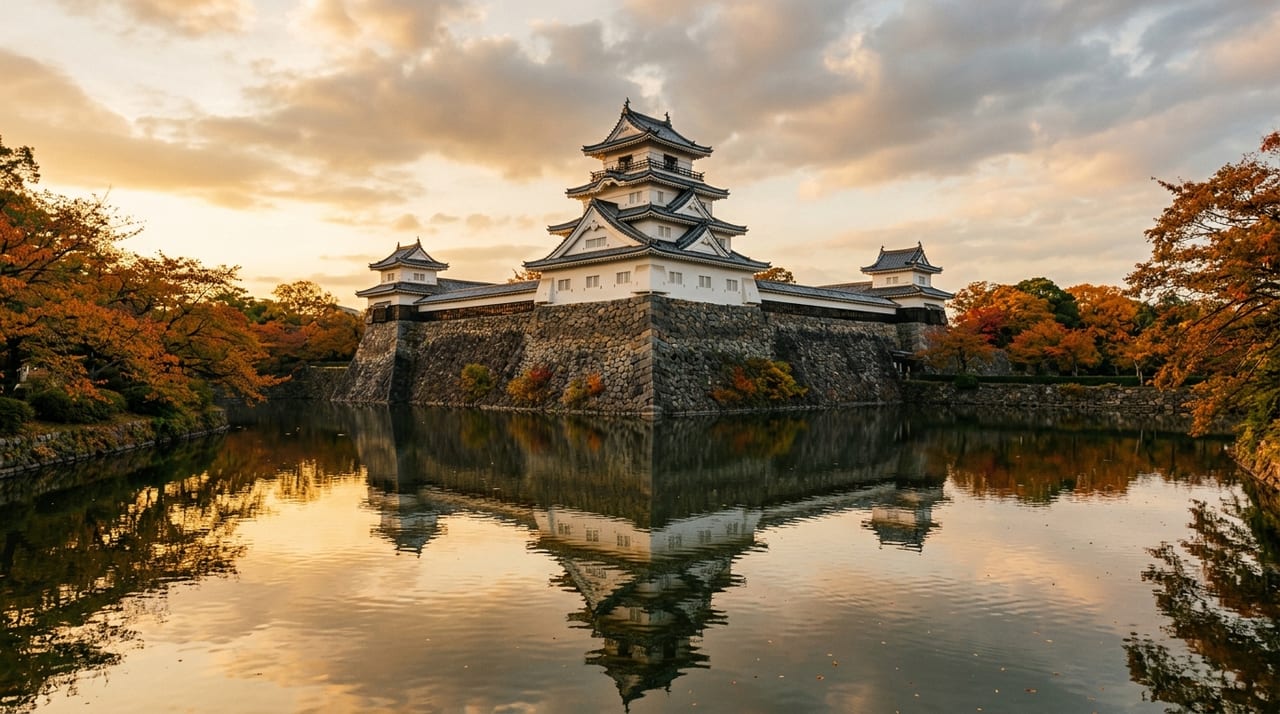
 * Image is for illustrative purposes only.
Funai Castle
府内城
Funai Castle is a historic castle in the Kyūshū region (Construction began around 1597 (Keichō 2); completed as a modern castle in the early Edo period). Its lord was Fukuhara Naotaka / Takenaka Shigetoshi / Hineno Yoshiaki / Ōgyū-Matsudaira clan.
Overview
Funai Castle (Funai-jō) is a flatland castle located in Ōita City, Ōita Prefecture, and is also called Ōita Castle. Built on the site of Funai, the central city of Bungo Province (present-day Ōita Prefecture), the castle is closely tied to the history of Funai, which developed as the castle town of the Christian daimyō Ōtomo Sōrin (Yoshishige). It also holds an important place in the history of the spread of Christianity in Japan in the 16th century.
The predecessor of the castle, Funai residence, was a base of the Ōtomo clan during the Muromachi period. The one who laid the foundations of the present castle was Fukuhara Naotaka, a retainer of Toyotomi Hideyoshi, whose construction began around Keichō 2 (1597). After the Battle of Sekigahara (1600), Takenaka Shigetoshi took up the domain, carried out a major renovation of the castle, and completed it. Hineno Yoshiaki entered in Kan'ei 11 (1634), and from Manji 1 (1658) the Ōgyū-Matsudaira clan took up residence. The castle functioned as the main castle of Funai Domain until the bakumatsu period.
The greatest historical background of Funai Castle is the relationship between Ōtomo Sōrin and Christianity. Sōrin was deeply impressed when Francisco Xavier came to Japan (1549), and he later received baptism and took the name Dom Francisco. Funai (present-day Ōita City) is the place where Xavier visited and preached, and it can be called the cradle of Japanese Christian culture. Sōrin actively engaged in trade with Portugal through the 'Ōtomo Nanban trade,' and he actively adopted cannons (culverin, or furanki-hō), firearms, and Nanban cultural goods.
The site is currently maintained as Ōita Castle Ruins Park, and Shūmon Yagura and Hitojichi Yagura survive. Parts of the moat and stone walls also remain, allowing visitors to imagine the scale of the castle in its heyday. Within Ōita City there is also the Ōtomo Clan Ruins (a national historic site), where several remains that tell of the prosperity of Funai in the Sengoku period survive.
Connection to Swords
The connection between Funai Castle and swords can be found in the fusion of Ōtomo Sōrin's Nanban trade with the culture of firearms and swords. Sōrin is known as a Sengoku daimyō who adopted furanki-hō (culverins, also called ishibiya) and firearms from Portugal. The spread of firearms changed the uses of swords, but even under Ōtomo rule, swords continued to be valued as the soul of the samurai.
Bungo (Ōita) is known as a production center of Bungo smiths, including the early Kamakura-period smith Yukihira and, from the Muromachi period onward, the Takada school (Hōshū Takada). It cultivated a distinctive sword culture from the Muromachi to the Edo period. Funai, the castle town of the Ōtomo clan, was one of the largest commercial cities in Kyūshū.
Otomo Sōrin was also well versed in the tea ceremony and is known as a warlord who loved named tea utensils and swords. Swords forged in Bungo Province, including those of the Hōshū Takada school, left important traces in Kyūshū's sword culture.
Highlights
- Francisco Xavier's evangelization site — the place where Sōrin welcomed Xavier
- Shūmon Yagura — an extant hira-yagura (flat turret), rebuilt in Ansei 6 (1859)
- Hitojichi Yagura — an extant two-story turret standing in the enclosure called the Hitojichiba, rebuilt in Bunkyū 1 (1861) (Ōita Prefecture designated historic site)
- Ōtomo Clan Ruins — a national historic site spreading to the southeast of Funai Castle, the ruins of a Sengoku daimyō's residence and castle town
- Base of Nanban trade — a medieval city that flourished through trade with Portugal, boasting prosperity on a scale among the largest in Kyūshū
- Ōita Castle Ruins Park — a place of rest for citizens where the moats and stone walls remain
* Opening hours and admission fees are subject to change. Please check the official website before visiting.