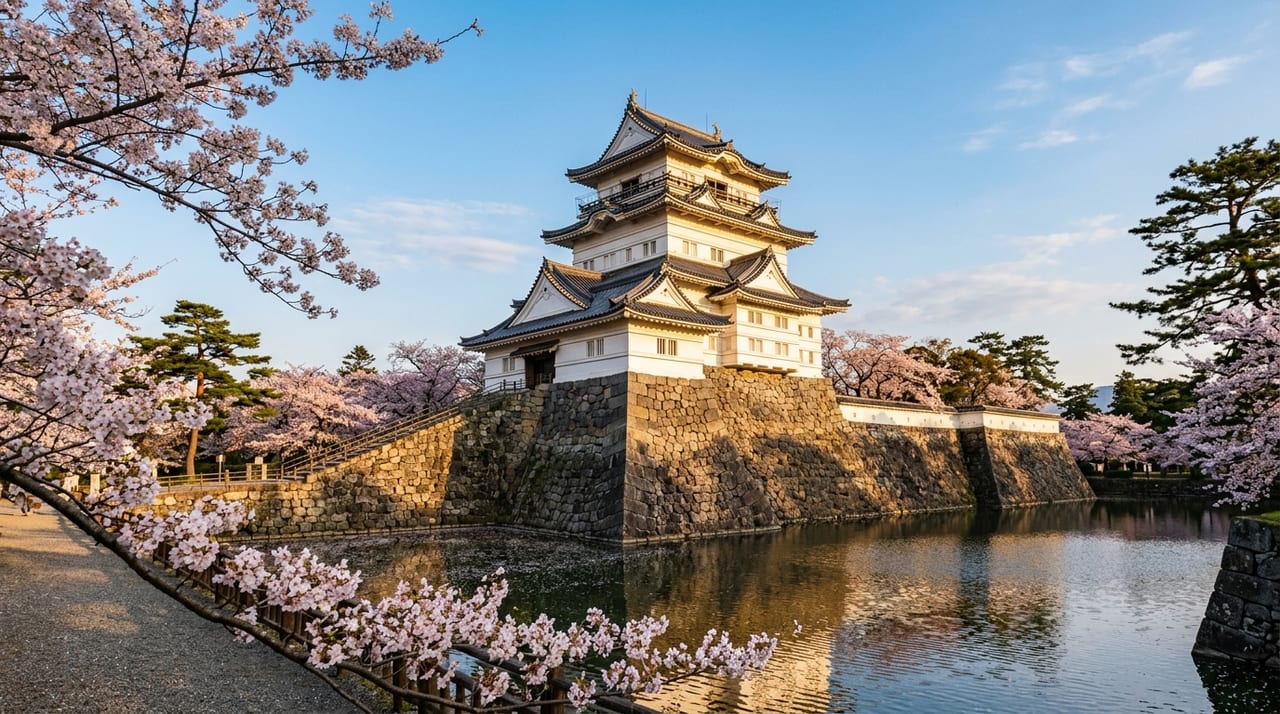
 * Image is for illustrative purposes only.
Kikuchi Castle
鞠智城
Kikuchi Castle is a historic castle in the Kyūshū region (Second half of the 7th century (Asuka to Nara period)). Its lord was Yamato Court (constructed in the second half of the 7th century).
Overview
Overview and Location
Kikuchijō (Kikuchi Castle; in ancient reading also 'Kukuchi no ki') is an ancient Japanese mountain castle built on a hilly plateau straddling the cities of Yamaga and Kikuchi in Kumamoto Prefecture. The castle area is about 55 hectares (roughly 12 Tokyo Domes), and the outer earthen and stone ramparts extend about 3.5 kilometers, making it a large-scale ancient castle site. In February 2004 it was designated a National Historic Site. Of the 72 building sites confirmed by excavation, two octagonal buildings (one presumed to be a drum tower), a rice storehouse, barracks, and a plank storehouse have been reconstructed and are open to the public.
The Battle of Baekgang and Ancient Defense System
The construction of Kikuchi Castle was part of the Yamato court's effort to rebuild its defenses after its crushing defeat at the Battle of Baekgang (Hakusukinoe) in 663. In 663, the combined forces of the Yamato court and Baekje were annihilated by the combined forces of Tang and Silla at Hakusukinoe on the Korean Peninsula. This defeat made a counter-invasion from the continent a real threat, and Emperor Tenji made the defense of western Japan the highest priority, having mountain castles built one after another at strategic points from Kyūshū to the Kinai region.
Kikuchi Castle played a special role within this defense system. In contrast to the frontline defensive castles such as Ōno Castle (Ōno, Fukuoka Prefecture, and Dazaifu), Kii Castle (Saga and Fukuoka Prefectures), and Kaneda Castle (Tsushima), Kikuchi Castle was positioned as a 'rear logistics base.' It is thought to have played the role of sending provisions and weapons to Dazaifu, the administrative center of Kyūshū. Excavations have revealed that it continued to exist for about 300 years, from the late 7th century to the mid-10th century.
Historical Records
Kikuchi Castle differs from Kinojō, which has no record in the historical texts, in that it is clearly recorded in Japan's official histories. The Shoku Nihongi (Monmu 2 / 698) contains an entry ordering Dazaifu to repair the three castles of Ōno, Kii, and Kikuchi, showing that Kikuchi Castle was maintained as an important castle under the jurisdiction of Dazaifu. Later, the Nihon Montoku Tennō Jitsuroku records anomalies in Ten'an 2 (858), including that 'the drum of the hyōko (armory) sounded by itself' and that '11 fudōsō (reserve granaries) burned.' The Nihon Sandai Jitsuroku records that in Gangyō 3 (879) 'the doors of the hyōko sounded by themselves,' which shows that the castle maintained a certain function until around the latter half of the 9th century.
Structure and Octagonal Buildings
One of the greatest features of Kikuchi Castle is the 72 building sites confirmed within the castle. Of particular note are the two octagonal buildings, one of which has been presumed to be a 'drum tower' and has been developed and reconstructed. Octagonal building sites have been found only at Kikuchi Castle among ancient mountain castles in Japan, and they are highly regarded academically as remains suggesting the involvement of refugees from Baekje.
The earthen and stone ramparts run around the outer perimeter of about 3.5 kilometers, combining hanchiku (rammed earth, a method of compacting soil in layers) with stone masonry. Within the castle, remains of three gates, water gates, and reservoirs have been confirmed, and large-scale storage facilities for food and water, assuming a prolonged siege, were also established.
Bronze standing Bodhisattva statues of Baekje style have been unearthed from the reservoir site, and together with the octagonal building sites, this suggests that refugees from Baekje were involved with the castle. Mokkan (wooden tablets) have also been unearthed, indicating that a documentary administration was carried out.
Storage of Weapons and Provisions
Kikuchi Castle is thought to have been a logistics base that sent weapons and food to Dazaifu, Ōno Castle, and Kii Castle. The groups of rice storehouses within the castle were for storing provisions, and the records of the 'hyōko' seen in the Nihon Montoku Tennō Jitsuroku and the Nihon Sandai Jitsuroku indicate that an armory (hyōko) was installed within the castle.
Abandonment and the Historical Park
According to excavations, Kikuchi Castle continued to exist until around the mid-10th century, after which it is thought to have been abandoned.
Today, the Kikuchijō ruins are being developed by Kumamoto Prefecture as the Kikuchijō Historical Park (Kikuchijō Historical Park), where four buildings, the octagonal drum tower, rice storehouse, barracks, and plank storehouse, have been reconstructed in wood and can be viewed. The adjacent 'Onko Sōseikan' (Onko Sōseikan) has a rich exhibition of excavated artifacts and video commentary, where visitors can learn in detail about the relationship between the ancient mountain castle and the cultural transmission from Baekje. Because the castle ruins straddle the cities of Kikuchi and Yamaga, a popular course is to visit them together with the nearby Kikuchi Gorge and Yamaga Onsen.
Connection to Swords
Built by the Yamato court in the latter half of the 7th century, it is thought to have served as a logistics base that sent weapons and food to Dazaifu, Ōno Castle, and Kii Castle. The existence of a hyōko (armory) recorded in the Nihon Montoku Tennō Jitsuroku and the Nihon Sandai Jitsuroku suggests the systematic storage of weapons.
Highlights
- National Historic Site (2004) / constituent heritage of Japan Heritage
- Late 7th century: the Yamato court's logistics base in Kyūshū, part of the defense system after the Battle of Baekgang
- Reconstruction of the octagonal drum tower: the only octagonal building site found at an ancient Japanese mountain castle
- Clear record in the Shoku Nihongi (698): unlike Kinojō, it is recorded in the official histories
- Excavation of Baekje-style bronze standing Bodhisattva statues and mokkan: materials suggesting the involvement of refugees from Baekje
- Kikuchijō Historical Park and Onko Sōseikan: four reconstructed buildings and well-developed exhibition facilities
* Opening hours and admission fees are subject to change. Please check the official website before visiting.